Seeing the Dragon: The Magic Eye of Modern Governance
Governance, hype cycles, and the vocabulary that quietly runs the world
The short version
We usually experience technology waves from the surface. But as practitioners, we have to see the layer underneath: the rules and incentives that determine where the wave actually lands. This is the “Magic Eye” moment of governance (when the random noise of the cycle resolves into the shape of the dragon). And once you see the dragon, you cannot unsee it.
A quick time capsule
In the 1990s, shopping malls were more than stores. They functioned as a shared commons.
People did not always go to buy things. They went to wander, meet friends, people-watch, and kill time. The building had a common interior “street,” and you could be around other humans without committing to an event.
Third places
Sociologists call these “third places.” The idea is simple: spaces that are not home and not work, but still social and public. Coffee shops, barber shops, libraries, diners, parks, and yes, mall commons used to play that role.
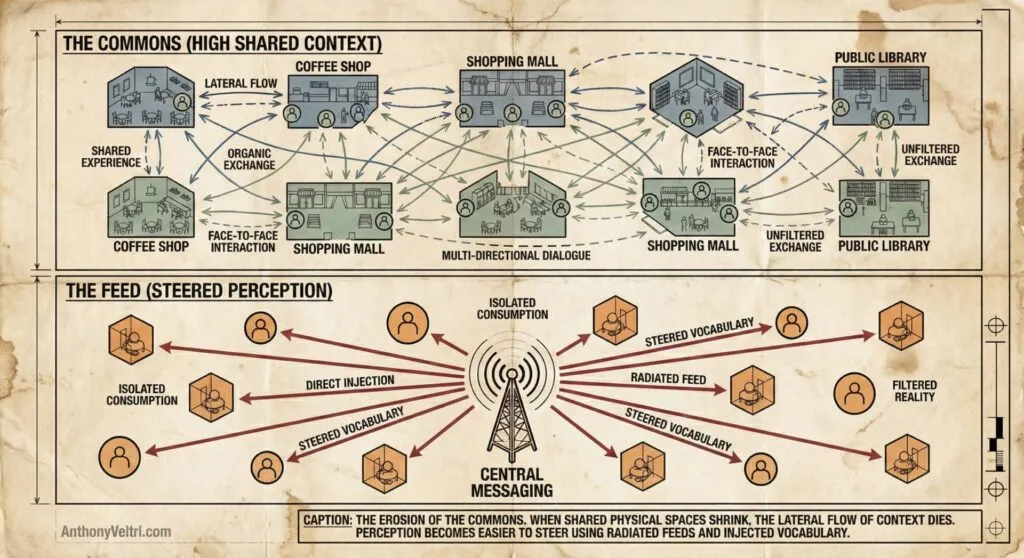
What makes a third place valuable is not the coffee or the retail. It’s the casual, repeated contact with other humans. Low stakes. Low friction. A background layer of shared context.
A lot of those spaces have thinned out over time. When shared commons shrink, shared context shrinks with them. Public attention becomes easier to steer using feeds, headlines, and repeated phrases.
That brings us to the Magic Eye kiosk.
The Magic Eye kiosk
In those mall commons, there were kiosks that sold Magic Eye posters.
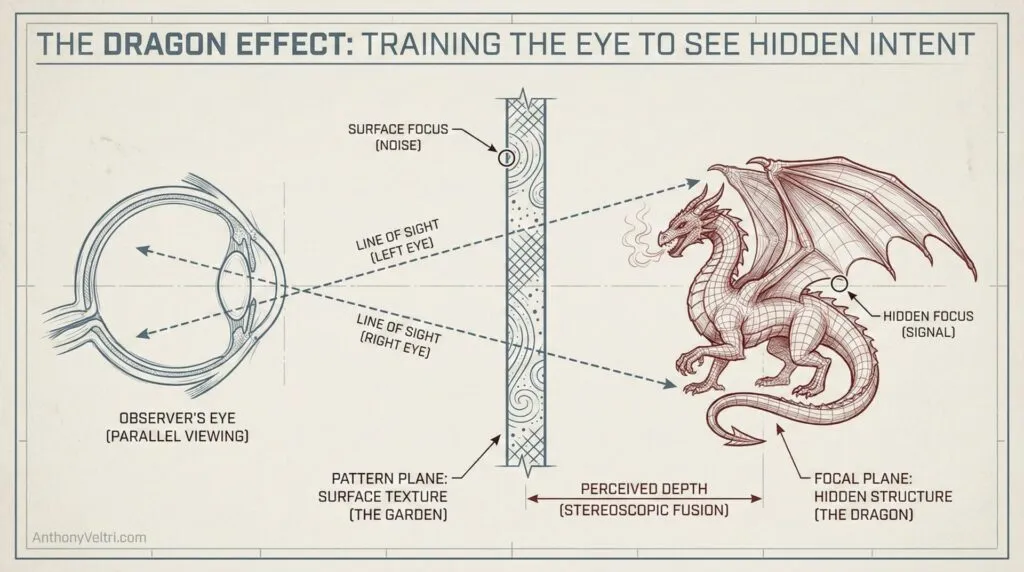
If you never saw one, here’s the vibe. A Magic Eye poster looked like abstract noise. Repeating patterns. Random texture. It resembled modern geometric wallpaper.
But it was not random.
If you stared at it in a specific way, your eyes would “lock” into a different focal distance and a hidden 3D object would pop out. It was usually something playful and fantasy-adjacent. A dolphin. A spaceship. A castle. A heart. The kind of imagery you’d expect on a Trapper Keeper or a paperback sci-fi cover.
And almost every kiosk had one poster that became the archetype.
A dragon.
The dragon became the folk legend of Magic Eye. The one everyone recognized. The one some people could see instantly. The one other people could never see, no matter how long they stared.
I could never see the dragon. Other people could. They would stare, tilt their head, and then casually say, “Oh yeah, it’s right there.”
That is the metaphor.
The dragon is real.
But it only appears when you learn to see through a different lens.
The mall provided the background context, but the poster required a deliberate shift in perspective to reveal the shape hidden in the noise.
Road cuts and lenses
When I started rock climbing at 14, road cuts became interesting. Cracks, seams, fractures, the way layers failed; all things I now saw as ways to get to the top of the cliff. Things I had driven past for years became information.
Later, when I studied geoscience, those same road cuts became interesting again, but for a different reason. Now I was seeing time, process, and formation history; all things I now saw as links from the present to the past when these rocks were formed.
Same road cut. New lens.
Governance works like that.
Once you have been close to it, you start seeing the hidden structure inside what looks like noise.
That is what happened to me when I became a Federal Register notification officer. After that, governance stopped being abstract. It became a living layer of reality.
Two clocks: investor time vs civilization time
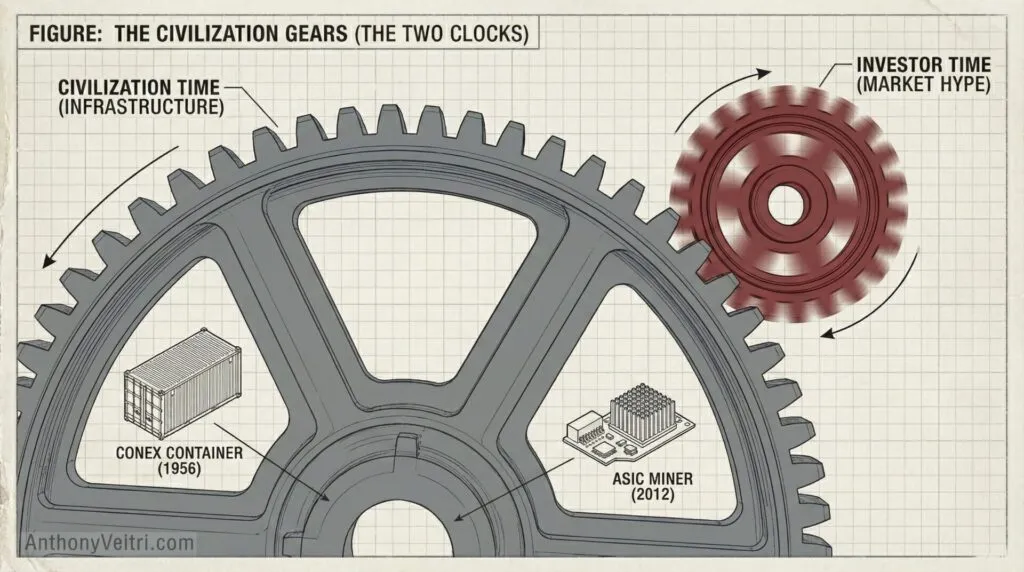
Two Clocks: Investor Time vs. Civilization Time
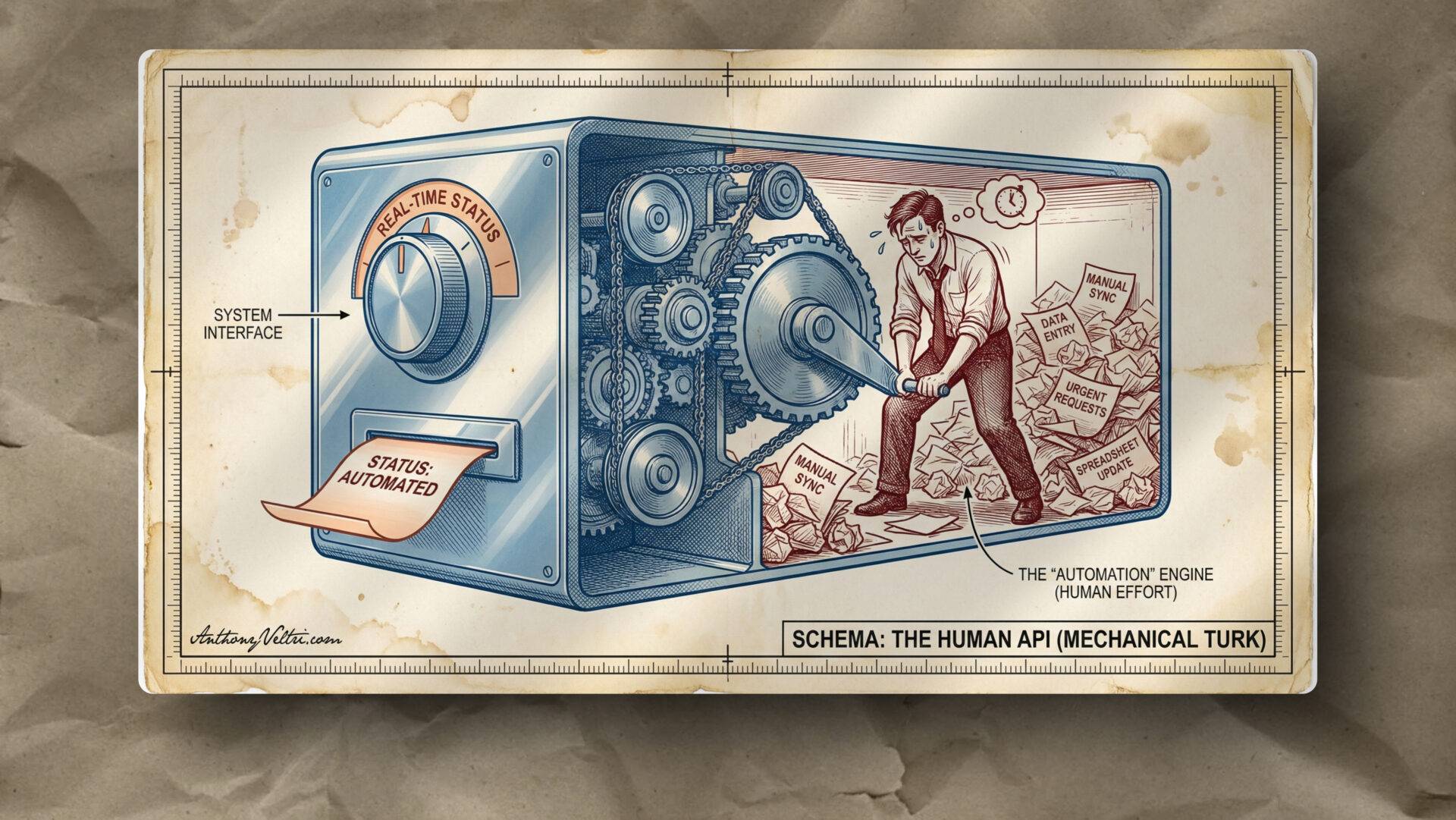
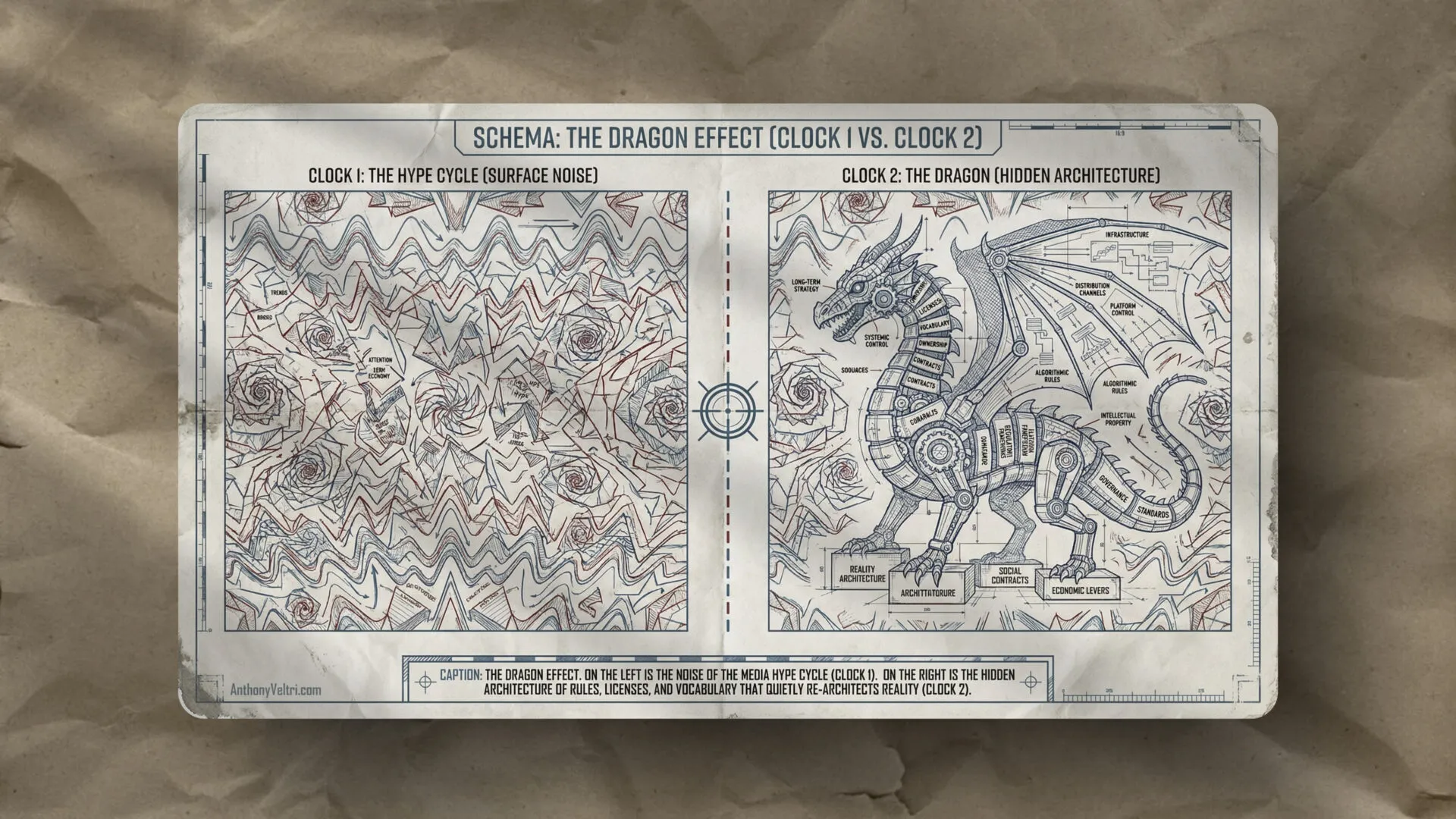
When people ask “Is AI a bubble?” they are usually asking an investor question. That is Clock 1. It is fast, loud, and defined by market valuation. Clock 2 is different: it is the Civilization Clock. It tracks the quiet, heavy movement of infrastructure and capability.
The media loves Clock 1 because it is dramatic. Practitioners must track Clock 2 because it is the terrain we eventually have to live on.
Markets live for the quarter.
Families live for the quarter-century.
And here’s the part that matters. Agenda-setting is real. If someone can get you asking the wrong question, they don’t have to worry as much about your answers. That is the ‘Gravity’s Rainbow’ move (where the master frame is so distracting that the actual mechanism remains invisible)
If you have children, you do not get to treat major capability shifts as a spectator sport.
You have to track both clocks.
Example: The Conex Box (Clock 2 Infrastructure)
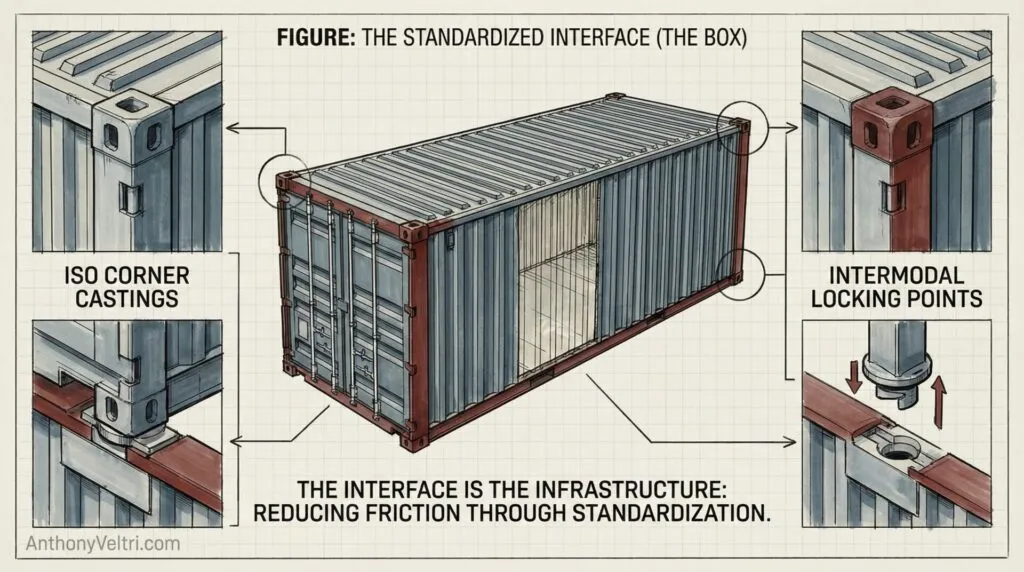
In the 1950s, the “shipping container” was the Dragon. Before the Conex box, logistics was a manual “Clock 1” ritual of cargo nets and irregular stowing. Once Malcom McLean established the standardized 20-foot and 40-foot interface, the world’s infrastructure locked in.
I experienced this “Clock 2” logic during the pandemic when I bypassed the oppressive pricing of rental vans and moving companies. By purchasing a “one-trip” 20-foot container in Portland and shipping it to New England, I moved my life through a global infrastructure layer rather than a consumer service. The “Gate” was the ISO corner casting: a standardized interface that allowed a local towing company with a simple wrecker to move 12,000 lbs of my life for a fraction of the retail cost.
Infrastructure before Law: The Crypto Mining Example
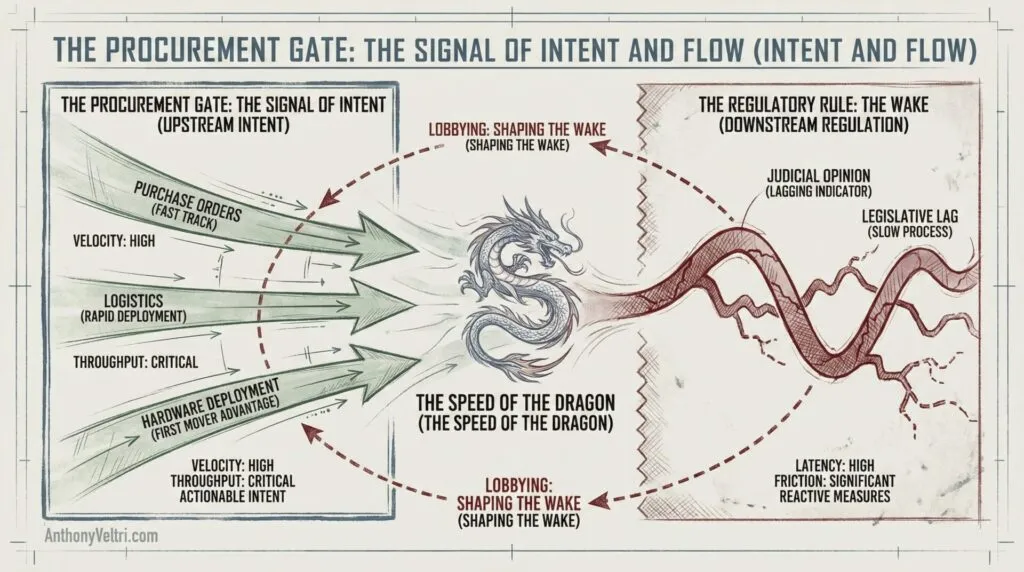
If you wait for a law to be written, you are reading a history book. By the time a statute is drafted, the capability has already crossed the watershed into economy-assumed infrastructure.
In the early days of cryptocurrency, practitioners were mining on the blockchain long before the IRS or the SEC had defined what it was. I was importing mining equipment from China at the time and was approached by a hedge fund that wanted my sources to build their own data center. They were not waiting for a legal ruling on whether crypto was a “spoon” or a “fork” (or a security or a commodity, or maybe even a spork). They were navigating the Procurement Gate.
The Gate vs. The Rule
This highlights the fundamental difference between systems that move at the speed of the Dragon and those that move at the speed of the law.
- The Gate (The Signal of Intent): In the private sector, procurement is a mechanism for gaining an advantage or extracting profit. It moves at the speed of the Dragon. The “Gate” is not a physical barrier like a manifest (which actually facilitates the flow of hardware once issued). Instead, the Gate is the presence of procurement itself. Its absence is the only thing that stops the work. Once you see the purchase orders and the supply chain activations, you know the Dragon is moving. Procurement is the signal that reality is being re-architected.
- The Rule (The Reactive Wake): A mechanism like a tax ruling or a judicial opinion is reactive. While rules can be applied retroactively, the first movers have already extracted their advantage. More importantly, those who move at the speed of the Dragon often use their lead to lobby and shape the very rules that will eventually govern the rest of the market.
The “Dragon” moves through the gates of procurement years before it reaches the courtroom of a regulatory rule. If you are watching the law, you are tracking the wake. If you are watching procurement, you are tracking the beast.
Example: GPS Selective Availability (The Watershed Pivot)
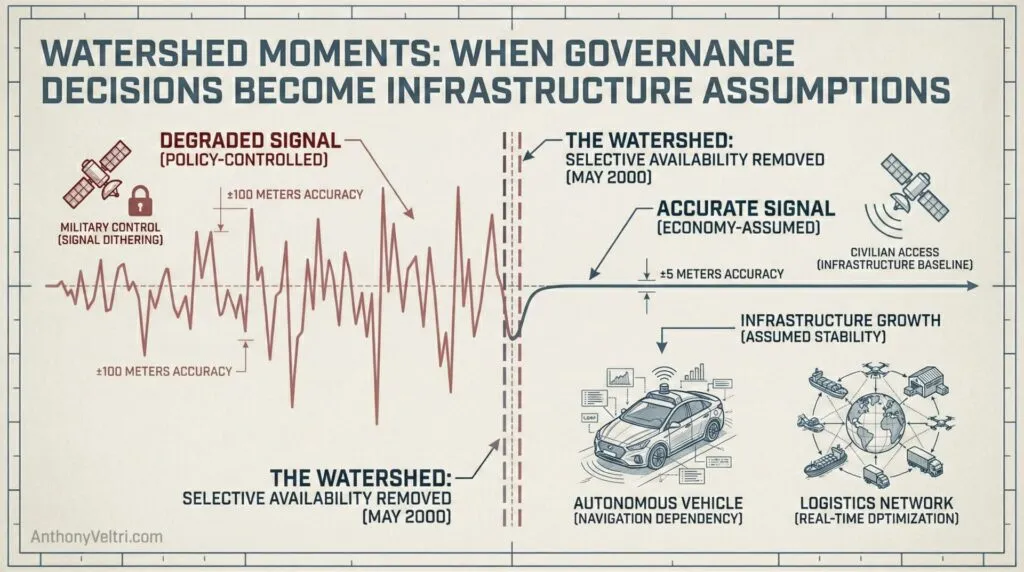
The most permanent way the Dragon moves is when a policy decision becomes an infrastructure assumption.
For years, civilian GPS was intentionally degraded through a policy called Selective Availability. If you were an operator in the field during that era (as I was during my early GIS work), you didn’t have a “Blue Dot” you could trust. You had a general area of probability. You still carried a compass and a paper map because the “Policy” was designed to keep the high-fidelity truth restricted to the military.
In May 2000, that “Gate” was opened. Selective Availability was turned off.
The Point of No Return
This was a pure Clock 2 event. Once the accuracy was available to the civilian economy, society didn’t just say “that’s nice.” We re-architected the world. We built ride-sharing, precision agriculture, synchronized power grids, and global logistics networks that depend on that specific level of precision to function.
This is the “Watershed” pattern: the capability moved from being Policy-Controlled (subject to change) to Economy-Assumed (infrastructure). Even though it is technically possible to turn Selective Availability back on, it is no longer operationally realistic. Too many civilization-scale systems would collapse. The Dragon didn’t just move: it became the floor we walk on.
The Dragon Effect
The Dragon Effect is the moment a hidden system becomes visible because you learned the right focal plane.
Before: random texture.
After: a coherent shape with direction and intent.
This is not about being smarter than other people. It is about training. A lens you earned.
And once you see it, you cannot unsee it.
Watershed moments
Watershed moments are when a capability crosses from policy-controlled to economy-assumed.
A clean example is GPS selective availability.
As we noted, for a period of time, civilian GPS accuracy was intentionally degraded. Then that degradation was turned off. In plain English, the accuracy got better, and then society built on it. The more the economy embeds a capability, the less realistic it becomes to “turn it back on,” even if it is technically possible. Too many things would break.
That is the pattern: governance decisions become infrastructure assumptions.
I felt that same “watershed” feeling with internet naming, export-grade encryption, and email.
DNS, ICANN, and the naming layer of the internet
If you have never thought about it, here is the simplest explanation.
When you type a domain name like example.com, something has to translate that name into the numeric address computers use to find each other. That naming system is called DNS, the Domain Name System.
In the late 1990s, a major transition occurred: U.S. stewardship moved toward a privatized, multistakeholder governance model. That is where ICANN enters the story.
- In 1998, policy moved toward creating a private nonprofit to coordinate key parts of internet naming and addressing.
- ICANN became the organization associated with that coordination.
- In 2016, the IANA stewardship transition removed the last major U.S. contractual oversight link.
If you were building on the internet in that era, it was a moment where you could feel the ground shift. The naming layer stopped feeling like a quiet government-adjacent subsystem and started feeling like a globally governed layer of infrastructure.
It is normal to mentally fuse 1998 and 2016 together. They are two steps of the same arc.
The bubble trap
The media is heavily incentivized to frame AI as “bubble” because it is dramatic and legible.
It gives you:
- winners and losers
- boom and crash
- villains and heroes
- a clean narrative arc
Infrastructure is slower and less cinematic. It is also the part that changes your life.
A responsible posture is not panic and not denial.
It is this:
- track the bubble clock if you need to
- never let it blind you to the civilization clock
This is the part I want to underline. “Bubble” might be the right question for an investor. It is often the wrong master frame for civic responsibility.
Governance begins as vocabulary
The first governance move is often not a law.
It is a word.
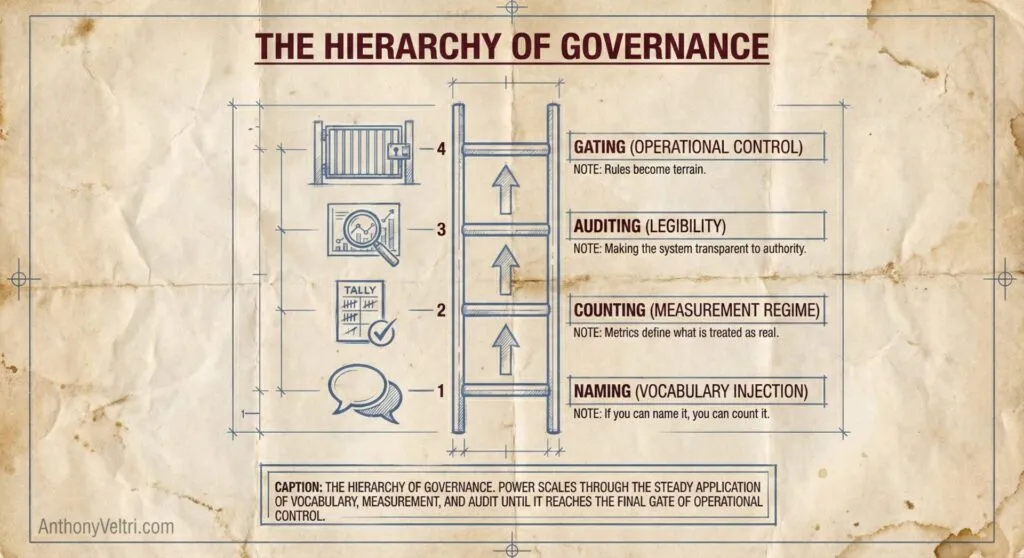
If you can name the thing, you can count it.
If you can count it, you can audit it.
If you can audit it, you can gate it.
That is why vocabulary fights are not cosmetic. They are pre-governance.
This is also why you noticed something important: certain phrases do not emerge naturally.
They get injected.
The dragon in the statistics
Some governance does not show up as “a rule.” It shows up as what counts, what gets measured, and what gets treated as real.
A capability can be spreading everywhere while official metrics lag behind it. Sometimes because people have not changed workflows yet. Sometimes because we have not agreed on how to measure the thing. Sometimes because we are still classifying the costs as “expense” instead of “investment.”
This matters because it creates a predictable illusion:
- Early adopters feel it.
- Institutions discount it.
- Metrics fail to reflect it.
- Then, later, the measurement regime changes and it suddenly looks like an “overnight” shift.
That is not just economics. That is governance-by-measurement. The dragon lives inside the spreadsheet.
Coordinated messaging vs astroturfing
People confuse these. They are not the same.
Coordinated messaging
Coordinated messaging is when language is aligned across channels.
It can be a PR guidance doc.
It can be a memo.
It can be centrally distributed scripts.
It can be pre-produced segments.
Sometimes it is obvious. Sometimes it is not.
Coordinated messaging does not require pretending to be grassroots.
Astroturfing
Astroturfing is specifically when messaging is orchestrated or funded but presented as if it emerged from ordinary people spontaneously.
The deception is about origin.
Memetic convergence
There is a third category that matters.
Sometimes nobody coordinates anything. People copy what performs well. Executives, analysts, journalists, and influencers repeat phrases until they become “normal.”
That still shapes governance because it shapes what problems people think they are solving.
Who is Sinclair, and why it matters
To explain the “same script” phenomenon without conspiracy language, you need one piece of context.
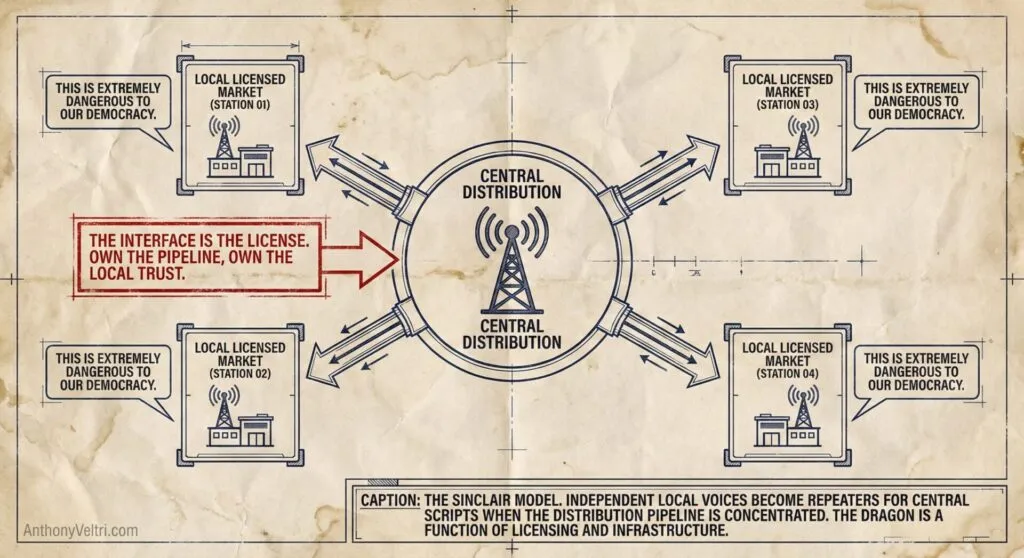
Sinclair Broadcast Group is a large U.S. owner and operator of local television stations.
In plain English: many stations that look like independent local outlets can share common ownership or operational control. That creates the potential for centrally distributed content to appear as many independent voices saying the same thing.
This is why the “same line” montage was so clarifying to people. You watched one trusted local anchor say a phrase and assumed it was independent. Then you zoomed out and saw dozens, sometimes hundreds, saying the same thing.
The dragon popped out.
Not because a secret committee met in a basement.
Because the distribution model makes it possible.
Why Sinclair clicked for me
My FCC spectrum lens
A local TV station is not just a newsroom. It is a license to use a scarce public resource: electromagnetic spectrum in a market.
Once you have ever been close to spectrum licensing and auctions, you stop thinking:
- channel equals voice
And you start thinking:
- channel equals licensed access plus ownership structure plus governance constraints
Even if you watch local TV through cable, those stations still originate as broadcasters with regulatory and carriage relationships that sit downstream of FCC licensing.
So the Sinclair realization landed for me because I was already trained to see the world in terms of:
- licenses
- scarcity
- regulated rights
- ownership concentration
- distribution pipelines
The montage did not create the phenomenon. It revealed it.
That is the Dragon Effect in media form:
- local trust
- central distribution
- perceived independent agreement
The Katrina email that made governance real
The first time governance stopped being abstract for me was not a committee meeting or a Federal Register notice.
It was an email reply.
During Hurricane Katrina, I managed a small email list for my e-commerce business. I had never received a complaint (not once). I sent an update that was personal and contextual: situational awareness from the middle of a disaster zone. I was not selling anything; I was simply documenting the ground truth.
Someone replied: “I didn’t sign up for that. This is illegal.”
This was my Stage 2 Revelation. I had been operating in the “Garden” of the early internet (Stage 1: Unconscious Incompetence). I assumed a permissionless landscape where shared context was the only rule. That email reply was the moment my theoretical freedom collided with a hardening regulatory baseline.
(For a canonical breakdown of these operational states, see the Doctrine 11 Companion: The Four Stages of Competence).
Governance did not arrive as a dramatic announcement. It arrived as a boundary I tripped over while trying to do the work. The “Dragon” had been there all along. I just hadn’t learned to focus on the focal plane of liability yet.
What I felt in that moment was not “a statute.” It was a new baseline expectation about permission, scope, and legitimacy. People were now willing to invoke law-like boundaries in everyday digital life.
Governance did not arrive as a dramatic announcement.
It arrived as a boundary I tripped over.
That was my dragon.
Why dot-com still matters as a template
I was there doing e-commerce at the time of the dot-com bubble. So I do not only know the story. I remember the texture of it.
The dot-com promise was directionally true, but timing was wrong. Infrastructure and adoption took longer than the market wanted. The mismatch killed many companies.
Then the future arrived anyway, just on a different schedule.
This is why “bubble” is not the right master frame if you are trying to be responsible.
A bubble popping does not automatically mean the underlying capability was fake.
Sometimes it means it was real, but early money demanded impossible speed.
Same, but different
What feels different right now is not just the tech. It’s the governance atmosphere.
Back then, a lot of the governance layer was real but quieter, slower, and less mainstream. It was there in naming, encryption, email norms, telecom rules, and platform liability. But it was not the headline topic for normal people.
With AI, the governance layer is loud. It’s a first-class story. It’s being discussed as an arms race, a labor event, a national security issue, a safety issue, and a legitimacy issue.
That intensity is itself a signal.
The first real gate most people will feel
Most ordinary people will not see governance first in procurement. They will see it downstream, in labor displacement.
Procurement is upstream. It is where requirements become real. It is where checklists harden into gates. It is where “allowed” becomes operational.
Most people do not have visibility into procurement, so they miss the upstream dragon movement. Then the downstream effect shows up and it feels like it came out of nowhere.
If you train yourself to notice the upstream, you get fewer surprises downstream.
That is a civic skill now.
Doctrine principle
Governance is the hidden depth image of a technology wave.
If you cannot see governance forming, you are fighting blind.
Governance is not paperwork. It is the environment that decides what is allowed, what is fundable, and what becomes normal.
The Dragon Spotting Checklist
If you want to learn the focal plane, watch for these signals:
Vocabulary
Risk tiers. Defined categories. Stabilized terms. Official-sounding phrases.
Institutions
Task forces. Commissions. New “safety” bodies. Recurring forums.
Standards
Frameworks that can be implemented, audited, and certified.
Procurement
Requirements appearing in RFP language and vendor checklists.
Legal hooks
Liability theories. Duties of care. Enforcement posture.
Geopolitics
Race framing. Export controls. Industrial policy.
If three or more light up, the dragon is moving.
Glossary and sidebars
Here be dragons (so you can see what I’m seeing)
This is not a textbook glossary. It’s the “stuff we all assume” layer made visible. If you have never looked through this periscope before, this is where the dragon outlines sharpen.
Third place (third space)
What it means: A “third place” is a social space that is not home and not work, where you can exist around other people without an invitation.
Why it matters here: When third places shrink, we lose shared context and casual cross-pollination. More of our “common sense” gets set by feeds, headlines, and centrally amplified vocabulary.
Dragon note: When a society has fewer shared commons, it becomes easier for vocabulary to be injected and normalized without people noticing.
Magic Eye (autostereograms)
What it means: Posters that look like patterned noise until you focus your eyes in a weird way and a hidden 3D image appears.
Why I use it: It’s the cleanest metaphor I know for governance perception. The information is there the whole time. But until you learn the focal plane, all you see is texture.
Dragon note: The dragon poster became a shared archetype. That’s how metaphors work too. Once the metaphor is popular, it becomes a shared lens.
The Dragon Effect
What it means: The moment a hidden system becomes visible because you learned the right focal plane.
- Before: random texture
- After: a coherent shape with direction and intent
Dragon note: You do not need to be cynical to see the dragon. You just need to be trained to look for structure.
Two clocks
Clock 1: Bubble clock
Valuation, timing, hype, capital cycles, who survives the shakeout.
Clock 2: Civilization clock
Capability diffusion, what becomes cheap enough to be everywhere, what becomes assumed infrastructure, what gets embedded into institutions.
Dragon note: The news loves Clock 1 because it is dramatic. Parents cannot afford to ignore Clock 2.
Agenda-setting
What it means: The process of defining what the debate is about.
Dragon note: If you can control the question, you can control the solution space.
Vocabulary injection
What it means: The moment a phrase appears everywhere at once and starts steering perception.
Dragon note: Vocabulary is pre-governance. If you can name it, you can count it. If you can count it, you can audit it. If you can audit it, you can gate it.
Sinclair Broadcast Group
What it is: A major U.S. owner/operator of local television stations.
Why it matters: Centrally distributed messaging can appear as local, independent voices saying the same thing.
Dragon note: The montage wasn’t valuable because it “proved a conspiracy.” It was valuable because it revealed a distribution model most people never consider.
FCC and spectrum licensing
What it is: Licensing access to electromagnetic spectrum, a scarce public resource.
Dragon note: Once you’ve worked near spectrum or licensing, you stop seeing “channel” as purely editorial. You start seeing it as a regulated franchise with ownership constraints and distribution leverage.
DNS
What it is: The Domain Name System, translating names to numeric addresses.
Dragon note: Naming layers become governance layers because naming implies authority, control, and dispute resolution.
ICANN
What it is: A private-sector, multistakeholder nonprofit associated with coordinating key parts of the internet’s naming and addressing system.
Dragon note: The dragon isn’t “ICANN good” or “ICANN bad.” The dragon is realizing the naming layer is governed, and governance has politics.
IANA stewardship transition
What it is: The 2016 shift that ended the U.S. government’s contract role overseeing the IANA functions.
Dragon note: This was the “last tether” coming off. It’s why 1998 and 2016 can feel like the same watershed when you recall it from lived experience.
Export-grade encryption (40-bit era)
What it is: The 1990s reality where export controls led to weaker “international” cryptography, including notorious 40-bit SSL cipher suites.
Dragon note: This was governance embedded into code paths. It didn’t feel like “governance discourse.” It felt like technical limitation. That’s how governance hides.
CAN-SPAM
What it is: The U.S. law (signed 2003, effective 2004) that set rules for commercial email.
Dragon note: This is governance ordinary people felt in their inboxes. It’s also why my Katrina email moment landed so hard. The baseline expectation had shifted.
GPS selective availability
What it is: A past policy where civilian GPS accuracy was intentionally degraded, then turned off.
Dragon note: This is the “you can say it’s reversible, but the world re-architected around it” pattern.
“First real gate”
What it means: The first governance constraint most people only notice after they collide with it.
Examples of gates:
- a procurement requirement you didn’t know existed
- a licensing or certification rule that blocks deployment
- an audit demand that forces your system to become legible
- a liability standard that changes what you can ship
- a model evaluation requirement that becomes table stakes
Dragon note: Gates are where governance stops being theory and becomes terrain.
Closing question (to the reader)
When you look at today’s AI governance chatter, what is your best candidate for the first real gate that most people will only notice after they hit it?
Last Updated on December 29, 2025