Why forcing perfect alignment destroys participation and slows down missions #
This page is a Doctrine Guide. It shows how to apply one principle from the Doctrine in real systems and real constraints. Use it as a reference when you are making decisions, designing workflows, or repairing things that broke under pressure.
Perfect interoperability is a myth. Useful interoperability is a skill. #
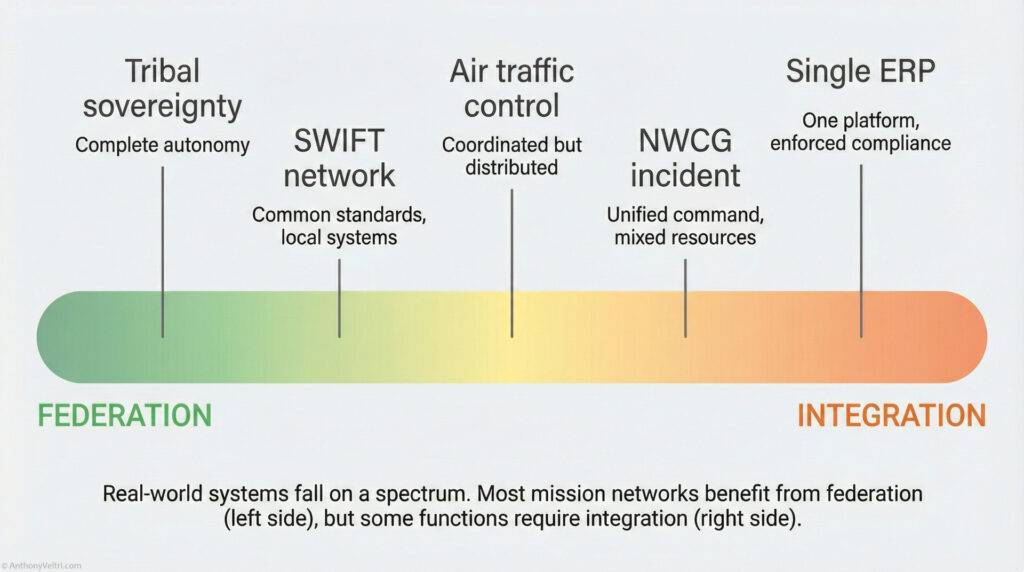
Mission environments are too diverse, too fast, and too asymmetric for perfect alignment.
- Partners use different tools.
- Data arrives in different formats.
- Systems update at different cadences.
- Authorities and budgets differ.
- Security rules conflict across organizations.
If you insist on perfect interoperability, you end up with no interoperability.
The architect chooses useful interoperability.
The least amount of alignment required to make the system valuable.
Lived Example: The partner with the aging server and the partner with the brand new cloud stack #
During a multi-agency activation, we had two partners:
Partner A
- modern Azure cloud stack
- real time publishing
- clean JSON schemas
- strong metadata discipline
- automated availability monitoring
Partner B
- a server older than some of their staff
- arcane file formats
- inconsistent timestamps
- manual updates
- unpredictable publishing windows
If we demanded perfect interoperability:
- Partner B could not participate
- Partner A would be forced to dumb down their system
- We would delay the mission waiting for alignment
- The published picture would shrink, not grow
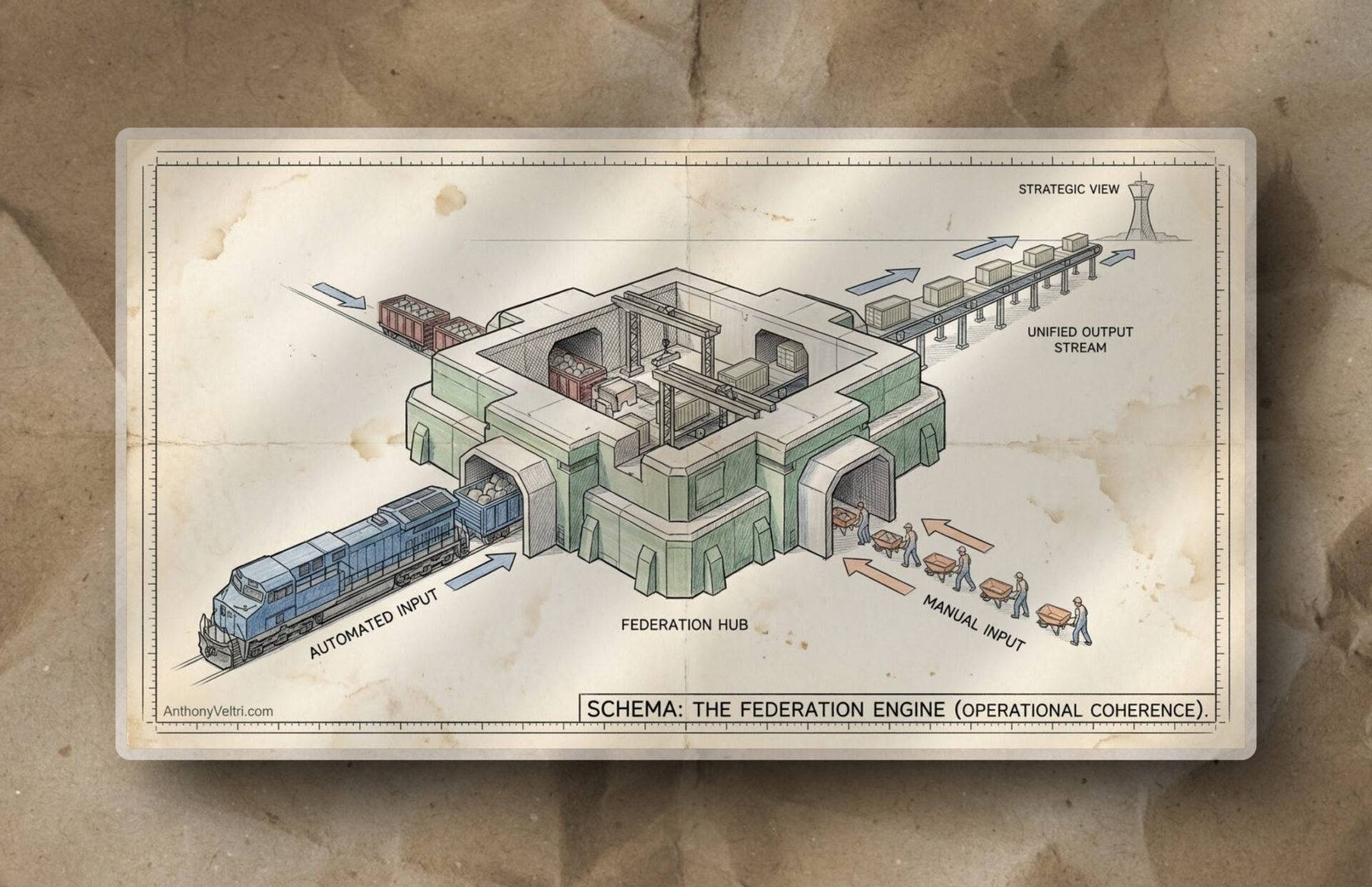
Instead we aimed for useful interoperability:
- harmonize what can be harmonized
- annotate what cannot
- merge what is compatible
- preserve what is distinct
- deliver a composite picture that works
The operational picture was not perfect.
It was useful.
And during a crisis, useful wins.
Business Terms: What useful interoperability looks like #
Useful interoperability:
- produces value with the minimum viable alignment
- accepts diversity as a feature, not a flaw
- grows participation instead of restricting it
- lowers the barrier for partners to contribute
- respects differing authorities and systems
- prevents political friction
- delivers faster
- reduces rework
- keeps the mission moving
Perfect interoperability requires perfect alignment.
Perfect alignment requires perfect control.
Perfect control never exists.
System Terms: The actual mechanics of useful interoperability #
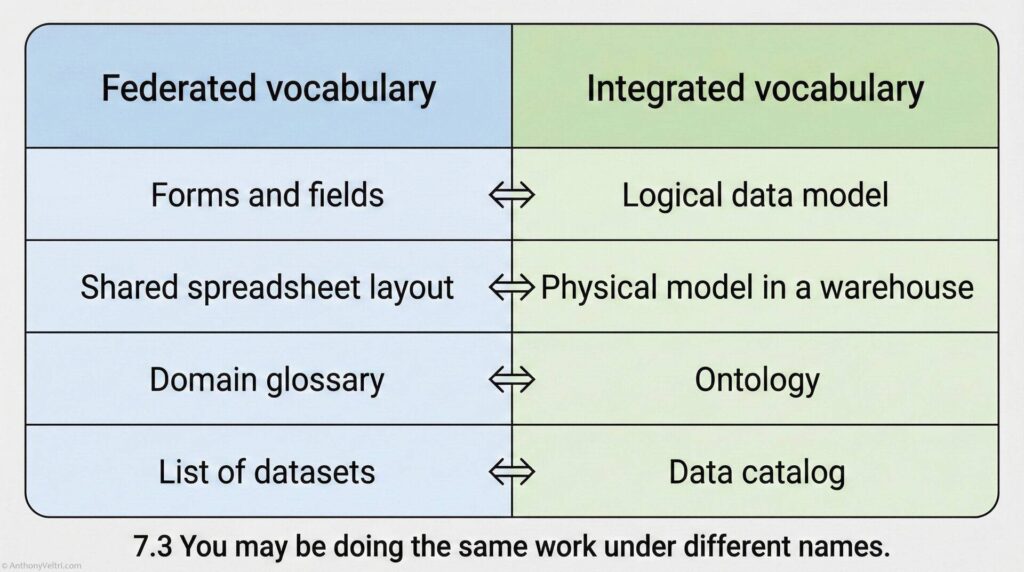
Useful interoperability is a set of architectural techniques:
- schema mapping
- partial harmonization
- caching of last known good data
- confidence scoring
- asynchronous updates
- fallback formats
- tolerant ingestion
- conversion at the edges
- context aware merging
It is about tolerance, not uniformity.
Perfect interoperability demands:
- synchronized schemas
- uniform security models
- identical update rates
- total consistency
- global version locks
- brittle, tightly coupled systems
In real environments these requirements collapse under pressure.
Why Perfect Interoperability Fails #
Business Perspective #
Perfect interoperability fails because:
- funding cycles differ
- technology baselines differ
- staffing differs
- politics differ
- partner incentives differ
- migration timelines differ
- adoption costs overwhelm smaller partners
Perfect interoperability shrinks participation.
Eventually, only well-resourced participants remain, and the mission picture becomes biased and incomplete.
System Perspective #
Perfect interoperability fails because:
- systems drift
- updates diverge
- partners upgrade at different times
- schemas evolve independently
- networks degrade
- unequal refresh rates break synchronization
- legacy systems cannot comply
Perfect interoperability collapses under real world variation.
Why Useful Interoperability Succeeds #
Business Perspective #
Useful interoperability succeeds because:
- it lowers expectations to what is actually needed
- it allows partial participation
- it grows the network of contributors
- it increases trust
- it encourages voluntary adoption
- it tolerates unequal maturity
- it meets partners where they are
Useful interoperability expands participation.
System Perspective #
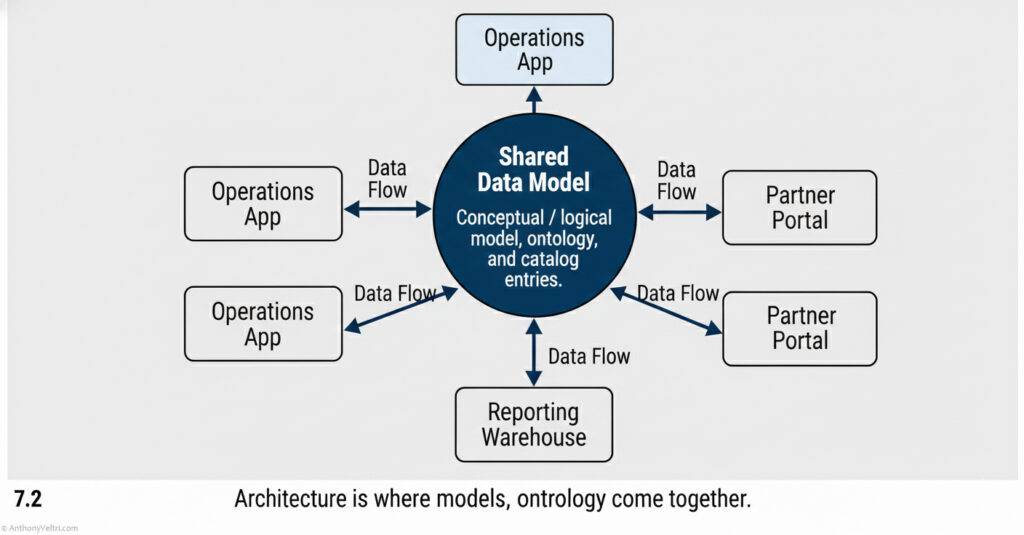
Useful interoperability succeeds because it:
- absorbs variation
- isolates failures
- handles partial updates
- provides fallback behavior
- tolerates stale data
- aligns only what matters
- evolves gradually
- scales without breaking
This is the architecture of resilient coalitions, not uniform empires.
Business Example: The “good enough” model that saved time #
Leadership often asks for data to be:
- complete
- current
- consistent
- identical across partners
But during an activation, we once created a “good enough overlay” in two hours that provided:
- partial but relevant data
- annotations for known gaps
- confidence indicators
- harmonized geometry
- clear time stamps
This imperfect product supported decisive action when a perfect product would have arrived too late to matter.
System Example: iCAV and tolerance as a design rule #
In iCAV:
- not every partner published the same geometry
- not every feed had the same projection
- some feeds had missing attributes
- some feeds updated every six minutes
- some only updated once per quarter!
- some were accurate but stale
- some were current but low fidelity
The system did not fail.
Why?
Because it was built for useful interoperability:
- normalization at the intake
- tolerant parsing
- marking stale layers
- prioritizing high value feeds
- merging where appropriate
- caching intelligently
- presenting inconsistent truth as contextualized truth
This allowed decision makers to work with a functional picture, not a perfect one.
Architect-Level Principle #
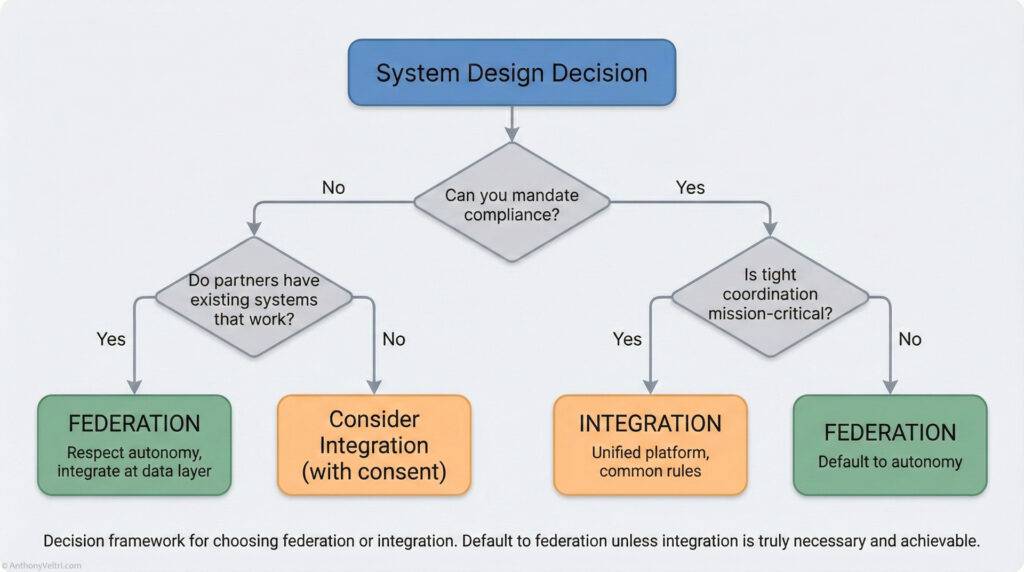
As an architect, I design systems for useful interoperability.
I aim for the alignment required to support the mission, not the alignment required to achieve perfection.
This increases participation, reduces fragility, and accelerates outcomes.
Twenty-Second Take: #
“Perfect interoperability does not exist in mission environments. Different partners have different systems, timelines, and constraints. Useful interoperability focuses on the alignment that actually delivers value. It respects diversity while still producing a shared picture. That is what I design for.”
Cross Links to Other Principles #
Useful interoperability directly supports:
- Federation vs integration
- Interfaces and ownership
- Degraded operations
- Emergent resilience
- Two-lane systems
- Architecture accelerates
- Decision drag
- Portfolio thinking
This principle is the operational twin of federation.
Doctrine Diagnostic – For Reflection: #
Ask yourself:
Do you really need perfect alignment, or do you need useful alignment?
If you choose useful alignment, you gain speed, participation, and resilience.
If you choose perfect alignment, you get delay, friction, and fragility.
Choose the model that works in the real world.
Field notes and examples #
- No Amount of Federation Saves a Broken Anchor Point
- Field Note: The Human Cost of Interoperability (and the Legal Cost of Speed)
- Bay St. Louis: Trust Before Logos After Hurricane Katrina
- When Data And Applications Divorce: Separating The Two Without Tearing The System Apart
- When You Choose Integration over Federation On Purpose
Last Updated on February 22, 2026