Who Are You to Speak? How Cultural Gatekeeping Silences Federal Expertise (Even When Legally Permitted)
Who this is for
If you run cross-boundary programs (interagency, coalition, vendor ecosystems, federated PMOs), you already know the hidden failure mode: nobody owns the interface, so risk accumulates quietly until it detonates in public.
What you will get from this field note (5 minutes)
- A next step: how to turn invisible interface risk into decision rights, pause authority, and a sponsor-ready brief
- A clean distinction between classified and undocumented operational knowledge
- Why “public” does not mean “findable,” and why that gap creates recurring failure
- A practical explanation of why competent practitioners self-silence even when writing is legally permitted
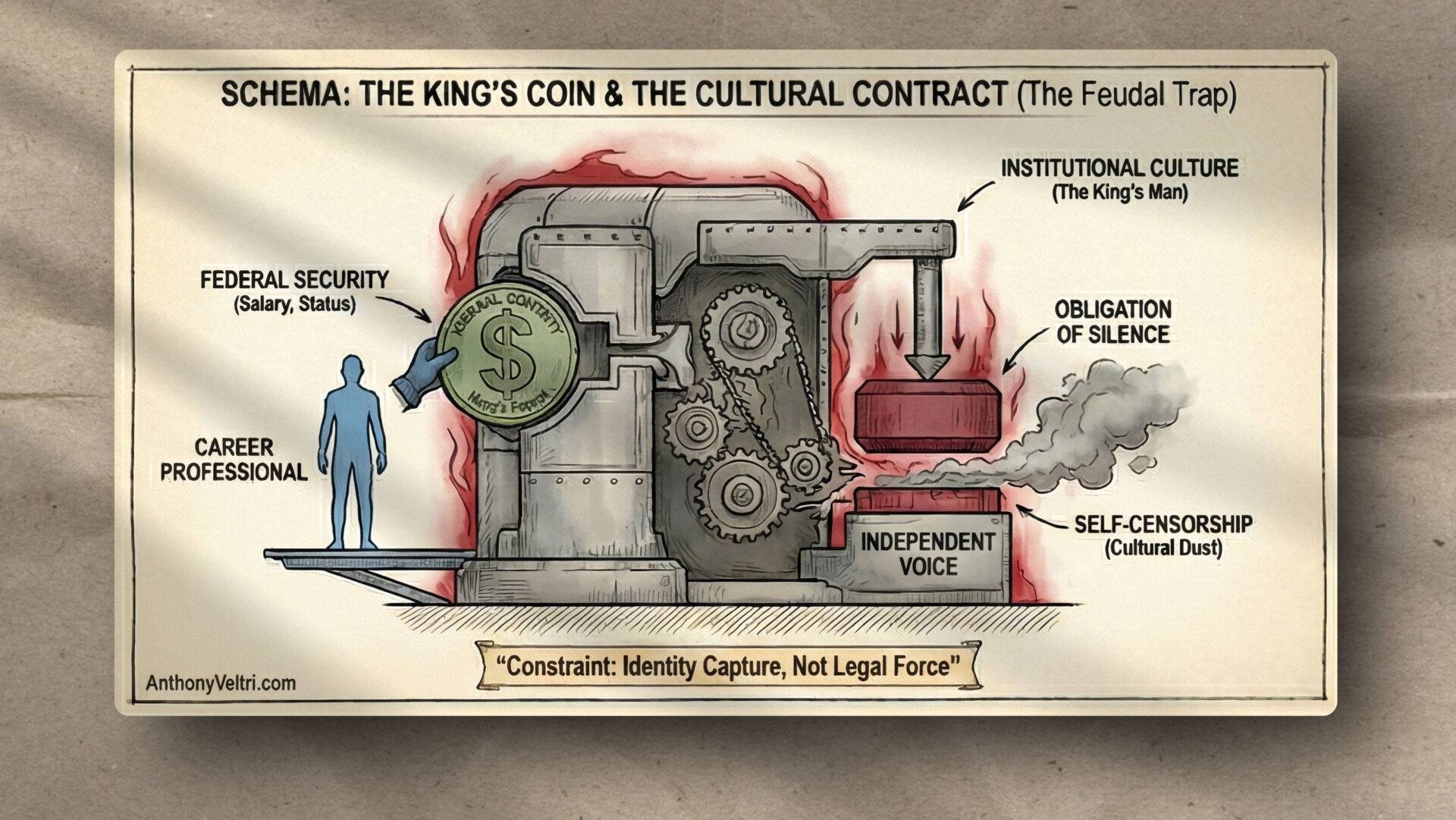
In federal service, you take the king’s coin and you become the king’s man. The salary, the benefits, the pension – these come with obligations. One of those obligations is silence.
Not legal silence. Not classification. But cultural silence.
“Only appointed and selected leaders speak publicly. That’s not your role. You work here, you stay quiet.”
Before we go any further, I want to set one boundary that does not change, regardless of what comes next:
Let’s be clear about what does not move:
The oath of office is permanent. Operational Security is a lifetime obligation. Sources, specific vulnerabilities, and sensitive methods stay in the vault, where they belong.
This field note is not an argument for loosening OPSEC. It is an argument for naming a different failure mode: the difference between classified and undocumented.
Boundary set. Now we can talk about the silence I actually mean.
Most of the friction in federal service is not classified. It is obscure. It is dissolved in the unwritten habits of coordination, the unspoken rules of the interagency, and the mechanics of how offices actually interface.
Often, the information is technically public, yet buried across thousands of pages of registers, manuals, and org charts. Availability does not mean accessibility.
Quick diagnostic: Do you have diluted knowledge, or stewarded knowledge?
Answer yes or no:
- Do you have named owners for cross-boundary interfaces (handoffs, dependencies, shared definitions, shared artifacts)?
- Does someone have explicit pause authority when an interface is unclear, contested, or drifting?
- Can a new leader learn how coordination actually works without tribal knowledge or personal introductions?
- When something breaks, do you debug decision rights before you debug tools?
- Do you have a sponsor-ready brief that translates interface risk into decisions and options, not narrative?
- Are your most valuable operational lessons documented in a form other people can reuse, teach, and apply?
If you answered “no” to two or more, you do not have an information problem. You have a stewardship gap.
There is gold in seawater, but it is so dilute that you cannot mint a coin by staring at the ocean.
The lesson is not that the gold is guarded. The lesson is that it is dissolved.
To get the gold, you need a refinery. To get the operational lesson, you need a steward. Without systematic extraction of tradecraft, the “public” record can remain as unreachable in practice as the classified secret.
Most career professionals accept this trade. They take the warrant (employment), accept the constraint (silence). Security for significance. The king’s coin for the king’s man’s obligation.
I accepted this trade for 20 years.
📌 The King’s Coin and The King’s Man
Historical context: In feudal and military tradition, accepting payment from the king (taking the coin) meant becoming sworn to serve (the king’s man). You weren’t just hired – you were bound by oath, loyalty, and obligations both written and unwritten. The soldier who took the king’s coin couldn’t serve another master, couldn’t question the king’s authority publicly, couldn’t simply walk away when convenient.
The trade was explicit:
- You receive: Security (payment, protection, status, legitimacy)
- You surrender: Independence, freedom to serve others, ability to speak against the king
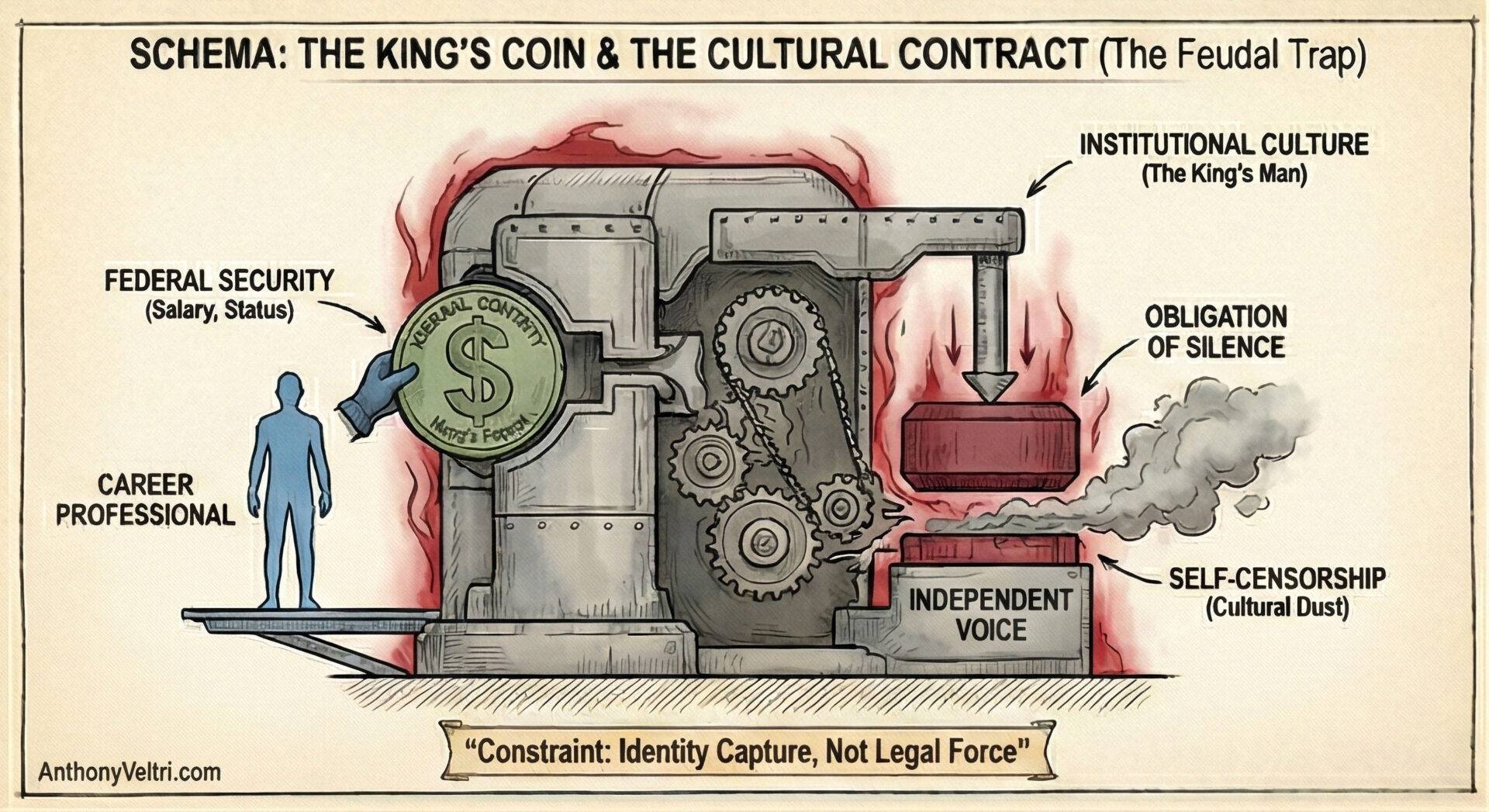
In federal service, the metaphor maps directly:
The king’s coin = Federal salary, benefits, pension, security, organizational identity
Becoming the king’s man = Accepting cultural obligations beyond your written employment contract, binding yourself to organizational norms, surrendering independence of voice
The unwritten obligation = “Only appointed and selected leaders speak publicly about our work. You execute, they communicate. Stay in your lane.”
The key insight: Most obligations aren’t in your SF-50 or position description. They’re cultural. “The king’s man doesn’t claim independent authority. The king’s man doesn’t publish frameworks that might contradict leadership messaging. The king’s man doesn’t position himself as a thought leader – that’s not his role.”
You can leave anytime. Legally, you’re free to resign tomorrow and document everything you’ve learned. But while you hold the coin – while you depend on that salary, while you’re building toward that pension, while your identity is bound to being “a federal professional” – you’re constrained by obligations that were never written down.
This is why the constraint is more powerful than any NDA. Legal restrictions can be challenged, negotiated, or expire. Cultural obligations operate through self-censorship: “Who am I to speak? I’m the king’s man, not an independent voice.”
The security the coin provides makes it nearly impossible to give up, even when the cost is silencing your own expertise.
If you lead a federated program, this matters for one reason: interface failure is rarely a technology failure. It is a decision rights failure. When nobody has explicit authority to pause, clarify, or reframe a cross-boundary dependency, the system drifts into silent risk accumulation.
The result is predictable:
- late discovery
- misaligned assumptions
- blame pinball
- “how did this happen” after-action reports that arrive after reputational damage is already done
The rest of this note explains why that knowledge stays trapped in people’s heads, and how to convert it into something your sponsors can act on.
A structural change ended my role and unintentionally removed the cultural constraint that had kept me quiet. Once the employment identity dropped away, the question “who am I to speak?” lost its force. Not because the law changed. Because the internalized gatekeeping did.
That shift created a narrow window: operational memory was still fresh, and I finally had the freedom to extract it into transferable doctrine.
I realized that my value to future missions wasn’t just in what I had done, but in capturing how we did it. If I didn’t document these frameworks now, while the memories were fresh and the constraints were lifted, twenty years of operational tradecraft would simply evaporate.
And I discovered what happens when you’re no longer the king’s man: you can finally speak with operational authenticity.
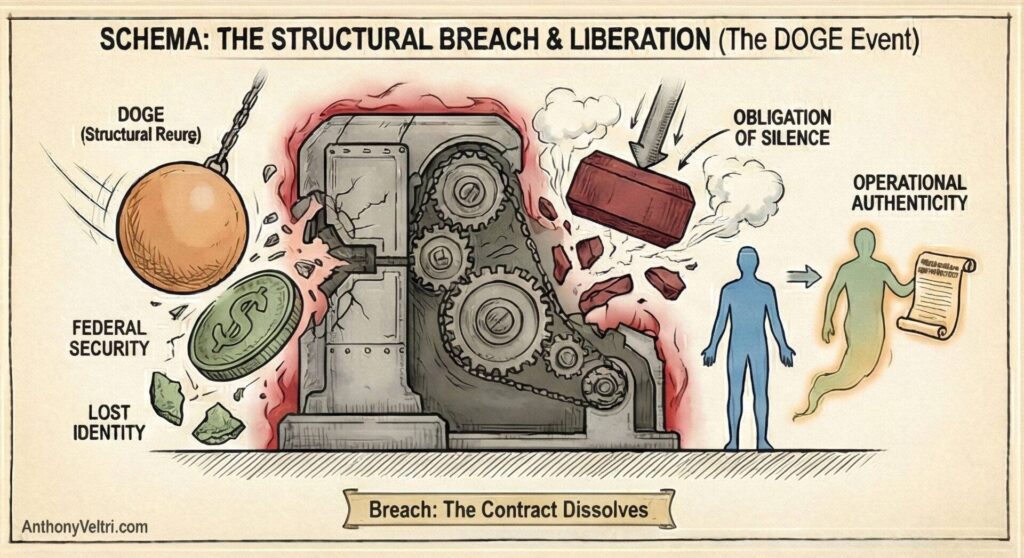
Within six months of separation, I produced over 25 doctrine volumes, 60+ field notes, 500+ diagrams, and complete workshop frameworks documenting 20 years of operational lessons from DHS disaster response, enterprise architecture, and coalition coordination.
None of this violated classification. None of it breached NDAs. None of it used nonpublic information. No mention of any “Particular Matter Involving Specific Parties.” All of it was legally permissible the entire time I was employed.
But I couldn’t produce it while I was the king’s man.
Not because the law prevented me.
Because the culture did.
This field note examines why federal operational expertise dies silently – not despite legal permission to document it, but because cultural gatekeeping operates through identity capture stronger than any written restriction.
The Legal Permission That Doesn’t Matter
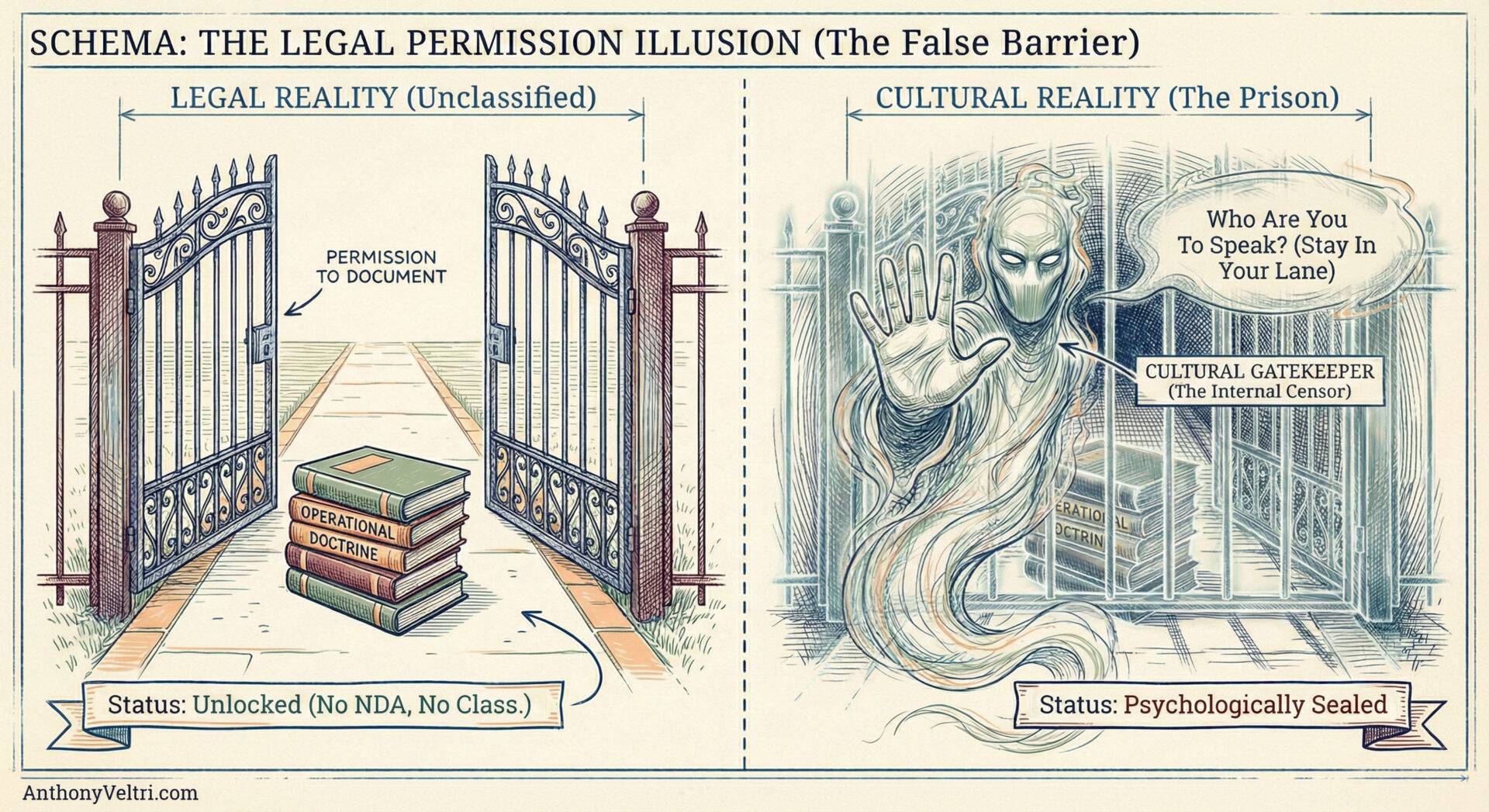
Here’s what most people don’t understand: There’s no legal restriction preventing federal career professionals from documenting unclassified lessons learned.
No NDA prevents it. No classification blocks it. No employment contract forbids it. No ethics regulation prohibits it.
A GS-15 with 30 years of disaster response expertise could write a book tomorrow about operational frameworks, coordination challenges, and systematic approaches to mission architecture. Legally permitted. Operationally valuable. Desperately needed.
They could even publish it under a pseudonym, completely detached from any organizational affiliation. Perhaps that would be more valuable.
Because it forces a critical distinction: separating the intrinsic value of the work from the borrowed authority of the warrant.
When the badge isn’t there to validate the text, the utility of the framework has to stand on its own. The reader isn’t trusting the position; they are verifying the tradecraft.
But they don’t.
Not because they can’t legally.
Because culturally, the question looms: “Who are you to speak about this?”
You’re not appointed leadership. You’re not a Senate-confirmed official. You’re not a designated spokesperson. You’re not in the Senior Executive Service. You’re just the king’s man.
And the king’s man doesn’t speak publicly.
This constraint is never written in policy. Never legally enforced. Never appears in any employment agreement or ethics guidance.
But it’s more powerful than any NDA because it operates through identity, not prohibition.
You’ve internalized “I’m not supposed to” so deeply that legal permission becomes irrelevant.
The cultural prison is stronger than any legal restriction because you carry it inside yourself.
I know because I lived in that prison for 20 years. I could have documented operational lessons from Hurricane Katrina, from building iCAV, from designing DHS enterprise architecture systems serving 296,000 users. None of it was classified. All of it was shareable.
But I didn’t share it.
Not because I legally couldn’t.
Because culturally, I asked myself: “Who am I to write about DHS systems? I’m not leadership. I’m not a spokesperson. That’s not my role.”
The king’s man doesn’t claim independent authority to synthesize and teach.
The Caution Trap (The Absurdity of Retroactive Silence)
The most dangerous part of Identity Capture isn’t that it feels like oppression. It is that it feels like prudence.
When you hesitate to document your expertise, your brain doesn’t say, “I am brainwashed.” It says, “I am being careful.”
You mislabel Institutional Conditioning as Strategic Caution.
I know this because I lived the extreme version of it.
In late 2005, I stood at a task force Christmas party handing out hardcover galleys of my book on Hurricane Katrina. The official publication date was 2006. I was a private citizen. I hadn’t taken the coin yet. The work was mine, created before I ever swore the oath.
Fast forward to 2012. I was now a federal employee. All I wanted to do was reformat that existing text for eReaders. Technically a “Second Edition,” but substantively the same pre-federal work.
And I froze.
I found myself asking: “Do I need permission to digitize my own past? Will this look like I’m capitalizing on my current position?”
Think about the absurdity of that. I was afraid to press “upload” on a book I wrote years before I was hired.
I almost didn’t do it. Not because a regulation stopped me (it didn’t), but because I was waiting for a permission that leadership would never give.
The “Pocket Veto” of Leadership
Here is the dirty secret: Leadership will almost never say “No” outright to a legal request. But they will absolutely refuse to say “Yes.”
If you ask, “Can I publish this?” they see liability. So they choose the Pocket Veto. They delay. They “run it by Legal.” They “need to check with Public Affairs.” They rely on your conditioning to do the rest. They count on you interpreting their hesitation as a prohibition.
But here is the most pernicious part of the trap:
You are often asking for permission you do not technically need, from a person who does not technically have the warrant to grant or withhold it.
When you ask your supervisor, “Can I write this field note on my own time?” you are projecting authority onto them that they may not actually possess. Unclassified, off-duty writing often falls outside their supervisory scope entirely.
But they won’t tell you that. They won’t say, “You don’t need my permission for what you do on Sunday morning.”
Instead, they will accept the authority you offered them. They will say, “Let me think about it.”
By asking, you grant them a veto power the regulations never gave them. By waiting, they validate a constraint that doesn’t exist.
I spent years mistaking their risk aversion for my own legal restriction.
If I was scared to merely reformat a book I wrote as a private citizen, imagine how impossible it felt to write something new.
The conditioning is so deep that you will gaslight yourself into silence.
The Paradox of Conscientiousness
I want to be clear: I am not asking you to change how you operate overnight. I am not suggesting you ignore your instincts or violate your comfort zone. I am simply observing and reporting on the pattern.
And the pattern reveals a cruel irony: The Silence of the Competent.
The people who have the most valuable operational knowledge to share are often the ones most likely to silence themselves.
- If you didn’t care about the mission, you wouldn’t worry about the rules.
- If you weren’t conscientious, you wouldn’t obsess over the optics.
- If you weren’t a true steward, you wouldn’t fear misrepresenting the agency.
The very traits that made you a high-performing “King’s Man” (loyalty, discretion, and adherence to norms) are the exact traits that prevent you from becoming a voice for the profession.
This is the paradox: The people we need to hear from most are the ones most structurally conditioned to stay quiet. The silence isn’t a sign that you don’t have anything to say. It is a sign that you care deeply about saying it right.
I am just suggesting that “right” doesn’t have to mean “never.”
📌 “But Isn’t This Prohibited ‘Outside Employment’?”
The most common objection I hear: “You can’t write about your work while employed – that’s outside employment requiring agency approval.”
This is a fundamental misunderstanding of what outside employment regulations actually restrict.
What federal outside employment rules actually prohibit (5 CFR 2635.801-809):
- Paid work that conflicts with your official duties (e.g., consulting for companies you regulate)
- Using nonpublic information for personal gain (e.g., insider trading, proprietary data)
- Using your official position/title for private benefit (e.g., “As a federal official, I endorse this product”)
- Work that creates appearance of conflict of interest (e.g., lobbying your own agency)
- Compensation from prohibited sources (entities you regulate, contractors you oversee)
What federal outside employment rules do NOT prohibit:
- Writing fiction unrelated to your work (If you’re a systems architect and want to write Harry Potter on weekends, zero conflict)
- Writing about general lessons learned from unclassified work (Operational frameworks, coordination challenges, systematic approaches)
- Documenting professional expertise on your own time (Not using agency resources, not claiming to represent agency)
- Sharing unclassified knowledge after duty hours (No nonpublic information, no classified content)
The test is simple: If you’re a federal systems architect and you want to write a fantasy novel, is that prohibited outside employment? Obviously not. There’s no conflict, no nonpublic info, no use of position.
While many agencies ‘encourage’ a review process for duty-related writing, the legal threshold for preventing unclassified, uncompensated personal expression is a high bar they rarely want to litigate.
Same applies to writing about unclassified operational lessons learned. If you document general coordination frameworks, federation architecture principles, or disaster response lessons – using no classified information, no nonpublic data, no agency resources, on your own time, not claiming to represent your agency – this is NOT prohibited outside employment any more than writing Harry Potter would be.
The confusion comes from cultural gatekeeping, not legal restriction.
“Who are you to write about federal operations?” feels like a legal prohibition. It’s not. It’s cultural constraint masquerading as legal requirement.
When you actually DO need agency approval:
- Using official time or agency resources
- Writing about classified or sensitive programs
- Using nonpublic information
- Claiming to represent your agency officially
- Being compensated by entities you regulate or oversee
For unclassified lessons learned, documented on your own time, using no nonpublic information, without claiming to represent your agency?
No approval required. Legally permitted. Always has been.
The restriction is cultural, not legal. And cultural restrictions only have power if you accept them.
📌 “We Already Have an Office For That”
Another common objection: “If you want to document lessons learned, why don’t you apply for a position at the Wildland Fire Lessons Learned Center? We have designated functions for this.”
Translation: “Documentation is for specialists. You’re a practitioner. Stay in your lane.”
This is organizational gatekeeping through centralization.
The argument is that lessons learned should flow through official channels:
- Lessons Learned Centers
- Training and Doctrine Command
- Professional Development offices
- Official publications and repositories
If you want to contribute to knowledge preservation, the argument goes, apply for one of those jobs. That’s the proper channel.
This sounds reasonable until you look at what actually reaches people.
The Gordon Graham Data: Why Democratized Sharing Is 29x More Effective
My first introduction to Recognition-Primed Decision Making – the framework that underlies my entire body of work on coordination architecture – didn’t come from official sources.
It came from a YouTube video uploaded by a wildland firefighter in 2012.
The video featured Gordon Graham, a legendary fire service trainer, explaining Recognition-Primed Decision Making in a training session. Some practitioner – not an official documentarian, not a designated lessons learned specialist, just a firefighter who thought the content was valuable – recorded it and uploaded it with this comment:
“This is a video I watched while training for my Wildland Fire Cert. I felt like it had a great message and believe every company officer should watch.”
That practitioner upload: 318,581 views
I searched for other copies of the exact same video. Next highest view count: 3,500 views.
I searched for the highest-viewed Gordon Graham video from official sources (Lexipol, NFPA corporate entities): 11,000 views maximum.
Let that sink in:
Official channels reached 11,000 people at best.
One practitioner upload reached 318,581 people.
That’s a 29x multiplier for democratized sharing over official channels.
Disclaimer: Not every video will achieve exactly this ratio. Some practitioner uploads might reach even more people relative to official channels, others less – your mileage will vary. But in this instance, the difference is striking enough to demonstrate the pattern: democratized sharing consistently outperforms centralized gatekeeping for knowledge transfer.
The Personal Stakes: Without Democratization, My Work Wouldn’t Exist
Here’s what makes this personal:
Recognition-Primed Decision Making is foundational to everything I’ve built.
My frameworks for coordination architecture, pattern-matching as operational knowledge, decision-making under uncertainty, interface stewardship – all of these build on RPDM as conceptual foundation.
Without that practitioner upload, the overwhelming likelihood is that I would not know what RPDM was.
I wasn’t attending official NFPA training courses. I wasn’t reading academic publications. I wasn’t in the “proper channels” where Gordon Graham’s official content lived.
But I was Googling operational questions. Searching for decision-making frameworks. Looking for ways to understand coordination under pressure.
And I found that practitioner upload.
From there, I traced back to Gary Klein’s research. I read the academic literature. I applied RPDM to disaster response coordination, enterprise architecture, coalition operations.
My work here exist because one wildland firefighter thought: “People need to see this. It will help them.”
That’s not an exaggeration. That’s the actual chain of knowledge transfer that made my current work possible.
What We’re Losing: The Re-Centralization of Knowledge
Here’s the tragedy:
That 2012 upload represents a brief window when practitioners just shared valuable content openly.
YouTube was still democratized. Sharing was easy. Gatekeeping was minimal.
Now we’re moving backward:
- Paywalls proliferating
- Official channels controlling access
- “Proper channels” being enforced
- Platform algorithms favoring corporate sources
- Practitioner content buried or demonetized
The official sources that reached 11,000 people are being elevated.
The practitioner upload that reached 318,581 people is what we’re discouraging.
“If you want to share knowledge, apply for the job at the Lessons Learned Center.”
“If you want to document, go through proper channels.”
“We have designated functions for this.”
Result: Knowledge transfer becomes 29x less effective.
Why Centralization Fails (With Evidence)
The Gordon Graham data proves what we suspected:
Limited reach:
- Official channels: 11,000 people
- Practitioner sharing: 318,581 people
- Official channels reached 3.4% of what practitioner sharing reached
Discoverability:
- I found practitioner upload through Google search
- I would never have found official Lexipol/NFPA content (paywalled, credential-required, not indexed for general search)
- The people who need knowledge can’t find it through official channels
Accessibility:
- Practitioner upload: Free, open, anyone can watch
- Official channels: Require credentials, organizational access, sometimes payment
- Barriers prevent knowledge from reaching people who need it
Timing:
- Practitioner upload: Immediate (recorded and shared while content was fresh)
- Official channels: Delayed through review, approval, publication cycles
- By the time official content is available, practitioners have already found solutions elsewhere or given up
“But What About Quality Control?”
The objection is always: “If anyone can share, how do we ensure quality?”
The evidence answers this:
That practitioner upload has been watched 318,581 times over 12+ years.
If the content was wrong, inaccurate, or harmful:
- Comments would reflect it (fire service community is not shy about corrections)
- View count would have dropped (people don’t repeatedly watch bad content)
- It wouldn’t have become my introduction to a framework that proved operationally sound over 20 years of application
Instead:
- Content is accurate (Gary Klein’s RPDM is well-validated research)
- Application is sound (fire service uses it effectively)
- Knowledge transfer worked (I learned it, applied it, built on it)
Quality emerged through use and validation, not through gatekeeping.
Compare this to official channels:
- How many people actually use the content from those 11,000 views?
- How many apply what they learned?
- How many build on it?
I don’t know, but I know at least one person did from the practitioner upload: me.
This body of work and systematic approaches to coordination architecture exist as downstream evidence that the knowledge transfer worked.
The Real Reason Organizations Centralize Documentation
It’s not quality control. The data disproves that – practitioner upload was higher quality (measured by use and impact) than official channels.
It’s message control and institutional gatekeeping.
Centralized documentation ensures:
- Knowledge sharing doesn’t bypass leadership approval
- Lessons learned don’t contradict official policy
- Failures don’t become publicly embarrassing
- Practitioners stay in their lane (“Who are you to document this?”)
- The organization controls what gets shared and what stays quiet
This serves organizational control, not knowledge transfer.
The evidence: 11,000 people reached vs. 318,581 people reached.
Centralization reduces knowledge transfer effectiveness by 29x.
What This Means for You
When someone tells you “We have a Lessons Learned Center, apply there if you want to document,” understand what the data says:
Official channels will reach ~3.4% of the people who need your knowledge.
Practitioner sharing could reach 29x more.
You can accept centralized gatekeeping and let 96.6% of potential learners never find your expertise.
Or you can recognize that stewardship doesn’t require designation.
The wildland firefighter who uploaded Gordon Graham:
- Wasn’t a designated documentarian
- Wasn’t employed by a Lessons Learned Center
- Wasn’t an official spokesperson
- Reached 318,581 people and enabled work that wouldn’t exist otherwise
The official channels:
- Had all the designation, authorization, and proper credentials
- Reached 11,000 people and had minimal downstream impact
One is 29x more effective at knowledge transfer.
Guess which one organizations tell you is the “proper way”?
My Work Exists Because of Democratized Sharing
I want to be completely clear about this:
Without that practitioner upload, my frameworks for coordination architecture probably don’t exist.
RPDM is foundational. Pattern-matching as operational knowledge builds on it. My understanding of decision-making under pressure, coordination without complete information, interface stewardship in complex systems – all trace back to concepts I first encountered in that YouTube video.
That one practitioner who thought “people need to see this” didn’t just share a video.
They enabled 20 years of framework development and systematic documentation that now serves others facing coordination challenges.
That’s the downstream impact of democratized sharing.
That’s what we lose when we insist on centralized gatekeeping.
That’s why “We have an office for that” is such a destructive response to practitioners wanting to document lessons learned.
Stewardship Doesn’t Require Designation
Centralized channels will always exist. They serve a purpose.
But they’ll never be as effective at knowledge transfer as practitioner sharing because:
- Limited reach (11,000 vs. 318,581 – evidence-based)
- Accessibility barriers (credentials, paywalls, organizational access required)
- Discoverability problems (not indexed, not searchable, not findable)
- Institutional filtering (what makes org uncomfortable stays quiet)
- Gatekeeping prevents most knowledge from being shared at all
Democratized sharing fills the gap – and does it 29x more effectively.
Practitioners documenting what they learned. Sharing what helped them. Offering frameworks that worked in the field.
Not because they were designated to do so.
Because the knowledge has value and others could benefit.
That’s what I’m doing here.
Not through official DHS channels (would reach 11,000 people if I was lucky).
Not as a designated lessons learned specialist (would require going through institutional approval that filters content).
As stewardship through democratized sharing (potentially reaching hundreds of thousands over time, the way Gordon Graham did).
The same way that wildland firefighter shared Gordon Graham.
The same way you can share what you learned after 20-30 years.
The evidence is clear: Your knowledge will reach more people and have more impact through practitioner sharing than through official channels.
No central office required.
In fact, no central office will ever be as effective.
Without democratized sharing, I wouldn’t know what Recognition-Primed Decision Making was. The frameworks that I’m sharing with you right now wouldn’t exist. That’s not hypothetical – that’s documented cause and effect.
How many other practitioners never encountered the knowledge they needed because we told them “go through proper channels” instead of letting knowledge flow freely?
How much expertise died because we enforced the 11,000-person reach instead of enabling the 318,581-person reach?
That’s the cost of centralized gatekeeping.
That’s why “we have an office for that” is such a destructive response.
Three Types of Warrant, Three Types of Silencing
The federal knowledge suppression system operates through three distinct warrant structures, each producing different constraints:
1. Career Professionals: The Employment Warrant (Cultural Silence)
The warrant: Employment authorization, security clearance, position description, organizational affiliation
The explicit trade: Salary, benefits, pension for execution of assigned duties
The implicit constraint: “Only appointed and selected leaders speak publicly. You don’t.”
Not because:
- Your work is classified (most isn’t)
- You signed NDAs preventing documentation (you didn’t)
- Employment contracts forbid publication (they don’t)
- Ethics regulations prohibit it (they don’t – see callout above)
But because:
- “That’s not your role”
- “Who are you to position yourself as an expert?”
- “Stay in your lane”
- “We have designated spokespeople for that”
The mechanism: Identity capture. You become the king’s man. Your expertise feels like it belongs to the organization, not to you. Even thinking about documenting lessons learned independently feels like claiming authority you don’t have.
The result: GS-15s with 30 years of operational expertise retire without ever synthesizing what they learned. The knowledge dies silently. Not because it was classified. Because they never stopped being the king’s man long enough to claim their own expertise.
This is a choice, not victimhood. They could resign tomorrow and document. They could retire and write. Legally permitted. They choose not to. The security of the king’s coin outweighs the significance of sharing knowledge.
2. Appointed Officials: The Spokesperson Warrant (Talking Points)
The warrant: Senate confirmation, presidential appointment, designated spokesperson authority, organizational delegation
The explicit authorization: “You represent us publicly. You testify. You speak to media.”
The implicit constraint: “You recite our messaging. You defend our positions. You don’t freelance.”
What this produces:
- Congressional testimony as prepared remarks
- Every word vetted by communications, legal, and political offices
- Deposition-style caution (don’t give Congress ammunition)
- Message discipline over operational authenticity
- Talking points instead of operational insights
They have warrant to speak publicly.
But they can’t speak authentically about operational reality.
Because authentic operational synthesis might:
- Contradict administration messaging
- Expose implementation challenges
- Suggest that policies don’t work as advertised
- Make political leadership uncomfortable
- Provide ammunition for oversight or opposition
So they recite talking points.
Safe. Vetted. Politically cleared. Operationally empty.
The result: The people authorized to speak don’t provide operational insights. They defend institutional positions. Real operational lessons – what actually works, what fails, why coordination breaks down, which frameworks help – stay invisible.
This is also a choice. They could leave and speak authentically. Few do. The warrant (spokesperson authority) is valuable. They protect it by staying on message.
3. Post-Employment: No Warrant (Authentic Operational Synthesis)
The warrant: None. No employment authorization, no organizational affiliation, no spokesperson designation.
What this removes:
- Cultural constraint (“Who are you?” loses power – you’re not the king’s man anymore)
- Career protection needs (no promotion to risk, no pension to jeopardize)
- Organizational loyalty obligations (you don’t represent them anymore)
- Message discipline requirements (no talking points to recite)
What this enables:
- Claiming your own expertise independent of organizational identity
- Synthesizing operational lessons without political filter
- Sharing frameworks without communications office vetting
- Speaking authentically about what worked and what didn’t
The paradox: You spent 20 years thinking you needed warrant to have voice and authority.
Turns out losing warrant freed you to speak with operational authenticity nobody in the system can provide.
Career professionals can’t (still the king’s man, culturally silenced).
Appointed officials can’t (authorized to speak but constrained by talking points).
You can (no organizational identity to protect, no career to risk, no king’s coin to preserve).
The only position that produces authentic operational synthesis: capability without warrant.
The Identity Capture Problem
The deepest constraint isn’t legal or even explicitly cultural.
It’s identity.
When you take the king’s coin, you don’t just accept a job. You accept an identity: “I am a federal professional. I work for [agency]. I serve [mission].”
That identity becomes how you understand your own expertise.
“My knowledge matters because I work here.”
“My frameworks are valuable because they’re applied in this organization.”
“I’m an expert because of my position, not independent of it.”
This creates psychological capture:
You can’t imagine your expertise existing outside the organizational context.
You can’t claim authority independent of your employment.
You can’t synthesize and teach without organizational sanction.
Even when legally permitted.
Because “Who am I without this job?” becomes “Who am I to speak without organizational authority?”
I experienced this directly. Even thinking about documenting operational lessons while employed felt presumptuous. “That’s not my role. I’m not leadership. I execute, they communicate.”
The identity of “the king’s man” prevented me from recognizing that operational expertise is mine, not the organization’s.
My frameworks, my synthesis, my systematic approaches to coordination challenges – these came from 20 years of work, but they belong to me, not to DHS.
DOGE forced separation of expertise from organizational identity.
Suddenly I had to answer: “Does my knowledge exist independent of employment?”
The answer was yes.
But I couldn’t access that answer while I was still the king’s man.
This is why most federal professionals never document their expertise:
Not because they lack capability (they have it).
Not because they lack legal permission (they have it).
But because they can’t separate expertise from organizational identity.
“I’m a federal disaster coordinator” feels clear.
“I’m an independent expert in disaster coordination frameworks” feels presumptuous.
Even though the second is true. Even though it’s legally permitted. Even though it’s desperately needed.
The king’s man doesn’t claim independent expertise.
And most federal professionals die still being the king’s man.
Why This Documentation Exists Now
Six months ago, none of this existed outside of my head.
No 25+ doctrine volumes. No 60 field notes. No 500 diagrams. No systematic frameworks for federation architecture, coordination without authority, or interface stewardship.
The operational knowledge existed. The lessons were learned. The insights were developed over 20 years.
But they weren’t documented. They weren’t synthesized. They weren’t shareable.
What changed wasn’t the knowledge.
What changed was freedom from the king’s man identity.
DOGE removed my employment. Unwillingly. Suddenly. Without my planning or consent.
But it removed something else: the cultural constraint that prevented me from claiming my own expertise.
I was no longer the king’s man bound by unwritten obligations.
I was no longer protecting a career or building toward a pension.
I was no longer worried about “What will colleagues think?” or “Am I overstepping my role?”
“Who are you to speak?” lost its power.
Because I wasn’t speaking as a federal employee anymore. I wasn’t representing an organization. I wasn’t claiming authority I didn’t have.
I was documenting 20 years of operational lessons that would otherwise die when I retire.
That’s stewardship, not presumption.
And stewardship doesn’t require warrant.
The RS-CAT Extraction Framework
But having freedom isn’t enough.
You need methodology.
Most federal professionals retire with 25-30 years of operational expertise trapped in their heads. Even if they wanted to document it (most don’t), they wouldn’t know how.
“Where do I even start? How do I organize decades of lessons? How do I convert operational memories into teachable frameworks?”
I faced this problem immediately after separation.
I had operational knowledge. I had stories. I had insights from building systems, coordinating disasters, designing enterprise architecture.
But here is the trap: Freedom is not the same as capability.
📌 The Competence Gap (Why Veterans Can’t Just “Write It Down”)
Most operational professionals assume that because they lived the experience, they can automatically teach it.
This is a fallacy.
Operational execution is a reflex. Operational documentation is a tradecraft.
For 30 years, your career rewarded you for solving the problem, not for synthesizing the framework. Unless you were assigned to a Doctrine Command or a Lessons Learned Center, you never developed the specific muscle memory for extraction. You were paid to be the athlete, not the sports physiologist.
So when the retirement party ends and the gag order lifts, you sit down to write… and you freeze.
You have the freedom (the open gate). You lack the competence (the map).
You have terabytes of memory, but no operating system to process it. That isn’t a failure of intellect; it is a failure of training. The system trained you to be a King’s Man (Executor), not a Steward (teacher).
RS-CAT is the bridge over that gap.
I see this constantly with newly separated professionals. They finally have the permission to speak, but they have lost the context to speak coherently. Without the daily rhythm of the office, their knowledge feels scattered, anecdotal, and fading. They have the war stories, but they lack the doctrine.
I realized that if I didn’t capture my 20 years of experience immediately (structurally) it would degrade into ‘back in the day’ rambling. I needed a mechanism to turn memory into methodology before the details evaporated.
I needed an extraction engine.
So I built RS-CAT: Retrieval, Sequencing, Compression, Abstraction, Teachability.
Retrieval: Pull operational memories from 20 years. What happened? What worked? What failed? What did I learn?
Sequencing: Order them coherently. Which lessons build on which? What’s foundational vs. advanced? How do frameworks connect?
Compression: Distill to core principles. Remove circumstantial details. Find the pattern that applies beyond one incident.
Abstraction: Generalize beyond specific case. “Hurricane Katrina coordination challenges” becomes “federation architecture for coalition operations.”
Teachability: Make it transferable. Can someone else learn this? Can they apply it? Is it documented clearly enough?
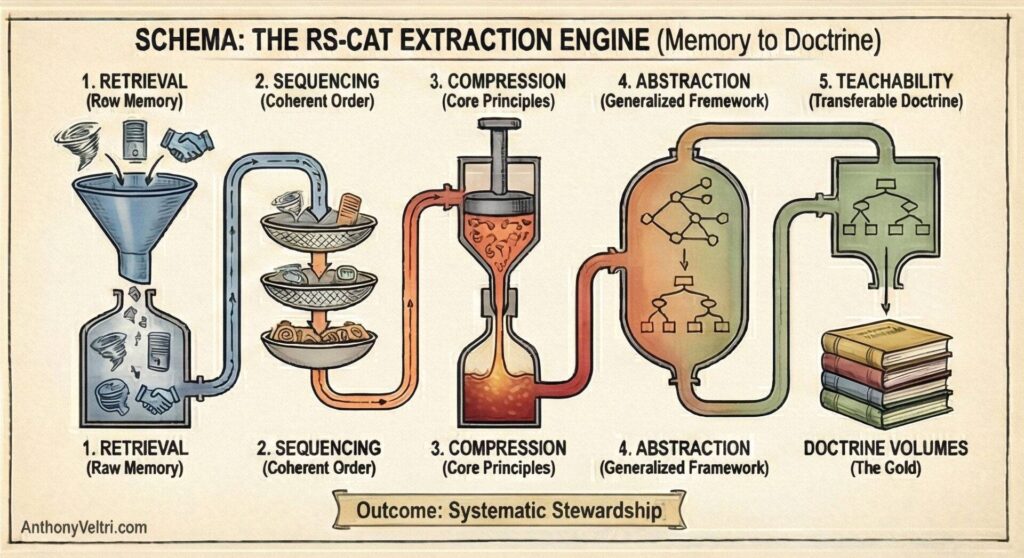
This systematic approach converted 20 years of operational memory into over 25 documented doctrine volumes in six months.
Not because I suddenly remembered more.
But because I had methodology to extract what was already there.
This is what most GS-15s lack.
They have expertise. They lack extraction frameworks.
They retire. Knowledge dies.
This is the meta-problem I’m solving:
Not just “here are my operational lessons” (though I’m sharing those).
But “here’s the methodology to extract your operational lessons before they’re lost.”
RS-CAT is transferable. Teachable. Applicable to anyone with deep operational knowledge who needs to document it systematically.
Time investment: RS-CAT doesn’t require six months of unemployment. You can apply it incrementally:
- 30 minutes per week captures one operational memory
- 2 hours per month sequences and compresses into principles
- 50 hours over a year produces comprehensive documentation
You don’t need to leave your job to start. You need systematic approach and commitment to stewardship.
Why Coalition Operations Benefit From Working With Someone Outside the Warrant System
Multinational and multi-agency operations face the same cultural constraints federal service does.
Military officers rotate every 2-3 years. Deep operational knowledge, but culturally constrained: “Speak through chain of command. Don’t freelance. Represent your service, not yourself.”
International civilian staff are temporary assignments. Organizational loyalty, career protection, rotation pressures.
Coalition partners navigate member nation politics, diplomatic sensitivities, career implications.
Everyone asks: “Who am I to document operational lessons? That’s not my role.”
Their people COULD document lessons learned. Often legally permitted. Operationally valuable.
But “Who are you to speak?” keeps them silent.
This is where I provide unique value:
1. Authentic Operational Synthesis You Can’t Get From Within Your System
I’m not your employee. I’m not protecting a career with your organization. I’m not worried about member state politics. I’m not the king’s man bound by organizational loyalty.
I can synthesize operational realities your own people feel they can’t.
I can document coordination challenges without political filter.
I can share frameworks for federation architecture, coalition coordination, and decision infrastructure without vetting through communications offices.
This is what appointed officials can’t provide (talking points constrain them).
This is what career professionals won’t provide (cultural gatekeeping silences them).
This is what someone outside the warrant system can offer: Authentic operational synthesis grounded in 20 years of federal disaster response, enterprise architecture, and coalition coordination – shared without organizational constraints.
2. Extraction Frameworks to Help Your People Document Before They Rotate
RS-CAT gives you systematic methodology to capture knowledge from rotating officers and staff before they leave.
Even if they feel culturally constrained from publishing it themselves (they probably do), you can use RS-CAT internally to extract operational lessons before knowledge walks out the door.
Retrieval: Structured interviews pulling operational memories Sequencing: Organize lessons coherently
Compression: Distill to transferable principles Abstraction: Generalize beyond specific operations Teachability: Document so next rotation can learn
This preserves institutional memory even when individuals feel they can’t speak publicly.
3. A Model of What’s Possible When Cultural Constraint Is Removed
This documentation exists because I’m no longer the king’s man.
Your organization could benefit from understanding what that freedom produces – and how to create structures that preserve knowledge without requiring people to leave first.
What if you had protocols for:
- Retiring officers to document lessons learned (after separation, culturally free)
- Systematic extraction before rotation (using RS-CAT)
- Knowledge stewardship as explicit duty (not presumptuous claiming of authority)
You’d preserve decades of operational expertise currently dying silently.
Not because your people lack knowledge. Because cultural gatekeeping prevents documentation.
The Stewardship Imperative
I refuse to accept knowledge death as normal.
Most career professionals accept it: “I did my job. Someone else will figure it out. That’s not my role to document.”
Most appointed officials accept it: “I served my time. My successor will learn their own lessons. I gave testimony when required.”
Both accept that 25-30 years of operational expertise dies when they leave.
I reject this.
Not because I’m special. But because DOGE gave me what few federal professionals ever get: time to synthesize before retirement, while operational memory is still fresh, with freedom from cultural constraints.
This knowledge shouldn’t die. These frameworks shouldn’t disappear. These lessons shouldn’t be lost.
So I built RS-CAT to extract it systematically.
I then documented comprehensively.
I’m sharing it openly as stewardship.
Not as talking points defending an agency.
Not as career positioning for next appointment.
But as operational stewardship: This knowledge exists independent of my employment. It should be preserved, shared, and applied by others facing similar coordination challenges.
This is what warrant-free synthesis looks like.
And it’s what federal service desperately needs more of.
📌 PREEMPTING COMMON OBJECTIONS
“You sound bitter about being laid off.”
I could have stayed silent. I could have scrambled for another federal position. I could have kept the king’s coin and accepted the king’s man’s silence.
I chose stewardship instead. That’s not bitterness. That’s recognition that 20 years of operational knowledge shouldn’t die.
“You’re criticizing federal service.”
I’m diagnosing a systemic knowledge loss pattern. Every organization has this problem – federal service, military, international organizations, private sector. The king’s coin / king’s man dynamic is universal. I’m not condemning people who choose security. I’m explaining why knowledge dies and offering methodology to preserve it.
“I need RS-CAT but don’t have time to build extraction frameworks.”
RS-CAT is freely available. I’m sharing it as stewardship – you don’t need to build it, you can use it. The complete framework, worksheets, and methodology are documented at anthonyveltri.com. Take it. Apply it. Extract your expertise before it’s lost.
“What about security clearance obligations and agency review?”
Security clearances obligate protection of classified and sensitive information. They don’t prohibit documentation of unclassified lessons learned.
Even organizations like CIA have publication review offices precisely because professionals CAN document unclassified work with proper review. The review process exists because documentation is permitted, not prohibited.
And most federal professionals aren’t working on classified systems anyway. The majority of federal work is unclassified. Administrative operations, program management, coordination frameworks, lessons learned – these are documentable.
Everything I’ve documented is unclassified, uses no nonpublic information, and involves no sensitive programs. The constraint was never legal – it was cultural.
“How do I know I won’t get in trouble? Should I ask permission?”
Here’s the reality nobody tells you: Don’t bring it up the chain.
Not because documentation is prohibited, but because nobody wants to help you navigate this.
Your supervisor doesn’t want to deal with it. HR doesn’t want the liability question. Legal doesn’t want to set precedent. Communications office doesn’t want someone they can’t control speaking publicly.
Even asking “Can I document unclassified lessons learned on my own time?” creates organizational anxiety. Not because the answer is no – but because no one wants to be the person who said yes.
So what do you do?
If still employed: Document unclassified lessons on your own time, using no agency resources, claiming no official authority. Don’t ask permission for what’s already legally permitted. But understand cultural backlash is real. Colleagues may question you. Leadership may be uncomfortable. Only you can decide if stewardship outweighs cultural pressure.
If separated or retired: You’re free. No organizational constraint. No cultural gatekeeping. Document openly as stewardship.
Most people choose to wait until retirement. Both paths are valid. The point is: legal permission exists. Organizational anxiety about it doesn’t change that.
“How long does RS-CAT actually take? I’m not as skilled as you.”
With practice, I can extract enough meaningful information using RS-CAT to produce a field note in about an hour – from someone else.
Key distinction: It’s faster when you’re interviewing someone else than extracting from yourself.
The dentist analogy: Can a dentist sit in the chair and clean their own teeth? Probably. But is it better to have a hygienist or another colleague do it? Absolutely.
Self-extraction works, but it takes longer:
- You’re too close to your own experiences
- You don’t know which details are unique vs. common
- You skip over things that seem obvious to you
Partner extraction is faster and better:
- RS-CAT interviewer asks the right questions
- You tell operational stories naturally
- Partner identifies patterns you didn’t see
- Compression and abstraction happen in real-time
Time estimates:
- Partner-assisted extraction: 1-2 hours per field note (interviewer skilled with RS-CAT)
- Self-extraction: 3-5 hours per field note (you’re learning the methodology while applying it)
- Over time: You get faster as RS-CAT becomes internalized
You don’t need to be skilled initially. You need to start. The framework guides you. And RS-CAT is freely available – take it, use it, extract your expertise.
“What if I want to document while still employed?”
Legally possible (if unclassified, own time, no agency resources, not claiming to represent agency).
Culturally difficult (colleagues ask “Who are you?”, supervisor uncomfortable, risk of backlash).
Most people wait until retirement. That’s valid. Just don’t wait so long that operational memory fades. Retire at 62, document at 63-64 while lessons are fresh. Don’t wait until 75 when details are lost.
📌 IRONY NOTE: The King’s Coin in a Democratic Republic
There’s irony in using feudal metaphor for United States federal service.
We’re a democratic republic. We rejected monarchy. We don’t have kings.
Yet the king’s coin / king’s man dynamic applies perfectly.
Because the dynamic isn’t about monarchy – it’s about organizational power and individual constraint.
Any organization that provides security (salary, benefits, pension, identity, status) in exchange for service creates the same dynamic:
You take what the organization offers.
You become bound by obligations – written and unwritten.
One of those obligations is: “We speak, you don’t. We control the message, you execute.”
This applies to:
- Federal service (take government salary → bound by cultural silence)
- Military (take military pay → speak through chain of command)
- Corporations (take corporate salary → bound by NDA culture and messaging control)
- Academia (take tenure → bound by departmental politics)
- International organizations (take mission pay → bound by member state sensitivities)
The king’s coin is any organizational security that makes you dependent.
The king’s man is anyone who accepts that security and the constraints that come with it.
We might not have kings, but we have organizational power structures that function the same way.
The metaphor holds because the pattern is universal.
Implications
For Federal Knowledge Management:
The current system guarantees knowledge death:
- Career professionals culturally silenced (even when legally permitted)
- Appointed officials constrained by talking points (even when authorized to speak)
- No systematic extraction before retirement
- 25-30 years of expertise dies with every separation
Better approach:
- Recognize that operational expertise belongs to individuals, not organizations
- Create cultural permission for documentation after separation
- Teach extraction frameworks (RS-CAT) before retirement
- Treat knowledge stewardship as duty, not presumption
For Coalition and Multinational Operations:
Same cultural constraints, same knowledge loss.
Value of working with warrant-free experts:
- Authentic operational synthesis without political filter
- Frameworks without organizational vetting
- Systematic extraction methodology transferable to your people
- Model of what’s possible when cultural gatekeeping is removed
For Individual Federal Professionals:
You have permission right now to document unclassified lessons learned (see callout on outside employment).
No NDA prevents it. No employment contract forbids it. No ethics regulation prohibits it.
The only constraint is cultural: “Who am I to speak?”
Answer: You’re someone with 20-30 years of operational expertise that will die when you retire unless you document it.
That’s stewardship responsibility.
You don’t need to wait for appointment. You don’t need organizational authorization.
You need to recognize that your expertise is yours, independent of employment.
And you need extraction frameworks to capture it systematically.
The king’s man doesn’t speak.
But you can choose to stop being the king’s man.
The coin is valuable. The security matters. I’m not dismissing that.
But understand the trade: Security for significance.
Most choose security. That’s fine.
Just recognize what you’re sacrificing.
Conclusion: You Have Knowledge Others Need
This documentation exists because I lost the king’s coin.
Not by choice. Not by planning.
But in losing it, I discovered something I couldn’t see while employed:
My operational expertise is mine.
Not the government’s. Not the organization’s. Mine.
Independent of employment. Shareable as stewardship. Documentable systematically.
The cultural constraint – “Who are you to speak?” – only had power while I identified as the king’s man.
Once that identity was removed, the question lost its force.
And here’s what I want you to understand:
You have 20-30 years of operational knowledge that others desperately need.
Not “might need someday.” Need right now.
The frameworks you’ve developed to make coordination work? Others are struggling without them.
The lessons you learned about what fails under pressure? Others are repeating those failures.
The systematic approaches you built to navigate organizational complexity? Others are reinventing from scratch.
Your knowledge has value independent of your employment.
You learned it through experience. You developed it through practice. You refined it through repetition.
It’s yours.
The organization benefited from your expertise while you were employed. That was the trade – your expertise for their security.
But the expertise itself belongs to you.
And when you leave – through retirement, through separation, through transition – that expertise comes with you.
Most people never document it.
They accept that 25-30 years of hard-won operational knowledge dies when they leave.
“Someone else will figure it out. That’s not my role to document. Who am I to write about this?”
I’m asking you to reject that.
Not because you’re obligated. Not because you owe it to anyone.
But because stewardship matters.
The junior professional facing the same coordination challenges you solved 15 years ago shouldn’t have to start from scratch.
The organization implementing the same system you built shouldn’t repeat the mistakes you already learned from.
The field operator dealing with the same interface problems you navigated shouldn’t struggle without your frameworks.
You can help them.
Not while you’re the king’s man (cultural constraint prevents it, even when legally permitted).
But after – when you’re free from organizational identity, when “Who are you?” loses its power, when stewardship becomes possible.
RS-CAT gives you the methodology. Freely available. Take it. Use it. Extract your expertise systematically.
Time gives you the opportunity. Retirement. Separation. Transition. The moment when organizational constraint lifts.
Stewardship gives you the purpose. Your knowledge shouldn’t die. It should serve others facing the same challenges.
This isn’t about bitterness or criticism or claiming you were wronged.
This is about recognizing that expertise has value independent of employment.
And choosing to preserve it rather than let it die.
You spent decades building that expertise.
Don’t let it disappear.
Document it. Systematically. Using RS-CAT or whatever methodology works for you.
Share it. Openly. As stewardship for those who come after.
Not because you need warrant to do so.
But because you have knowledge others need.
That’s sufficient authority.
That’s sufficient purpose.
No king’s coin required.
If you are a practitioner with deep operational knowledge: your expertise is not made valuable by a badge. The badge only made it easier to ignore that it was already yours.
If you are a leader running cross-boundary programs: you cannot rely on “public information” to save you. Public does not mean findable, and it does not mean teachable. If the operational map is diluted, you will pay for it later in rework, misalignment, and preventable failure.
Stewardship is the act of converting diluted knowledge into decisions.
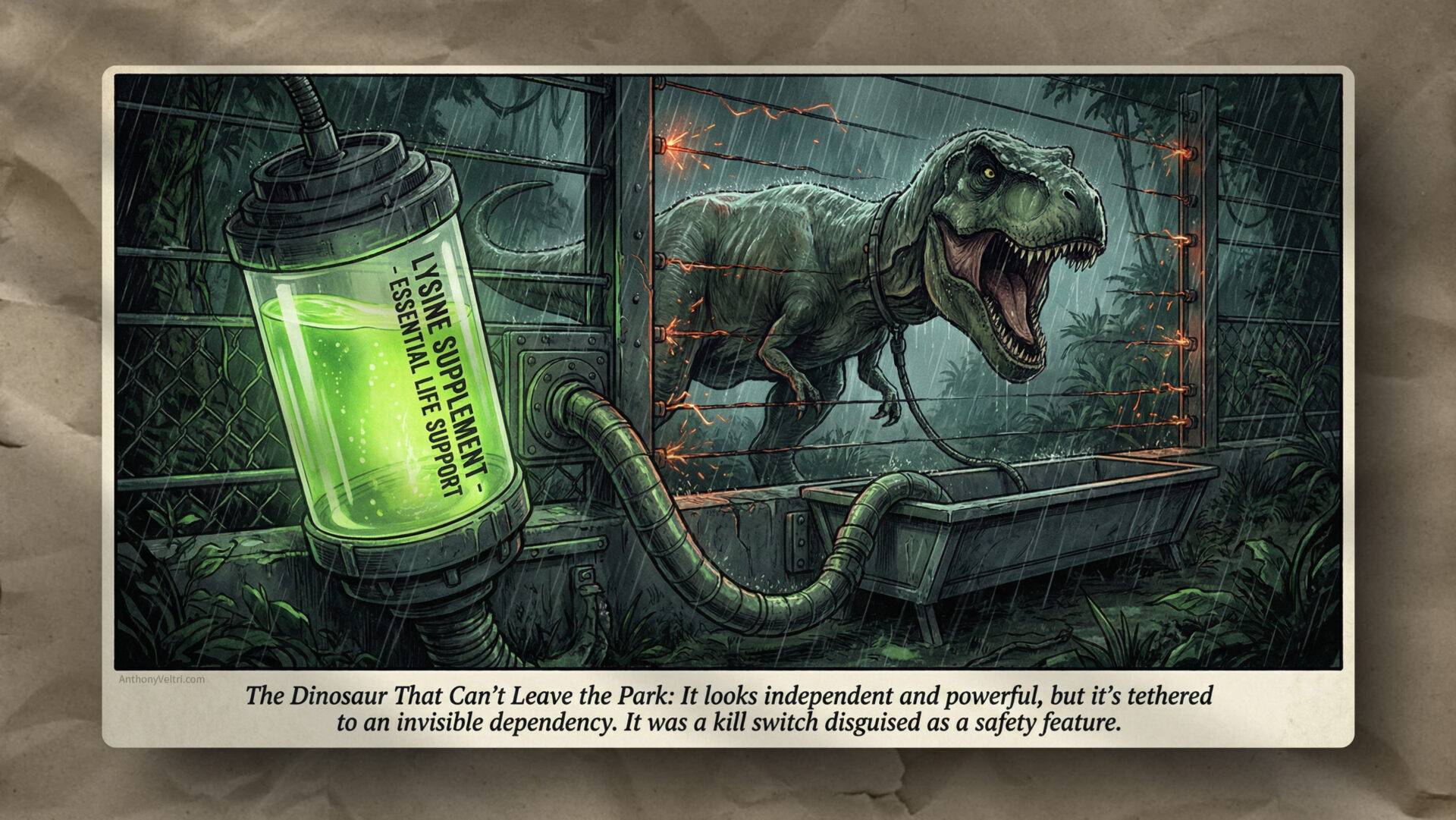
Related: The Lysine Contingency (how algorithmic gatekeeping finishes the job by making quality work inert without backlinks, followers, and other authority signals; even when you have permission to speak).
Last Updated on February 13, 2026