[UNABRIDGED AUDIOBOOK]
FIXING BROKEN SYSTEMS
A practitioner archive on surviving technical debt
The archive is ungated. No email required.
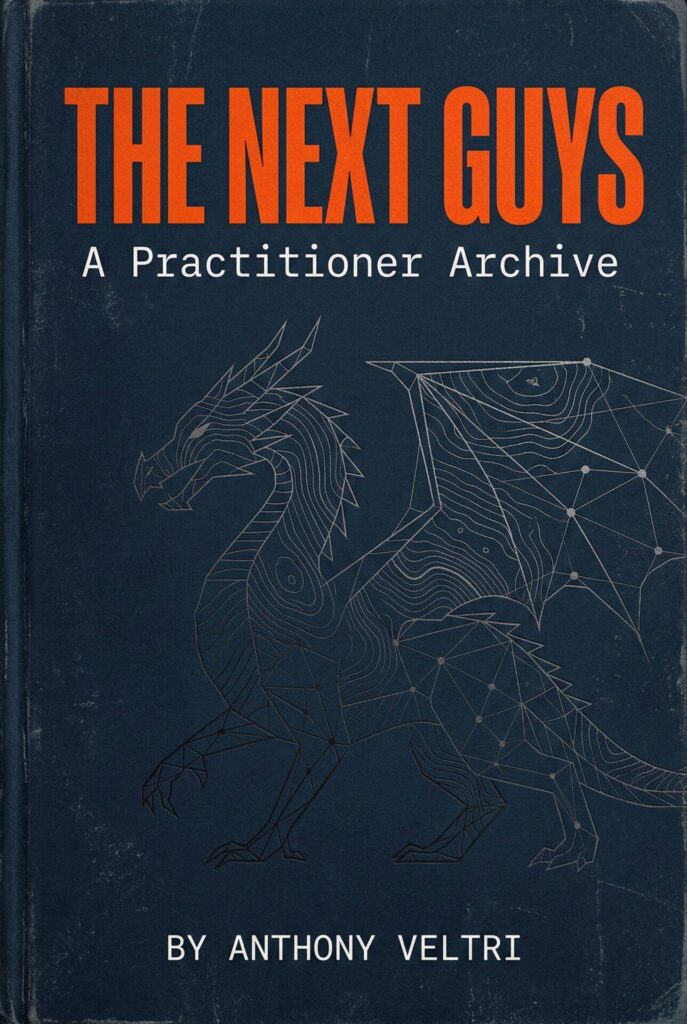
On a construction site or a factory floor, leaving a mess for “the next guys” is an obvious problem. The incoming shift sees the debris immediately and knows exactly what they have to clean up (and who needs a talking to).
But in complex systems and operational architecture, the mess is completely invisible.
You walk into a new role, sit down at a new desk, and inherit a system held together by undocumented expertise, orphaned data feeds, and anonymous sticky notes. Everything looks fine on the surface. The technical debt is completely hidden until a critical incident occurs, at which point you realize nobody actually owns the architecture.
This is a book about what happens next.
The archive opens in Hawaii, with a retired Chief Warrant Officer named Roger standing in red volcanic mud, pointing at a drainage ditch, and explaining in three unhurried sentences everything a new road engineer will not be able to learn in three days.
Roger is patient. Roger is resigned. Roger is also, by every measurable indicator, completely correct.
Some of the people in this archive carried twenty years of operational knowledge and had roughly seventy-two hours to hand it to someone who did not yet know what questions to ask.
This book is about what gets lost in that handoff. And what does not have to.
He is the first of several people in this book who carry that kind of knowledge. You will also meet Sam, who manages critical national security infrastructure with the calm of someone who has already seen every possible way it can break. Mr. Kahale, who has forgotten more about sovereign land rights than most federal managers will ever learn. And the Union Steward, who figured out exactly how to make weaponized compliance work for the mission rather than against it, and has the bright orange vest to prove it.
The author voices all of them. No voice actors. No AI. Just someone who was actually in the room with these people, trying to hand you the memory exactly as it sounds in his head.
That turns out to be enough.
This is the full, unabridged audiobook. We have arranged the chapters in sequential order so you can easily consume the archive from start to finish. Start with the Author’s Note and proceed chronologically. The entire archive is completely ungated (no email required). You can hit play directly below, or search for The Next Guys in your preferred podcast app to take the audio into the field.
How This Fits into The Doctrine (AKA the Patterns) The Next Guys is a practitioner archive. It is a specific, bound collection of field notes curated for a single purpose: teaching you how to fix broken systems without burning yourself out.
This book is pulled directly from The Doctrine. The Doctrine is the living, active operational framework housed here at anthonyveltri.com. While The Doctrine constantly evolves with new practitioner data, The Next Guys is the foundational manual you need to survive your current operational reality.
Anthony Veltri spent twenty years inside the federal machinery. From unpaved military roads in Hawaii to geospatial coordination systems at the Department of Homeland Security and wildland fire operations for the Forest Service, he inherited undocumented expertise, orphaned interfaces, and systems propped up entirely by individual heroics.
Organizations celebrate the heroes who save the day during a disaster. But systems that require heroics to function are structurally broken. When the heroes finally leave or break under the pressure, the systems fail catastrophically.
The Next Guys is not a theoretical management textbook. It is a practitioner archive. Through field notes gathered from two decades of operational reality, Veltri extracts the hidden patterns that govern how complex systems actually work.
Through field notes gathered from two decades of operational reality, you will learn:
Stop being the hero who fights the system. Become the steward who builds it to last.
Because the next guys deserve better than inheriting a broken system held together by heroes who left.