Federation Architecture for Coordination in Heterogeneous Digital Government Ecosystems
Observation
This paper presents the decision framework layer of the federation doctrine: when to choose federation over governance integration in the first place, and how to recognize when governance integration is already failing.
The companion argument lives in the field note series “Ground Truth, Federation, and the Anchor Point.” That series addresses what federation cannot fix: the stewardship obligation at the calibration chain, the anchor point that must be physically grounded and named regardless of how sophisticated the coordination architecture above it becomes. These two bodies of work address different moments in the same problem. The series asks what federation cannot do. This paper asks whether federation is the right pattern to begin with, and what to do operationally when it is.
The framework identifies five conditions that make governance integration structurally misaligned: absent authority to compel conformance, mission and tempo heterogeneity, legal boundary constraints, misaligned incentive and cost placement, and resilience requirements that demand independent operation. When those conditions are present, integration does not fail because of poor execution. It fails because the coordination model is wrong for the ecosystem.
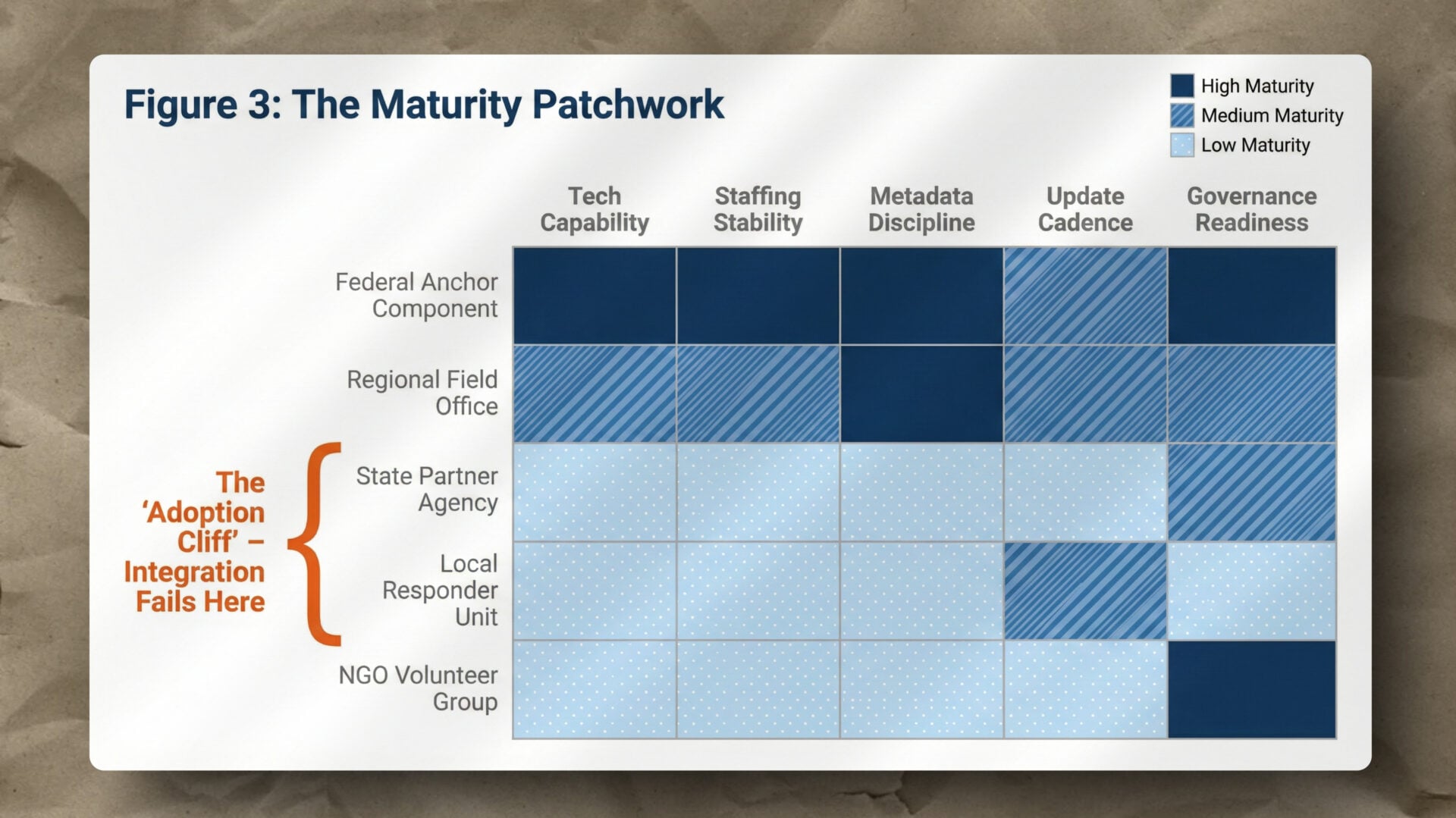
The maturity patchwork table (Table 1) is the most portable artifact here. It maps low and high maturity signals across eleven dimensions, identifies the failure mode that forced governance integration produces in each case, and describes the federation accommodation that absorbs rather than eliminates the variance. Practitioners mid-project watching their interagency initiative accumulate workarounds will recognize the table immediately.
The case study draws on GII/OneView, a DHS enterprise coordination system with a sustained operational lineage of approximately 18 years: 296,000 users, 22 components, more than 200 sovereign partner organizations across multiple technology refresh cycles. The analysis reflects the author’s broader 20+ years of federal operational experience across cross-jurisdiction coordination, wildland fire, disaster response, and geospatial federation, of which GII/OneView represents one sustained program thread. HSIN provided the authenticated cross-jurisdiction identity layer. USDA Forest Service and partner land management agencies participated through federated feeds during wildfire coordination and hurricane recovery operations.
This paper was submitted to the 27th Annual International Conference on Digital Government Research (dg.o 2026) for the full paper track in the management and policy category. It was not accepted. The conference offered a poster option. I declined. The argument is complete. The framework can benefit others as-is. The content belongs in the public domain. Enjoy.
PDF below.

Last Updated on June 7, 2026