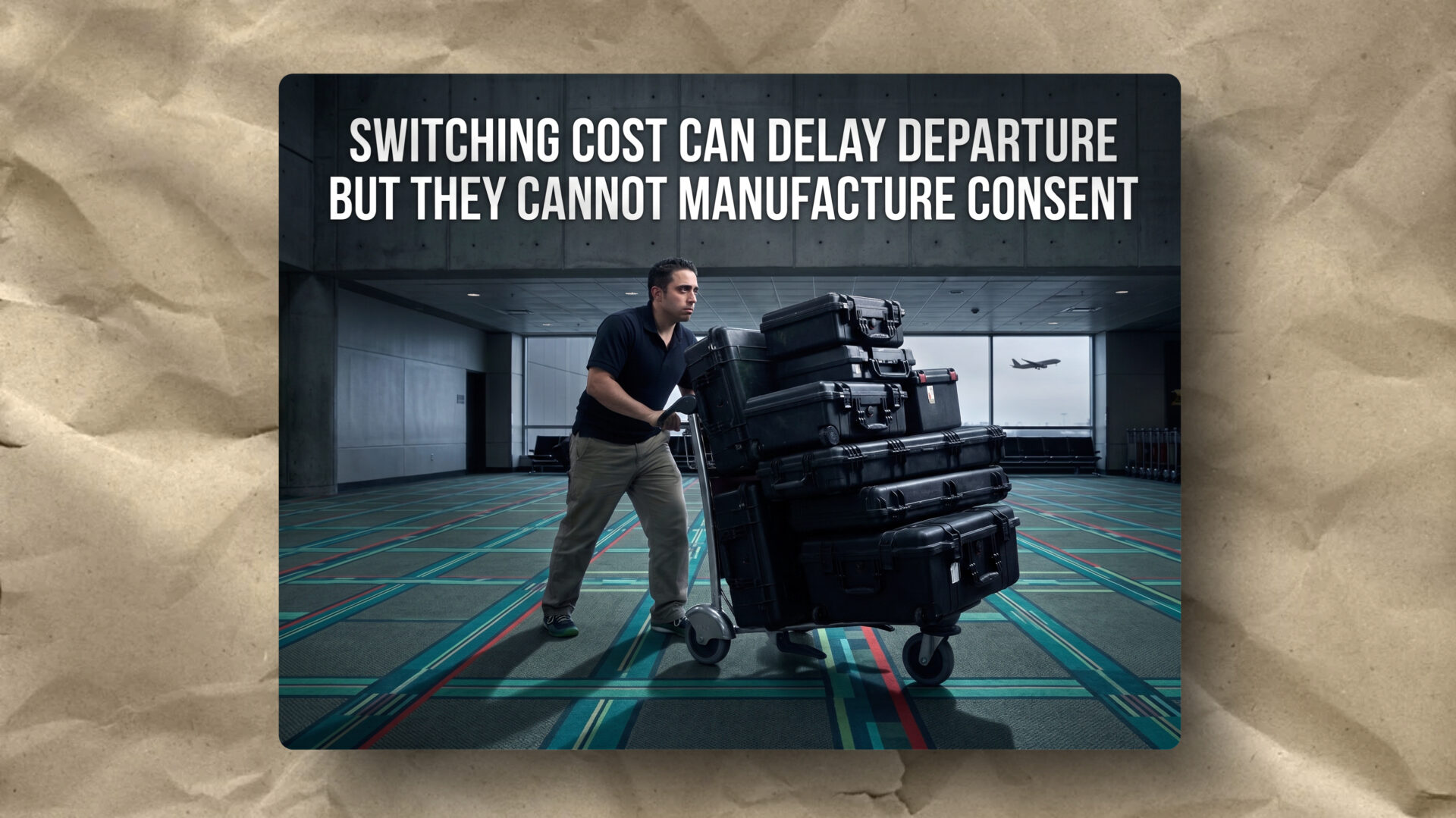
Switching Costs Can Delay Departure, But They Cannot Manufacture Consent.
Canon did not lose me overnight
For most of my life, I was a Canon person.
That story started before I was spending my own money. My grandfather gave me my first camera. If I remember correctly, it was a Canon A-1, or perhaps an AE-1, with maybe a fixed 35mm or 50mm lens. It was not part of the later system I would eventually buy into. In practical terms, that older film camera and the Canon Rebel I later purchased mostly shared the word Canon and not much else. They were not some seamless interoperable ladder from one generation to the next.
But that is exactly the point.
My loyalty to Canon did not begin with a rational evaluation of systems. It began with a name that felt familiar, and a grandfather who trusted it. A lot of dependence starts as inherited familiarity rather than active assessment. The brand felt like the natural place to keep buying, not because I had compared it carefully against alternatives, but because the positive association arrived before I knew enough to question it.
Brand loyalty often begins long before real system logic does.
My first actual purchase was the Canon Rebel. By then, I already had that positive association, and probably some naïveté too, because I did not yet have much exposure to other ecosystems. That early experience, plus the familiarity of the name, was enough to send me down the rabbit hole. Then came lenses. Then better lenses. Then fixed primes. Then the serious gear. Eventually a C100 cinema camera. White-bodied L glass. Cases. Batteries. Chargers. Media. Accessories. Over time, what began as a brand preference turned into a whole working environment.
That is what people miss when they talk about switching. They picture someone casually deciding to try another product, as if changing systems were like grabbing a different cereal box off a shelf. That is not how it works once you are embedded. Once you are embedded, you are not just carrying equipment. You are carrying habit, workflow, packing logic, battery families, accessories, muscle memory, and years of accumulated decisions.
A practical, methodical packing sequence. Every item has a specific place, a habit learned from years of EMS/wildland fire work. This level of organization is necessary for critical bags, but it demonstrates how deeply you embed your logic and muscle memory into a single piece of hardware. It ensures you know where things are, even when the rest of your environment is chaotic. (time lapse, no sound)
Leaving a system like that is expensive. Not just expensive in the abstract. Expensive in the very real sense. Listing gear. Taking the photos. Writing the descriptions. Paying the fees. Hoping the buyer is legitimate. Accepting the haircut. Trying not to think too hard about what you paid for some of it. Trying not to resent the time involved in unwinding what took years to build.
There is also an emotional cost. Some gear feels like part of your hand. Some gear is connected to places, phases of life, and ways of working. Selling it is not just a transaction. It is an acknowledgment that the relationship has already changed.
That is why I keep coming back to this distinction. High switching costs are not the same thing as loyalty. They can delay movement. They can hide dissatisfaction. They can keep someone in place long after the relationship has already started to fail. But they do not create real consent. They do not prove health. Often they just mean the person has not yet reached the point where leaving feels cheaper than staying.
The Fractal Question
Once I started seeing that pattern in my camera bag, I started asking the diagnostic question in other places.
Where else am I carrying something I would not choose today? Where else has accumulated investment displaced active evaluation? Where else am I staying because the cost of leaving feels high, rather than because the relationship is still genuinely working?
The answers were more interesting than I expected.
One of them involved a fitness community. The gym we attended for years was a CrossFit affiliate. The owner made a considered decision to drop that affiliation, change the programming, and pursue a different direction. That was not a failure. By most measures it was a success. The gym grew. The owner found what he was looking for. I have no complaint about his judgment or his execution. But it was no longer what we needed.
That is a different kind of separation than the Canon story, and the difference is worth naming.
There is a useful distinction between fit for purpose and fit for use. Fit for purpose asks whether something does what it is designed to do well. Fit for use asks whether it fits the actual context in which you need to use it. Those two things sound like they should track together, but they often do not. A thing can be excellently designed for its stated purpose while still being a poor fit for a specific deployment context. And a thing can be imperfect on paper while being exactly right for the situation at hand. The gym, after the change, was probably higher fit for purpose in the owner’s new direction. Better programmed for a broader audience, better positioned for growth. But it was lower fit for use for what we actually needed. Nobody did anything wrong. The axes simply diverged.
This divergence between purpose and use extends far beyond organizational shifts. In fact, the clearest illustration brings us right back to the hardware.
I saw the ultimate expression of this alignment in 2017 at a D.C. video shoot-off hosted for military and government personnel.
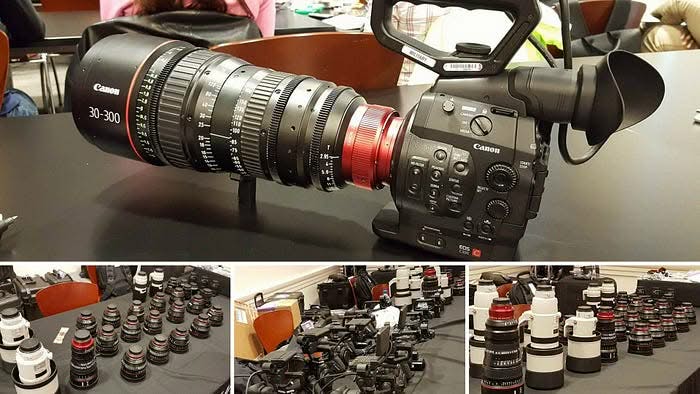
The room was essentially a ‘Hall of Canon’ containing an estimated half-million dollars (plus) of loaned equipment. If you have a defense budget and a dedicated logistics tail, you have the luxury of maintaining multiple, heavy, specialized systems. During the event, instructors explained why the Canon C100 cinema camera (a core part of my own kit back in 2015) was so heavily utilized by tactical units.
Canon did not design that unit to military specifications for night-time surveillance. It was engineered to be a cinema camera. However, the exact characteristics that made it a good cinema camera (an exceptionally large physical pixel size on the sensor) also made it highly capable for military observation when pushed with a boost range.
This is a fascinating example of the framework in action. In that specific military context, the camera was not being deployed for its stated purpose at all. The tactical units simply discovered that an off-the-shelf commercial tool possessed an exceptionally high fit for use for their specific mission. Fit for use drove the adoption, regardless of the original engineering intent.
But my use case as an individual practitioner was different. By the time of this 2017 event, I was already accomplishing what I needed to with my Panasonic. Do not get me wrong: we took full advantage of the ‘Hall of Canon’ for the actual competition. We grabbed whatever we wanted to use. For the duration of the event, Canon successfully masked the friction of their heavy ecosystem. They charged the batteries. They packed the bags. They handed over a ready-to-deploy system, essentially subsidizing the switching cost right there in the room.
The only thing they did not provide was someone to carry it all around D.C.
You see this divergence most clearly when you compare those flagship systems against consumer tech. Take any of those heavy camera bodies with good glass. The sensor is larger. The pixel size is larger (which matters more than megapixel count alone in most real-world shooting conditions). The dynamic range, the low-light performance, the control over depth of field, the ability to shoot usable footage: all of it is demonstrably superior to what a smartphone can do. The fit for purpose comparison is not even close. Then ask which one grandma is going to use to capture and share a moment at a family gathering.
The smartphone wins. Not narrowly. Comprehensively. She gets it out faster. She takes the photo or video in one motion. It uploads automatically. It is shared before the person with the serious camera has finished chimping the shot. The people who were supposed to see it have already seen it. Fit for purpose does not determine the outcome when fit for use is what the mission actually scores on.
That realization changed something in how I think about incumbents and alternatives. The technically superior option, the more capable platform, the established system with the longer track record, is not automatically winning just because it is winning on the specification axis. The governing question is always which axis the actual mission runs on. And once that question is loose in your head, you start applying it to things much larger than cameras or gym memberships.
The Incumbent’s Miscalculation
Canon did not lose me because it lacked engineering talent. This was not some story about a technology so superior that the incumbent had no real answer. Canon had real capability. In some areas, arguably superior capability. That is what makes the lesson sharper. The issue was not inability. The issue was choice. Choice about features. Choice about workflow. Choice about what users were asking for. Choice about whether to treat the installed base as people to keep serving, or as people who would keep absorbing friction because they had too much invested to move.
For a while, that assumption probably looked smart. People like me stayed. We adapted. We carried more. We tolerated more. We found workarounds. We told ourselves we could make it work because we had so much sunk into it already. But sunk cost is not devotion. It is trapped energy.

What finally moved me was not infatuation with another brand. It was the practical experience of seeing a cleaner way to work. Panasonic, and in a different direction Sony, represented a different design philosophy. In my case, Panasonic let me do stills and video in one coherent package. It let me shrink what had become a couple of Pelican cases into one heavy but manageable backpack. It reduced the number of batteries, bodies, and parallel logistics chains I had to carry. It did not magically invent photography or video. It simply made my life easier. A rival does not always win by becoming miraculous. Sometimes it wins by becoming less irritating to live with.
Canon could have kept me. That is the part that still sticks with me. They did not lose me because retention was impossible. It would have been relatively easy, compared to the cost of losing me and others like me, to respond to what the market was clearly asking for. But they seemed to think they could shape demand by sheer force of brand gravity. They thought the installed base would keep carrying the burden. For a while, they were right. Until they were not.
That threshold is not usually crossed in public. It gets crossed quietly. First in the imagination. Then in the packing logic. Then in the shopping. Then in the side-by-side comparisons. Then in the mental rehearsal of a different workflow. Then finally in the sale. By the time the gear is on eBay, the relationship is already over.
The Systems Question
Any incumbent that relies too heavily on switching costs is taking a dangerous shortcut. That shortcut may hold for a while in consumer markets, and it may hold for a while in larger systems too. But eventually the people inside the structure begin asking whether they are staying because they still believe, or because they have not yet absorbed the cost of leaving. That question does not belong only to consumer products. It shows up in platforms, institutions, partnerships, and alliance structures too.
A dominant player can remain highly capable and still become harder and harder to live inside. It can keep asking more from the people already invested while assuming their continued presence proves loyalty. It can read delay as endorsement. It can confuse dependence with consent. That is where the misread becomes dangerous.
The people inside the system are often running a different calculation than leadership imagines. They are not only asking whether the incumbent is still strong. They are asking whether the relationship is still workable, still reciprocal, still worth carrying.
How hard are you making it for me to remain in relationship with you?
That is not just a consumer question. It is a systems question. Customers can ask it. Partners can ask it. Member organizations can ask it. Longstanding allies can ask it. Anyone with real switching costs can ask it. And once enough people begin redesigning their workflows, their procurement, their planning, or their strategic options around the possibility of exit, the old advantages start to erode in a different way. The alternatives do not need to be perfect. They only need to become thinkable. Then workable. Then preferable. Once that mental shift occurs, the incumbent is operating without real consent. They are merely coasting on the friction of departure.
That is how a dominant position starts weakening before the official break. The break looks sudden only to the side that had stopped listening.
A system begins to fail when it mistakes captivity for loyalty.
Last Updated on May 2, 2026