What this route does in 10 minutes
You’ll understand why decisions drag, identify what decision altitude is appropriate for your situation, and know how to clarify decision ownership and intent so progress can resume.
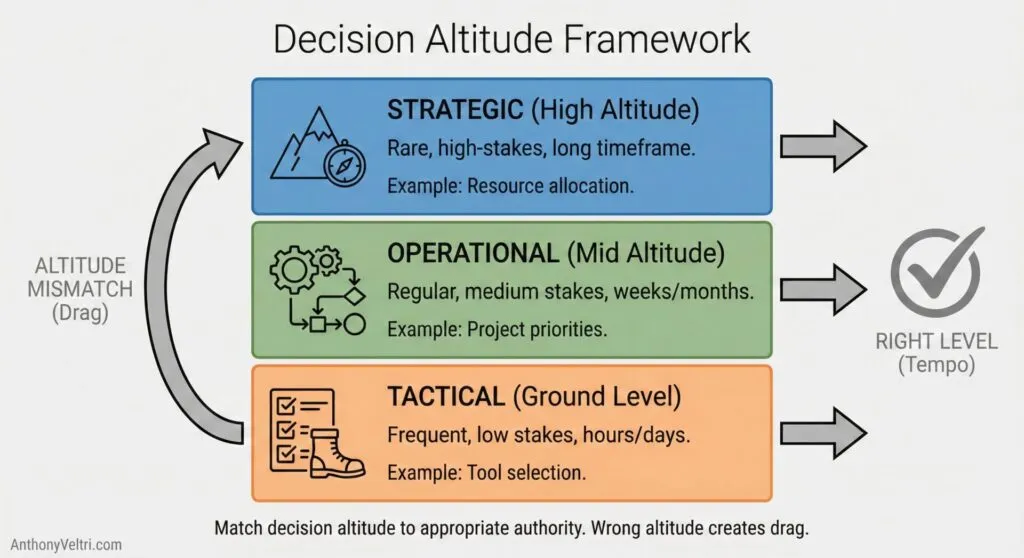
Start here: Three fast questions
Before you dive in, orient yourself:
- What decision needs to be made? Not the topic being discussed, but the actual choice that needs selection.
- Who has authority to make it? Can you name the person who can commit resources or change direction?
- What is the decision for? What outcome or constraint drives the need for this decision?
If you can’t answer question 2, or if meetings keep happening but decisions don’t, you’re in the right route.
Quick diagnostic
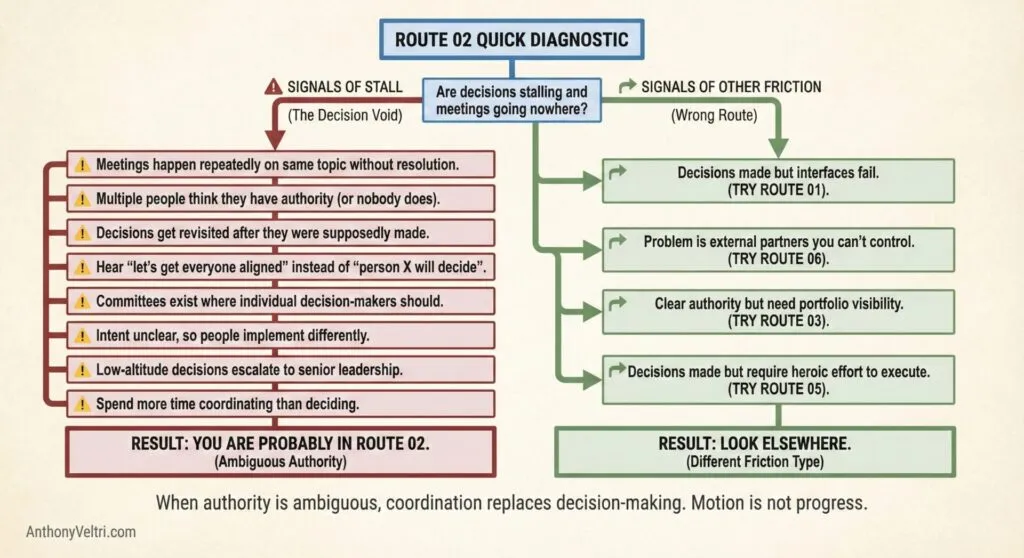
You are probably in this route if:
- Meetings happen repeatedly on the same topic without resolution
- Multiple people think they have decision authority (or nobody does)
- Decisions get revisited after they were supposedly made
- You hear “let’s get everyone aligned” instead of “person X will decide”
- Committees exist where individual decision-makers should
- Intent behind decisions is unclear, so people implement differently
- Low-altitude decisions escalate to senior leadership
- You spend more time coordinating than deciding
You are probably NOT in this route if:
- Decisions are made but interfaces between teams fail (try Route 01)
- The problem is external partners you can’t control (try Route 06)
- You have clear decision authority but need portfolio visibility (try Route 03)
- Decisions are made but require heroic effort to execute (try Route 05)
Doctrine and Annex anchors
These pieces define the principles and provide the models:
Doctrine 09: Decision Drag Is the Enemy of Mission Tempo. Architecture Is the Remedy Why slow decisions compound into operational paralysis and how to diagnose where decisions are stalling.
Doctrine 08: Clear Intent Compresses Ambiguity, Reduces Conflict, and Accelerates Action How explicit intent allows people to make aligned decisions without constant coordination.
ANNEX D. Decision Altitudes Model The framework for determining what decisions should be made at what level, and why altitude mismatch creates drag.
Field Notes that show the failure mode in the wild
These cases show what happens when decision authority is unclear and what changes when you fix it:
Field Note: When You Call a Committee a Team How committees disguised as teams create decision paralysis. Real examples of when consensus kills velocity.
Field Note: Rapid Goal Setting For Cross Functional Teams Case study of decision-making during Hurricane Florence when clarity of intent enabled distributed execution without coordination overhead.
Field Note: Business Analysis Center of Excellence – How To Stop Committing Project Malpractice Why projects fail when decision authority, portfolio visibility, and intent are all unclear simultaneously.
Field Note: Pattern-Matching as Operational Knowledge Why decision-making operates at different speeds for different people (conscious competence vs unconscious competence) and how this creates meeting friction.
Choose your situation
Pick the scenario that most closely matches your context:
Scenario A: Committee pretending to be a decision-making body
Signals:
- Group of 6+ people meets regularly to “decide” things
- Everyone has input, nobody has authority
- Decisions require “alignment” from everyone present
- Topics get revisited because someone wasn’t at the last meeting
- You hear “we need buy-in” instead of “person X decides”
Start with:
- Field Note: “When You Call a Committee a Team” (see the pattern)
- ANNEX D (identify correct decision altitude)
- Doctrine 09 (understand decision drag cost)
Scenario B: Wrong decision altitude
Signals:
- Operational decisions escalate to executive leadership
- Strategic decisions get made by front-line staff
- Senior leaders are bottlenecks for routine choices
- Low-consequence decisions require multiple approval layers
- People escalate to avoid taking responsibility
Start with:
- ANNEX D (map decisions to appropriate altitude)
- Doctrine 08 (provide clear intent so people can decide at right level)
- Doctrine 09 (calculate cost of altitude mismatch)
Scenario C: Unclear intent causes implementation chaos
Signals:
- Decision is “made” but people implement it differently
- You hear “I thought we decided X” followed by “No, we decided Y”
- The decision itself is clear but the reason behind it is not
- People relitigate decisions because they don’t understand the constraints
- Implementation requires constant clarification from decision-maker
Start with:
- Doctrine 08 (document intent, not just decision)
- Field Note: “Rapid Goal Setting” (see intent-driven distributed execution)
- ANNEX D (ensure decision altitude matches intent scope)
Scenario D: No clear decision owner
Signals:
- Multiple people think they have authority to decide
- Decision gets made but then reversed by someone else
- Nobody wants to commit without “checking with” others
- Responsibility is distributed but authority is not
- You hear “let me run this by [person]” at every level
Start with:
- ANNEX D (assign decision ownership at appropriate altitude)
- Doctrine 09 (show cost of distributed authority)
- Doctrine 08 (clarify what intent allows distributed decisions vs what requires single owner)
Scenario E: Not sure which scenario fits
Start with:
- ANNEX D (map your decisions and identify altitude mismatches)
- Doctrine 09 (understand decision drag)
- Doctrine 08 (clarify intent)
- Field Note: “When You Call a Committee a Team” (see the failure mode)
- Field Note: “Rapid Goal Setting” (see what good looks like)
Recommended default path
If you’re unsure which scenario fits, follow this sequence:
- ANNEX D. Decision Altitudes Model (10 minutes) Map your stalled decisions to appropriate altitude levels.
- Doctrine 09: Decision Drag Is the Enemy of Mission Tempo (5 minutes) Understand the compounding cost of slow decisions.
- Doctrine 08: Clear Intent Compresses Ambiguity (5 minutes) Learn how explicit intent reduces coordination overhead.
- Field Note: When You Call a Committee a Team (5 minutes) See how committees create decision paralysis.
- Field Note: Rapid Goal Setting Under Pressure (5 minutes) See distributed decision-making with clear intent in action.
Total time: 30 minutes from problem recognition to concrete next actions.
What to do next
In the next 15 minutes:
- List your top 5 stalled decisions
- For each one, write down: “Who should decide this?” (name a person, not a group)
- Use ANNEX D to identify if altitude is correct (strategic/operational/tactical)
In the next 60 minutes:
- Pick the highest-impact stalled decision
- Write down: the decision, the person with authority, the intent (why this matters)
- Draft a one-paragraph decision brief: “Person X will decide Y by [date] because [intent]. Implementation will look like [expected outcome].”
- Share with stakeholders for confirmation
This week:
- Audit your recurring meetings – which ones are committees pretending to make decisions?
- For each meeting: name the decision owner or cancel the meeting
- Document decision altitude for your team’s common decision types
- Create a decision log showing: decision, owner, date, intent, outcome
- Establish a norm: every meeting agenda must name the decision owner
Optional: Send me 5 sentences
If you want targeted guidance for your specific situation, describe:
- What decision is stalled? (the actual choice to be made)
- Who is involved? (people, teams, roles)
- What’s at stake if this stays undecided? (consequences of delay)
- What constraints matter? (budget, timeline, compliance, politics)
- What would “decided” look like? (clear outcome state)