What this route does in 10 minutes
You’ll understand why busy teams don’t equal valuable outcomes, identify what actually matters in your portfolio, and know how to create visibility so leadership can make informed resource decisions.
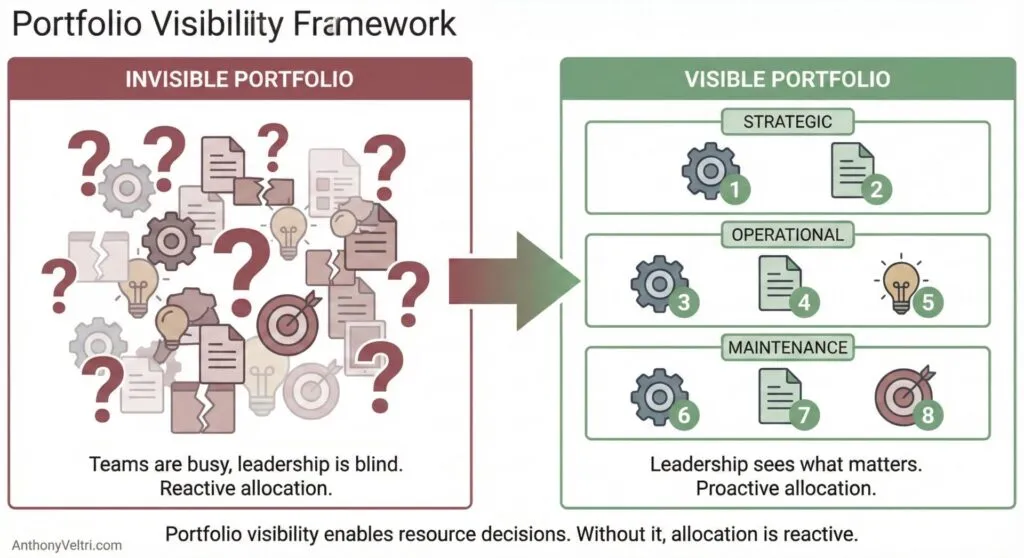
Start here: Three fast questions
Before you dive in, orient yourself:
- Can you list your active projects? All of them, including the ones that “don’t count” or are “just maintenance.”
- Do you know which ones matter most? Not which are loudest or most urgent, but which deliver the most value or reduce the most risk.
- Can leadership see this? Is portfolio status visible to people who allocate resources and make strategic decisions?
If you can’t answer question 2 or 3, you’re in the right route.
Quick diagnostic
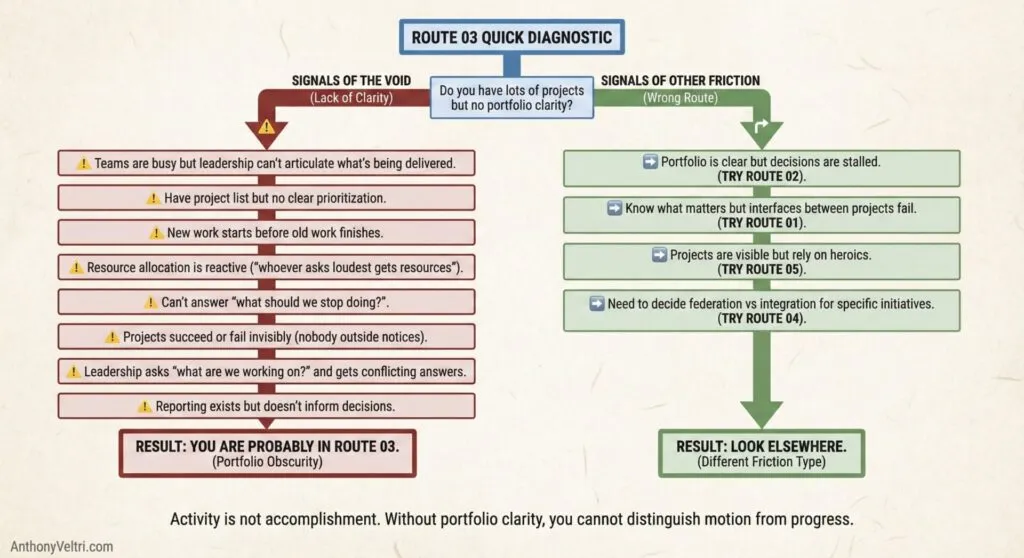
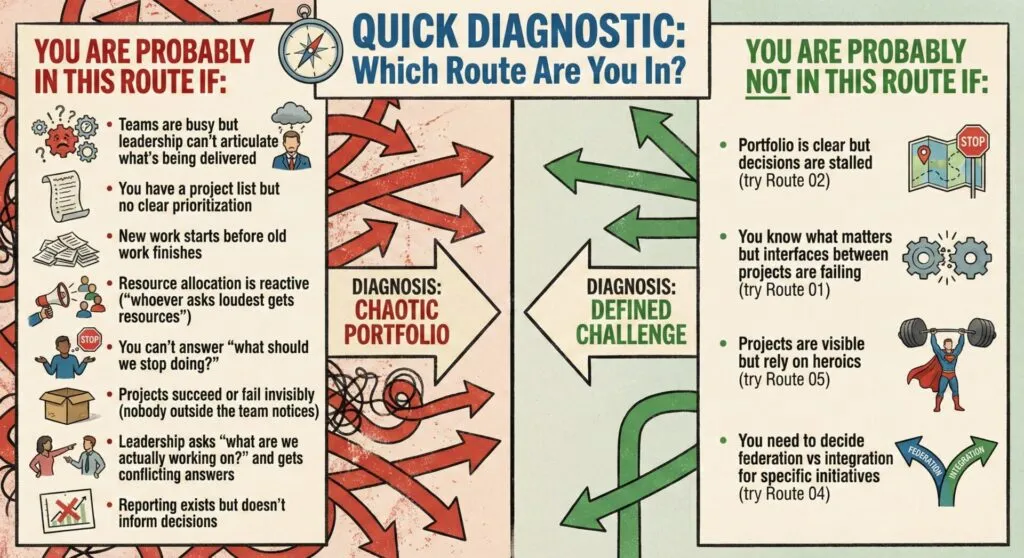
You are probably in this route if:
- Teams are busy but leadership can’t articulate what’s being delivered
- You have a project list but no clear prioritization
- New work starts before old work finishes
- Resource allocation is reactive (“whoever asks loudest gets resources”)
- You can’t answer “what should we stop doing?”
- Projects succeed or fail invisibly (nobody outside the team notices)
- Leadership asks “what are we actually working on?” and gets conflicting answers
- Reporting exists but doesn’t inform decisions
You are probably NOT in this route if:
- Portfolio is clear but decisions are stalled (try Route 02)
- You know what matters but interfaces between projects are failing (try Route 01)
- Projects are visible but rely on heroics (try Route 05)
- You need to decide federation vs integration for specific initiatives (try Route 04)
Doctrine and Annex anchors
These pieces define the principles and provide the models:
Doctrine 16: Portfolio Thinking Ensures Effort Aligns With What Actually Matters Why managing projects individually obscures whether you’re working on the right things, and how portfolio visibility changes resource decisions.
ANNEX I. High Visibility Workflows The framework for making work visible to people who need to make resource and priority decisions but shouldn’t need to ask for status.
ANNEX F. Pattern Library Reusable patterns for common portfolio problems (too many projects, unclear priorities, invisible maintenance work).
Field Notes that show the failure mode in the wild
These cases show what happens when portfolio visibility is missing and what changes when you create it:
Field Note: Business Analysis Center of Excellence – How To Stop Committing Project Malpractice How projects fail when nobody can see the portfolio, priorities are unclear, and resource allocation is reactive.
Field Note: Living With Incomplete Pictures Why operational teams have detailed visibility but executives have gaps, and how to bridge that asymmetry.
Field Note: Architect as Translator: Earplugs in the Data Hall, Briefing at HQ Case study of creating portfolio visibility across technical and executive audiences with different information needs.
Field Note: Why I Kept Quiet (And Why I’m Not Anymore) Why operational work remains invisible to executives unless someone builds the visibility infrastructure, and the stewardship obligation to document what’s actually happening.
Choose your situation
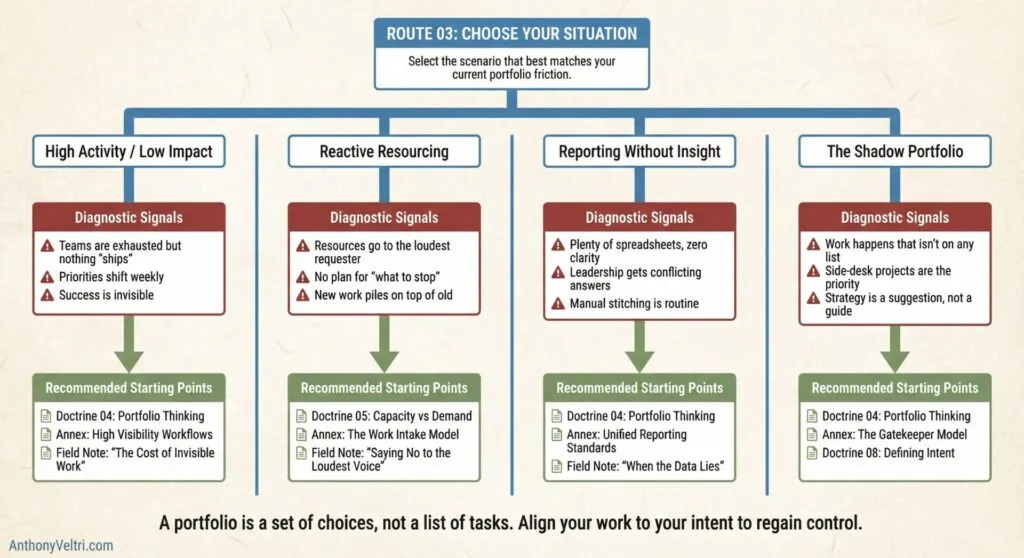
Pick the scenario that most closely matches your context:
Scenario A: Lots of projects, no prioritization
Signals:
- Everything is “high priority”
- New work starts without evaluating against current portfolio
- Teams context-switch constantly
- You can’t answer “if we had to stop 3 projects, which ones?”
- Resource conflicts resolved by whoever escalates loudest
Start with:
- Doctrine 16 (shift to portfolio thinking)
- ANNEX I (make work visible for prioritization decisions)
- Field Note: “Project Malpractice” (see the failure mode)
Scenario B: Work is invisible to leadership
Signals:
- Executives ask “what’s actually happening?” and get conflicting answers
- Operational teams know status but can’t communicate it upward
- Leadership makes resource decisions without portfolio visibility
- You hear “we need better reporting” but reports don’t change decisions
- Important work happens but nobody outside the team notices
Start with:
- ANNEX I (create visibility workflows)
- Field Note: “Architect as Translator” (bridge technical/executive gap)
- Field Note: “Why I Kept Quiet” (understand visibility as stewardship)
Scenario C: Maintenance work is invisible
Signals:
- New projects get resourced, maintenance doesn’t
- Technical debt accumulates because it’s not visible
- Systems degrade slowly because nobody tracks maintenance
- “Keeping the lights on” work doesn’t count toward team metrics
- You hear “just maintenance” as if it doesn’t matter
Start with:
- Doctrine 16 (portfolio includes maintenance, not just projects)
- ANNEX F (patterns for making invisible work visible)
- Field Note: “Living With Incomplete Pictures” (see information asymmetry)
Scenario D: Can’t answer “what should we stop?”
Signals:
- Portfolio only grows, never shrinks
- Finished projects don’t close (they become maintenance)
- Nobody has authority to stop initiatives
- Stopping work feels like failure
- Teams are overcommitted but can’t identify what to drop
Start with:
- Doctrine 16 (portfolio decisions include stopping work)
- ANNEX I (visibility enables stop decisions)
- Field Note: “Project Malpractice” (see consequences of never stopping)
Scenario E: Not sure which scenario fits
Start with:
- Doctrine 16 (understand portfolio thinking)
- ANNEX I (create visibility infrastructure)
- ANNEX F (identify your portfolio pattern)
- Field Note: “Project Malpractice” (see the failure mode)
- Field Note: “Architect as Translator” (see visibility in action)
Recommended default path
If you’re unsure which scenario fits, follow this sequence:
- Doctrine 16: Portfolio Thinking Over Project Thinking (5 minutes) Understand why project-by-project management obscures what matters.
- ANNEX I. High Visibility Workflows (10 minutes) Learn how to make work visible to people who make resource decisions.
- ANNEX F. Pattern Library (10 minutes) Identify which portfolio pattern matches your situation.
- Field Note: Business Analysis Center of Excellence – Project Malpractice (5 minutes) See what happens when portfolio visibility is missing.
- Field Note: Architect as Translator (5 minutes) See portfolio visibility working across technical and executive audiences.
Total time: 35 minutes from problem recognition to concrete next actions.
What to do next
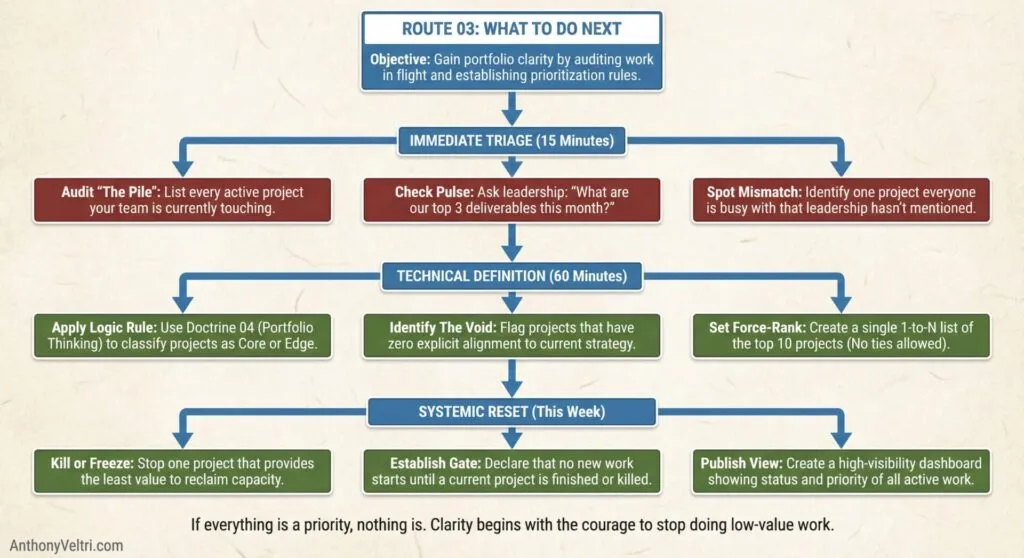
In the next 15 minutes:
- List every active project (including maintenance, “small stuff,” and work that “doesn’t count”)
- Mark each one: Strategic / Operational / Tactical
- Identify 3 projects where you can’t articulate the value or outcome
In the next 60 minutes:
- Create a one-page portfolio view showing all active work
- For each item: name, owner, status, value/outcome, estimated completion
- Share with one executive or decision-maker
- Ask: “Is this what you expected to see? What’s missing?”
This week:
- Establish a portfolio review cadence (monthly minimum)
- Create visibility mechanism that doesn’t require manual status requests
- Identify top 3 candidates for “what should we stop?”
- Document decision criteria for starting new work vs stopping current work
- Make portfolio status available to anyone who needs to make resource decisions
Optional: Send me 5 sentences
If you want targeted guidance for your specific situation, describe:
- How many active projects/initiatives do you have? (rough count)
- Who needs to see portfolio status? (roles, not names)
- What decisions would change with better visibility? (resource allocation, priority, stopping work)
- What constraints matter? (reporting requirements, tools, organizational structure)
- What would “good” look like? (desired visibility state)