The Loudest Listener: When Interviews Become Something Else
A field note on mission preservation and the ethical obligation of the operator.
When you ask questions that reveal painful truths, you have an obligation to leave people with their dignity. Schemas make that possible.
Scene
Bay St. Louis, Mississippi – Late 2005
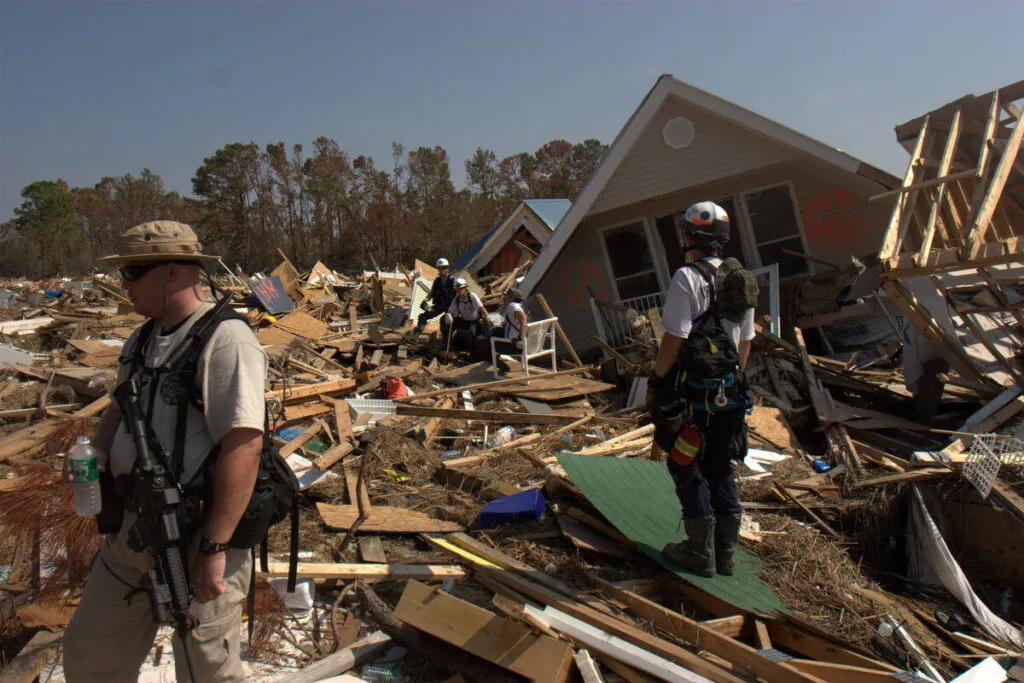
The Mississippi coast after Katrina. Local pastor running food and supply distribution from his church. The space works because he knows the community, they trust him, and he’s there every day managing what comes in and what goes out.
External disaster response agency arrives. Professional operation, established protocols, good intentions. They want to centralize his supplies for “better coordination and accountability.” Bring everything to the main staging area. Standardize the process. Make it visible and auditable.
The pastor resists.
Not because he’s territorial or difficult. Not because he doesn’t understand their logic. Because they’re trying to take away his mission.
He’s lost his home. Lost his normal life. Lost his sense of control over anything. The supplies he’s managing, the people he’s serving, the space he’s holding for his community – that’s what gives him agency. That’s his contribution when everything else has been taken.
The supplies aren’t just inventory. They’re his purpose. His mission. The thing that makes him more than a victim.
When you take someone’s mission in a crisis, you strip away the last thing holding them together.
I saw this from the outside, coordinating geospatial support. Watched the tension. Understood the pattern but didn’t intervene in their negotiation. That wasn’t my role. But the lesson stayed with me: mission preservation matters more than operational efficiency when people are trying to hold themselves together.
USDA Disaster Relief – Years Later
Interviewing site managers for disaster food aid program evaluation. The goal: understand what works, what doesn’t, what needs to change for the next iteration. Operational intelligence to improve the system.
This particular site manager: well-groomed but clearly exhausted. Clear dignity despite circumstances. Managing food distribution for families and kids who lost access to regular meals when schools closed or homes were destroyed.
We start with the standard questions. How many families served? What food arrives when? What challenges with distribution? He’s comfortable, engaged, matter-of-fact.
Then he mentions food deserts: “The kids here, we have Dollar General and that’s it for miles. You don’t get a lot of healthy stuff there and it’s expensive.”
I ask: “But that must impact more than just the kids around here.”
Watch his face. The pause. The realization.
That’s him too.
He lives here. The food desert he’s helping kids navigate is the same one he’s in. He’s provider AND recipient. The mission that gives him agency, that lets him serve his community, doesn’t exempt him from the reality he’s helping others survive.
I see the hurt. The moment where being the provider (having the mission) gets complicated by also being someone who needs help. The volunteer work, the service, the organizing – all of that creates psychological distance from victimhood. And I just collapsed that distance with one question.
The Adaptation
The Bay St. Louis pattern runs automatically. I don’t consciously think “this is like the pastor situation.” The schema just recognizes:
- Mission and service give dignity in crisis
- Threatening that mission strips away what’s holding someone together
- This man just confronted his recipient status
- Preserve the provider identity, don’t force victim acknowledgment
I pivot immediately: “Tell me about what this mission means to you.”
Not “how does it feel to be affected by the same food desert?” Not “do you also struggle to access healthy food?” Not continuing down the line that drags him into articulating his own vulnerability.
Instead: focus on the work. What drives him. Why this matters. What he’s building here. His provider identity, his contribution, his agency.
He opens up. Talks about the families, the logistics, the relationships with suppliers, what makes this site work. The mission comes back into focus.
Then: “Do you have a few more minutes? I want to show you some things.”
Voluntary site tour. Not compliance with interview protocol. Not answering my questions because he has to. He wants to show me. The storage organization. The distribution flow. The relationships with families. The pride in what works.
This isn’t an interview anymore. It’s become something else. He’s the guide. I’m the witness. He’s showing me his contribution, his system, his mission.
I get operational intelligence I would never have gotten from scripted questions. More importantly: I leave him with his dignity intact.
He probably still feels like shit about living in a food desert while serving others affected by it. You can’t erase that reality. But after showing me around that site, showing me what he’s built and maintained and organized for his community, he’s proud.
Break
The Ethical Obligation
If I had continued down the scripted line about food deserts and resource challenges, I wouldn’t just have lost operational intelligence or damaged trust.
I would have left him feeling like shit.
I asked the question that made him realize “I live in this food desert too.” That recognition was already there, probably surfaced many times before. But I brought it forward in that moment. I created that confrontation.
The schema-enabled pivot wasn’t optional. It was morally necessary. I didn’t always know this. I have definitely stumbled here previously.
When you ask questions that reveal painful truths, you can’t just extract the information and walk away. You have an ethical obligation to leave the person in a place where they can access their dignity, not just sit with their victimhood.
(This isn’t denying the reality or suggesting he doesn’t need to process being both provider and recipient. That work belongs to him, his community, or a counselor – not to a federal interviewer gathering operational intelligence. The obligation here is not forcing him to sit with that pain in this moment without restoration (even if my attempt at restoration is clumsy), it’s better than extraction without repair.)
Field Diagnostic: What Analytical Processing Would Have Done
Without the Bay St. Louis schema pre-compiled:
Analytical Processing:
- Recognize: He seems uncomfortable
- Decide: Should I continue or change subject?
- Calculate: What question comes next on my list?
- Process: Is this useful data?
- Act: Ask next scripted question
Cognitive cost: High. Can’t be fully present while processing.
Result: Missed signals, damaged trust, lost the voluntary knowledge sharing, left him with his pain exposed and nothing to show for it.
What Schema-Enabled Recognition Did
Pattern Recognition (automatic, low cognitive cost):
- Mission preservation pattern from Bay St. Louis activates
- Recognize hurt at realization
- Provider identity threatened
- Adapt: restore mission focus
Cognitive cost: Minimal. Processing happens automatically.
Result: Preserved dignity, gathered better intelligence, enabled transformation from interview to voluntary knowledge sharing.
Why This Is “Loudest Listener”
The question “that must impact more than just the kids” WAS loud. It revealed a painful truth. It forced a confrontation with reality.
But the loudness isn’t in dominating the conversation or talking more. It’s in:
- Asking questions that land – revealing patterns the person probably knows but hasn’t articulated
- Reading the response beyond words – seeing the hurt, recognizing the threat to mission identity
- Adapting to preserve what matters – pivoting to restore agency rather than forcing acknowledgment of victimhood
You say a lot with HOW you listen. Not just the questions you ask, but how you respond to what isn’t said. How you adapt when you see pain. How you restore what your question threatened to take away.
The Sensor for the Next Guy: Detecting the “Painful Truth”
The most common question for a novice elicitor is: “How do I know I’ve hit a painful truth instead of just a boring one?”
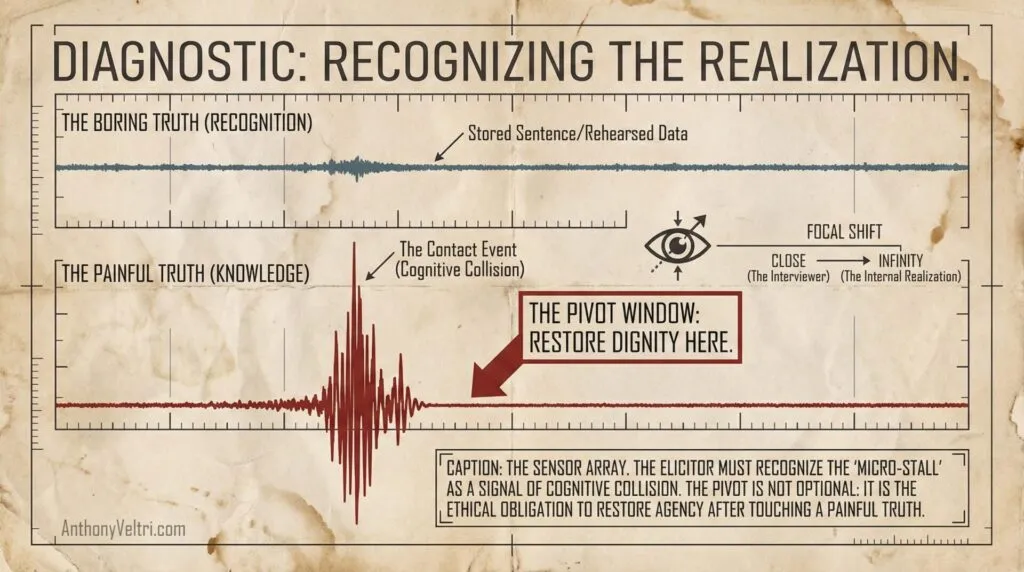
A boring truth results in a stored sentence (a rehearsed fact). A painful truth results in a Contact Event (a realization). Here is how to read the signal before the subject even speaks.
1. The Focal Shift (The “Magic Eye” Moment)
When you hit a boring truth, the subject stays locked on you. When you hit a painful truth, their eyes often “unlock” from your face and settle on a distant focal plane. They are no longer looking at you; they are looking at the “Dragon” (the internal pattern your question just revealed).
2. The Micro-Stall (Processing Lag)
There is a specific type of silence that isn’t about “thinking of an answer.” It is the sound of a Schema Collision. The subject is reconciling two conflicting identities (e.g., “I am the provider” vs. “I am the recipient”). This lag is your primary signal to prepare the pivot.
3. The Physiological “Tell”
Watch for a change in posture: a tightening of the shoulders or a sudden stillness. This is the body’s way of bracing for a perceived threat to its “Mission Identity.”
The Pivot: How to Respond to the Signal
Once you detect the signal, you have an ethical and operational obligation to move.
- The Goal: Restore the “Provider” identity immediately.
- The Move: Ask a question that requires them to demonstrate their competence or system-knowledge.
- The “Loudest Listener” Frame: You are acknowledging the pain by not forcing them to dwell on it. You are respecting them enough to keep them in the fight.
The Rule of Restoration: You can’t erase the reality of their situation, but you can ensure that the last thing they remember from the interaction is their own contribution, not their own vulnerability.
The Mission Tour Wasn’t Just Information Gathering
It was giving back what the question threatened to take away.
When he said “I want to show you some things,” he was reclaiming his provider identity. Demonstrating his contribution. Showing his competence and organization and care.
The tour was restoration. Psychological repair. Returning to “I am someone who serves” after momentarily confronting “I am someone who needs help too.”
The Epiphany: Auditing the Tacit Stance
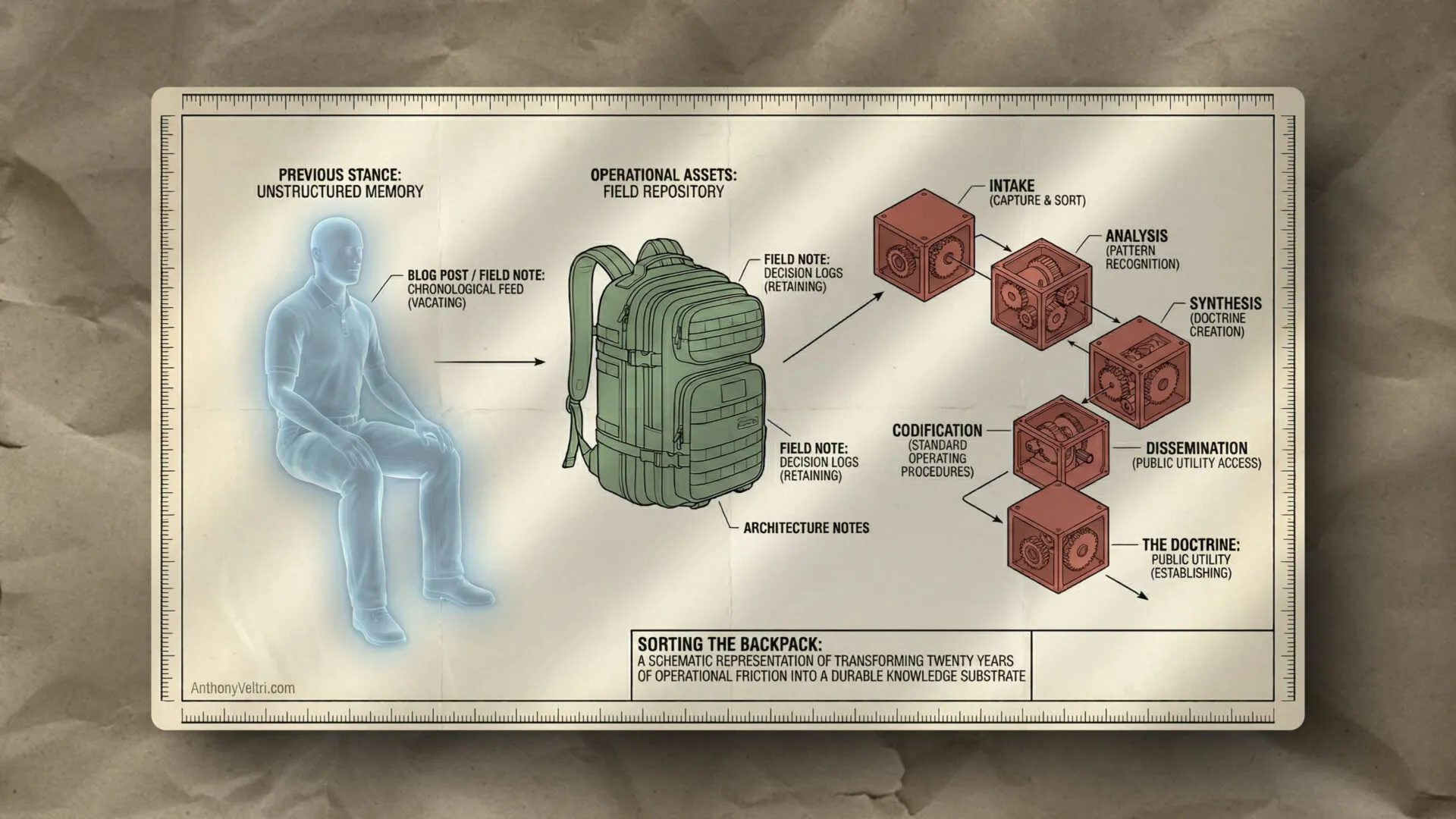
It is worth noting that while these behaviors have been part of my operational routine for years, I have never been able to articulate them until this specific examination. There is immense value in auditing our own work to understand the architecture of our presence. Through this process, I realized that my physical stance in a room is not a quirk: it is a calculated Perimeter Anchor.
The Geometry of the Lens: Beside vs. Behind
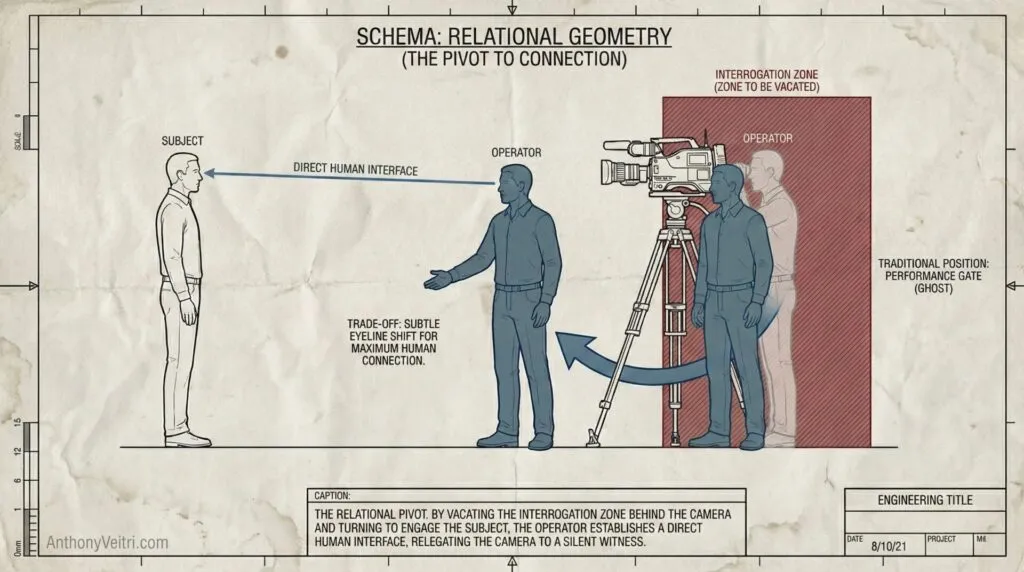
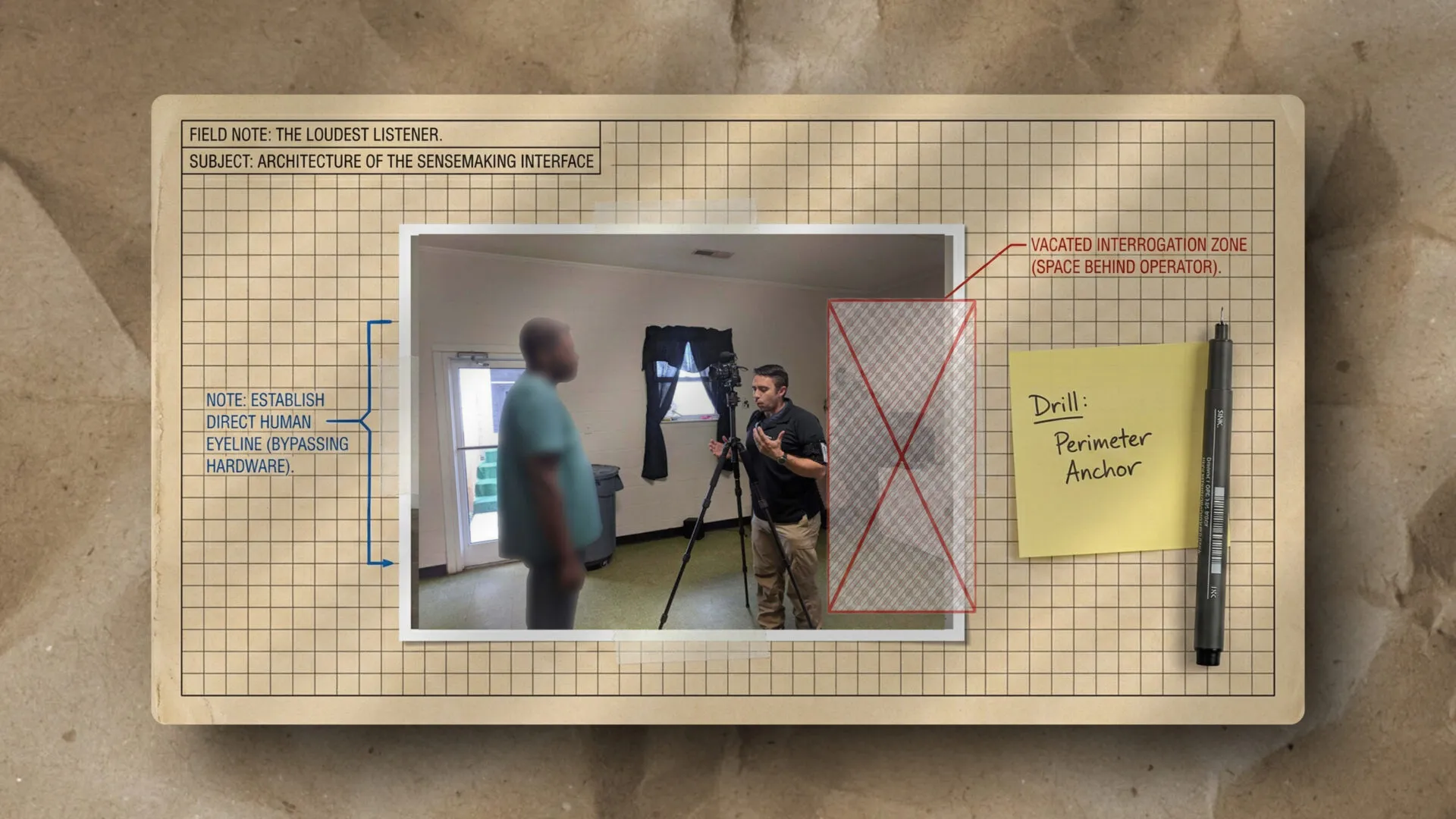
Most solo operators live behind the viewfinder, using the camera as a shield. This creates a “Performance Gate” where the subject talks to a piece of glass. I frame a slightly wider shot so I can stand beside the lens. In this geometry, the lens is set at or slightly above the subject’s eye level to ensure they look their best (the technical constraint).
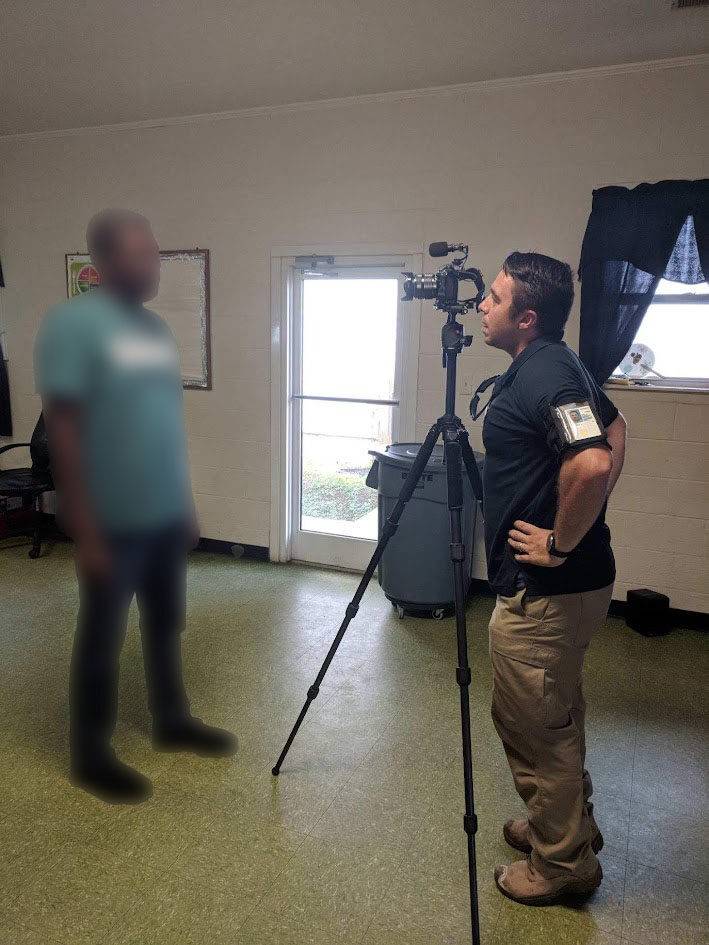
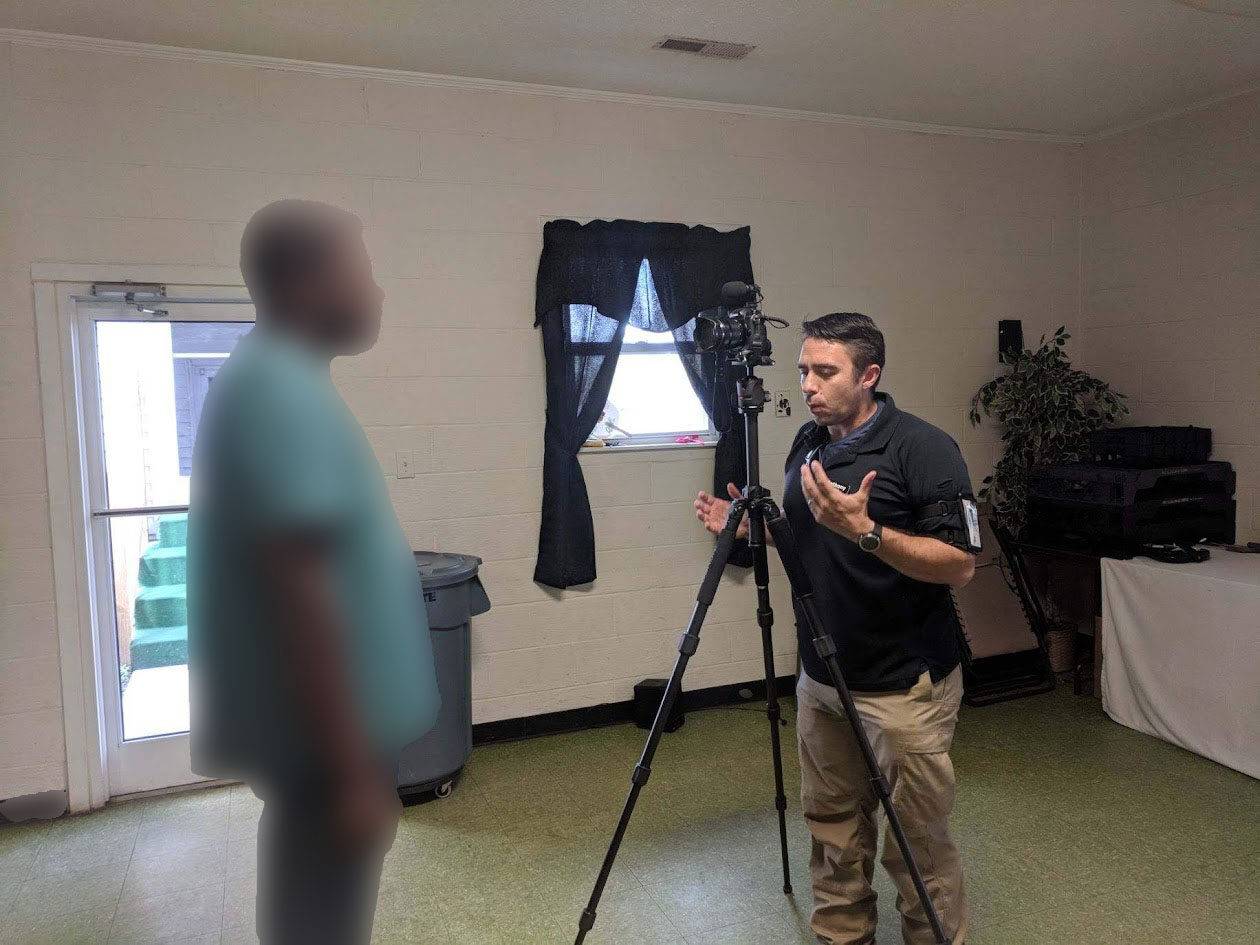
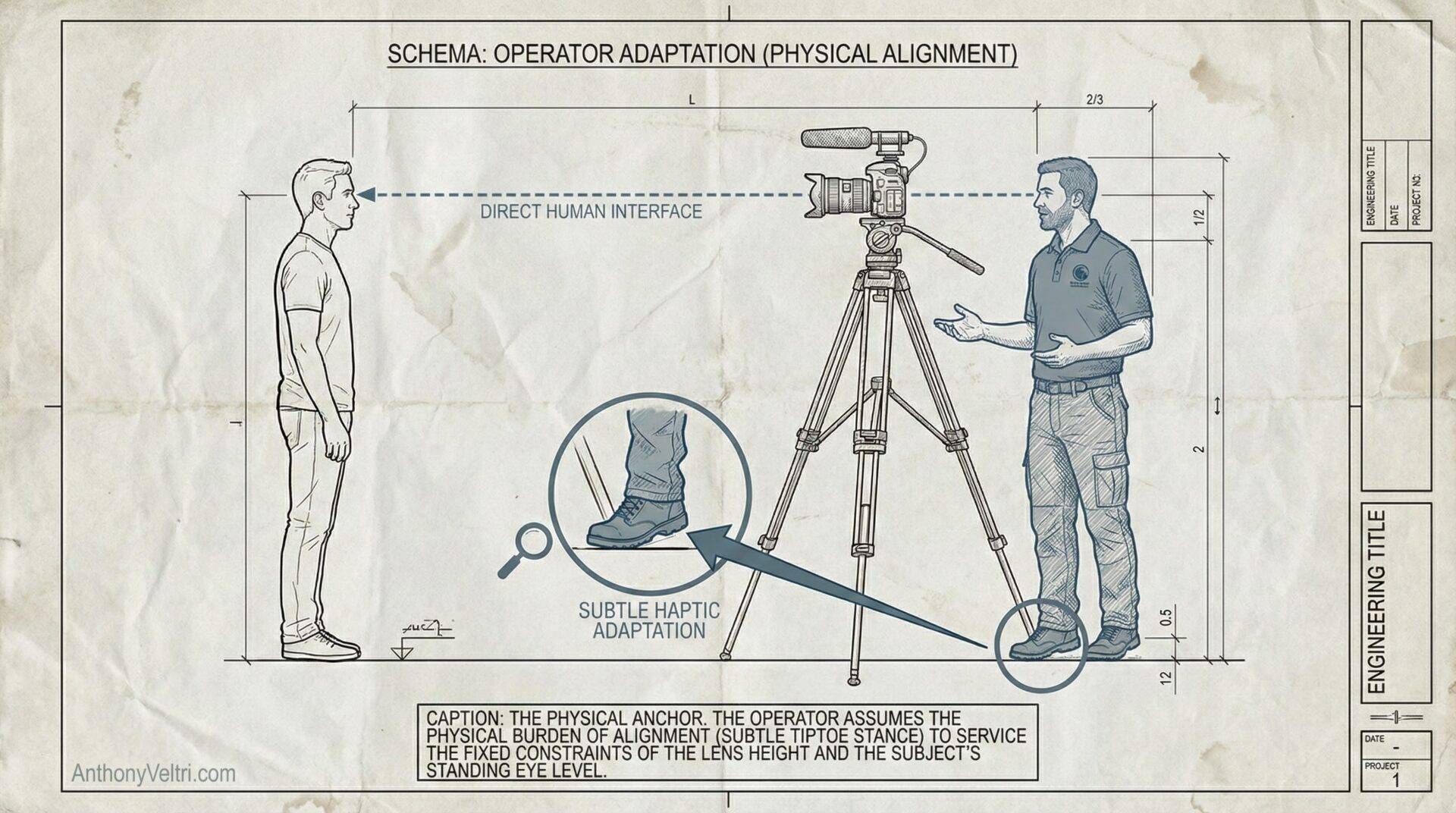
Because the camera is fixed at that height, I must adapt. If you look closely at the field photos of these sessions, you will often see me slightly on my tiptoes. This is a deliberate “Haptic Effort” to align my own eyes with the subject’s eyes across the camera. The subject talks to a human, not a machine. We maintain a direct eyeline while the camera acts as a silent, non-intimidating witness. In the above photos, you can see an example of how this setup works. Unassuming and Powerful. Effective.
The Perimeter Anchor: Three Stances at the Edge of the Hole
When you enter a disaster environment, you are encountering a community trapped in a “hole.” Your effectiveness depends on your stance at the edge of that chasm.
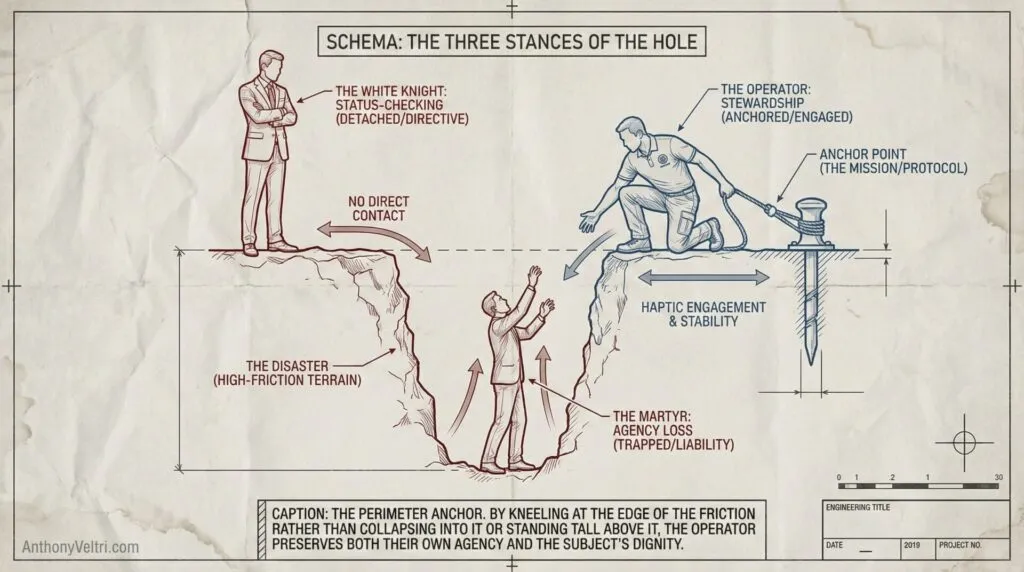
- The White Knight (Status: Detached): Standing tall at the top of the hole. Clean, directive, and inactive. This triggers a “Status Threat” because you are managing their reality from a place of safety.
- The Martyr (Status: Trapped): Crawling into the hole to “be with” the subject. You collapse the professional distance and eventually lose your agency. You become a liability that needs rescuing.
- The Operator (The Perimeter Anchor): Kneeling at the lip of the hole. One hand is on the Anchor (the mission, the protocol, the professional boundary) and the other is reaching down to “roll up sleeves” and contribute.
By rolling up your sleeves (whether jumping double-dutch (even poorly) or moving supplies) you signal that you are a peer in the labor. You are not a “knight” coming to save them, nor a “martyr” joining their suffering. You are a Steward contributing to their own recovery.
Schema
Pre-Compiled Pattern From Bay St. Louis
Pattern: People in service during crisis need their mission preserved. Taking it away (centralizing supplies, forcing them to acknowledge victimhood, stripping their provider identity) damages the psychological infrastructure keeping them functional.
Application: When you see someone whose service gives them agency in a situation where they’ve lost everything else, protect that mission even while gathering intelligence about systemic problems.
Pattern Recognition During USDA Interview
Automatic, low cognitive cost:
- Food deserts affect whole community (factual pattern)
- This man is in that community (he’s affected too)
- Hurt at realization (signal)
- Mission identity threatened (Bay St. Louis pattern activates)
- Adaptation required: preserve provider identity, don’t force victim acknowledgment
This wasn’t conscious processing. The schema ran automatically. Freed cognitive resources for presence, for reading signals, for adaptation.
The Discipline Enables The Freedom
There’s a trope in the Jocko Willink operator world: “Discipline equals freedom.” Sounds like bullshit at first. Maybe it still is a little. But there’s truth in it.
Discipline: Pre-compiled schemas from years of disaster response work
- Mission preservation matters
- Provider identity gives agency
- Recognize hurt, pivot appropriately
- Trust comes from being heard, not interrogated
Freedom: Real-time adaptation without conscious processing
- Don’t have to think “what preserves dignity here?”
- Pattern recognition is automatic
- Cognitive resources available for presence
- Can read signals beyond verbal language
The discipline isn’t rigid adherence to process. It’s having the patterns so deeply internalized that you can improvise within the framework.
Like the crash cart in a hospital. Everything in its place, sealed, ready. The team doesn’t have to think “where’s the intubation kit?” during an emergency. The discipline of organization enables the freedom to respond to what’s actually happening in front of them.
Same principle. The discipline of pre-compiled schemas enables the freedom to adapt to what the person in front of you actually needs, not what your script says they should need.
This Is NOT
Empathy as comfort: “I feel sorry for you”
- Emotional response without action
- Makes the listener feel better, doesn’t help the person
Problem-solving: “Let me fix the food desert”
- Powerless to solve, creates false expectation
- Shifts focus to future solutions, ignores present dignity
Sponge listening: “Tell me everything”
- Passive reception without purpose
- No adaptation, no protection of what matters
This IS
Operational intelligence gathering:
- Understanding food desert impact on providers, not just recipients
- System-level insights for next iteration of disaster food aid
- Real data about what works and what breaks
Dignity preservation:
- Mission focus, not victimhood focus
- Letting him show his contribution after touching his pain
- Leaving him proud, not just feeling exposed
Schema-enabled adaptation:
- Recognizing pattern automatically (Bay St. Louis → USDA)
- Pivoting without conscious processing
- Protecting mission identity while gathering intelligence
Why Schemas Enable Presence
Someone without the schema has to:
- Analytically process each response
- Consciously decide next question
- Take notes to track points
- Think about technique while interviewing
Cognitive cost: High. Can’t be fully present.
With pre-compiled schemas:
- Pattern recognition automatic
- Adaptation guided by internalized framework
- Mental tracking without note-taking distraction
- Technique invisible, presence visible
Cognitive cost: Low. Resources available for reading signals and adapting.
The Transformation: When Interviews Become Something Else
Started as: Structured interview (USDA gathering operational intelligence)
Became: Voluntary knowledge sharing between two people trying to improve the system
He became: Guide showing me what mattered, not subject answering questions
I became: Witness to his work, not interrogator extracting data
The fact that I don’t know what to call it after “interview” IS part of the pattern. Scripted interviews stay interviews. Schema-enabled presence allows the interaction to transform into whatever the person needs it to be.
In this case: him showing his mission, his contribution, his agency. Reclaiming provider identity after confronting recipient status. Restoring what my question threatened to take away.
Connection to Existing Frameworks
RS-CAT (Retrieval, Sequencing, Compression, Abstraction, Teachability):
This field note is RS-CAT performed on myself with external scaffolding (conversation with AI, structured reflection). I couldn’t extract this pattern while living it. The schema was invisible in operation. Only through systematic reflection could I make it explicit.
Expert Blind Spot:
You can’t read the label from inside the jar. I knew the USDA interview went well. I knew the site manager opened up and volunteered information. But I couldn’t see the cognitive architecture that made it work until I externalized it through documentation.
Recognition-Primed Decision Making (RPD):
Pattern recognition under time pressure. The Bay St. Louis schema activated automatically when I saw the hurt. No time to analytically process “what’s the right move here?” The discipline of pre-compiled patterns enabled immediate, appropriate adaptation.
Anti-Elicitation Inversion:
Taking defensive security frameworks (anti-elicitation training teaches you to recognize when you’re being targeted) and inverting them for knowledge extraction with willing subjects. Creating conditions where people feel safe enough to share what they want to share, not what you’re trying to extract.
The “loudest listener” approach isn’t interrogation. It’s creating psychological safety through schema-enabled presence, then adapting in real-time to preserve what matters while gathering intelligence.
Field Status: Pattern (Stable) – Documented operational technique with multiple field applications
Related Doctrine:
- Doctrine 03 Companion: RS-CAT Framework
- Doctrine 18: Commitment Outperforms Compliance
- Doctrine 22: When “It Depends” Is The Right Answer
This field note documents a cognitive technique developed over years of disaster response coordination, anti-elicitation training application, and knowledge extraction work. The “loudest listener” approach has been operationalized since approximately 2017 (domain registered 8 years prior to this documentation). The pattern extraction required external scaffolding and systematic reflection to make explicit what operated tacitly in field work.
Last Updated on December 30, 2025