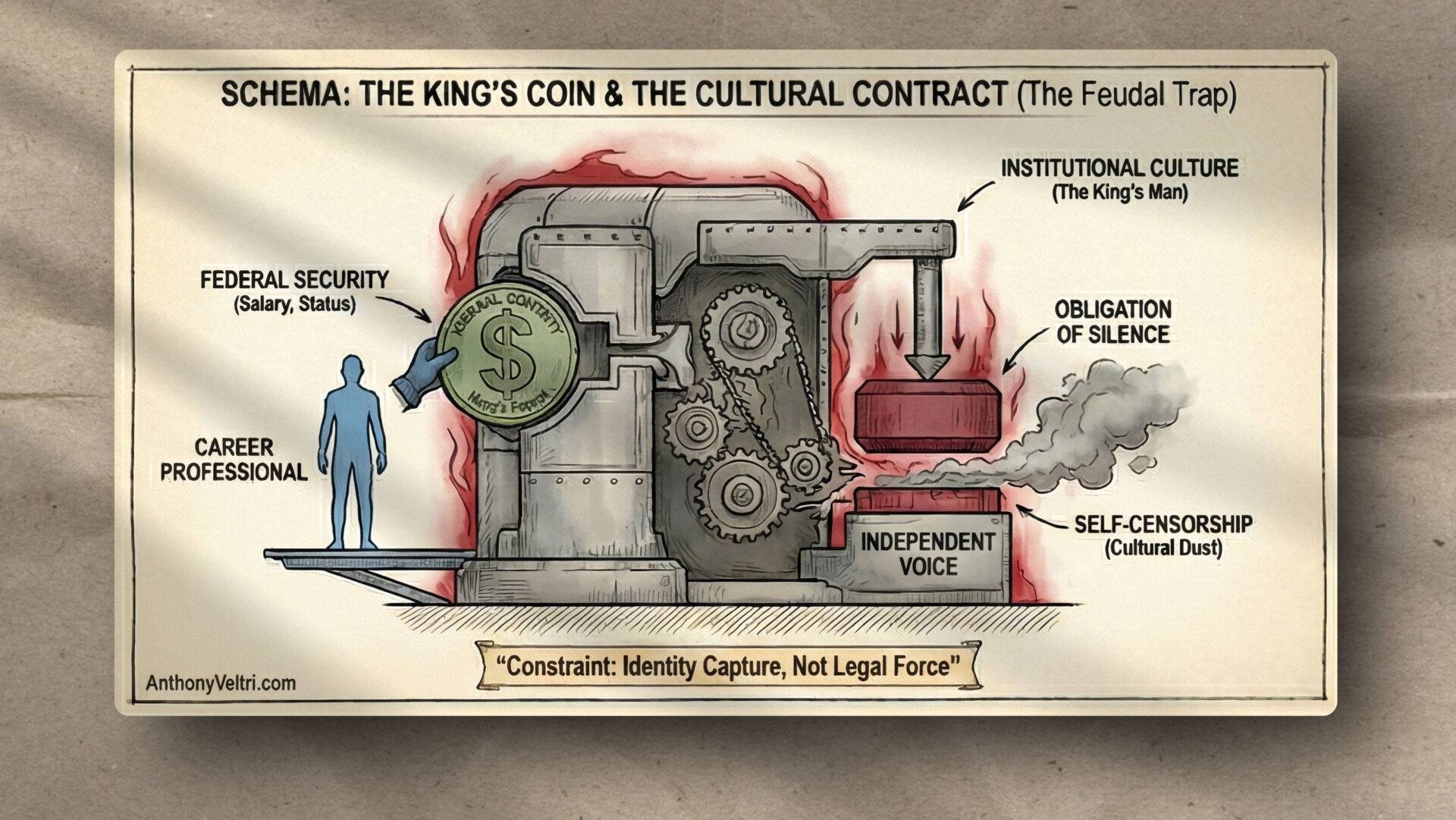
The Lysine Contingency: How the Internet Stopped Being Meritocratic (And Which Game You’re Actually Playing Now)
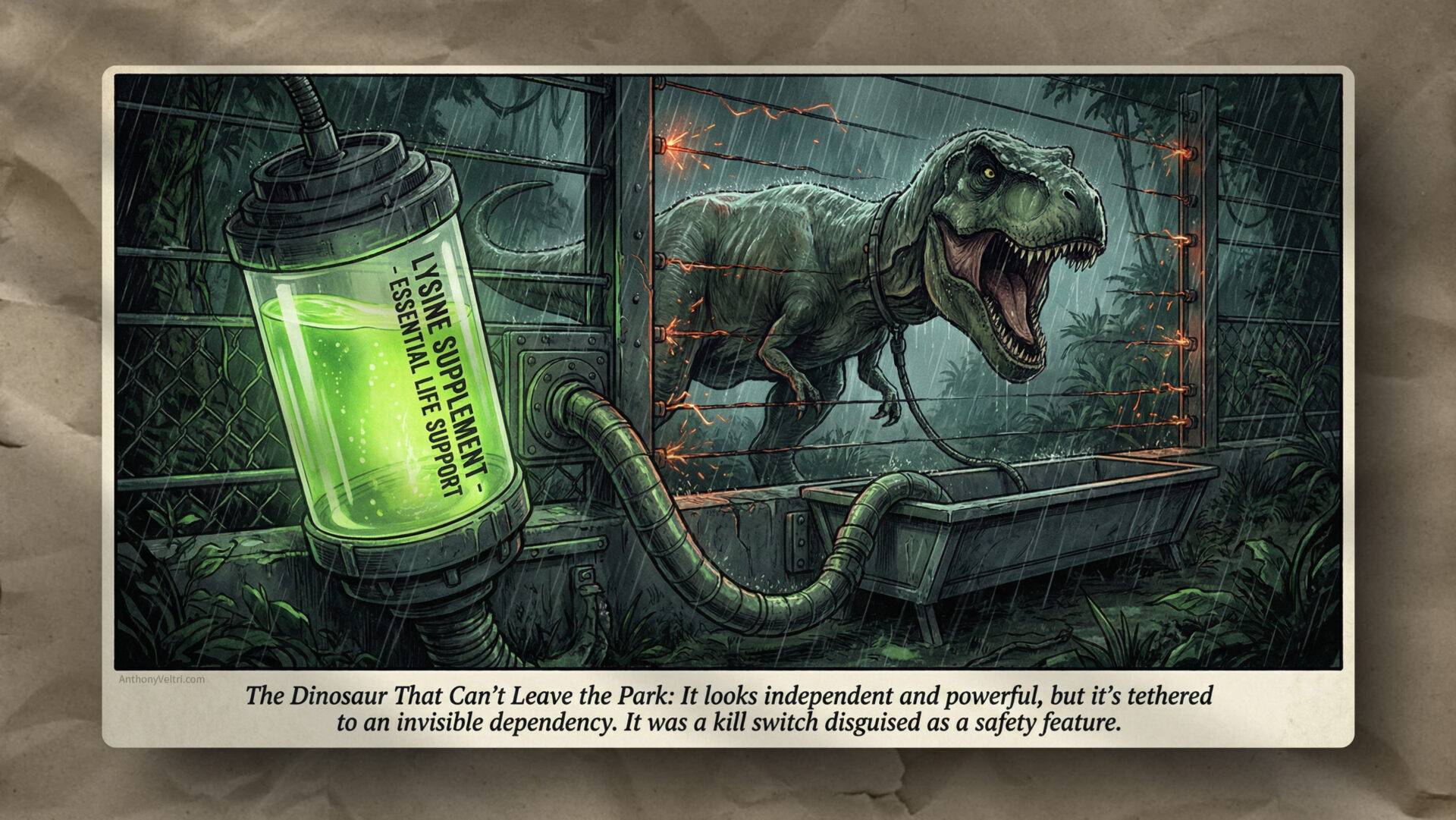
Scene: The Dinosaur That Cannot Leave the Park
In the film Jurassic Park, the dinosaurs were engineered with a lysine contingency. They could not produce lysine naturally; the park supplied it through their food. This created an invisible dependency: the dinosaurs appeared independent and powerful, but they could not survive outside the park’s controlled ecosystem. A kill switch disguised as a safety feature.
The modern internet is a lysine contingency. But it wasn’t always that way.
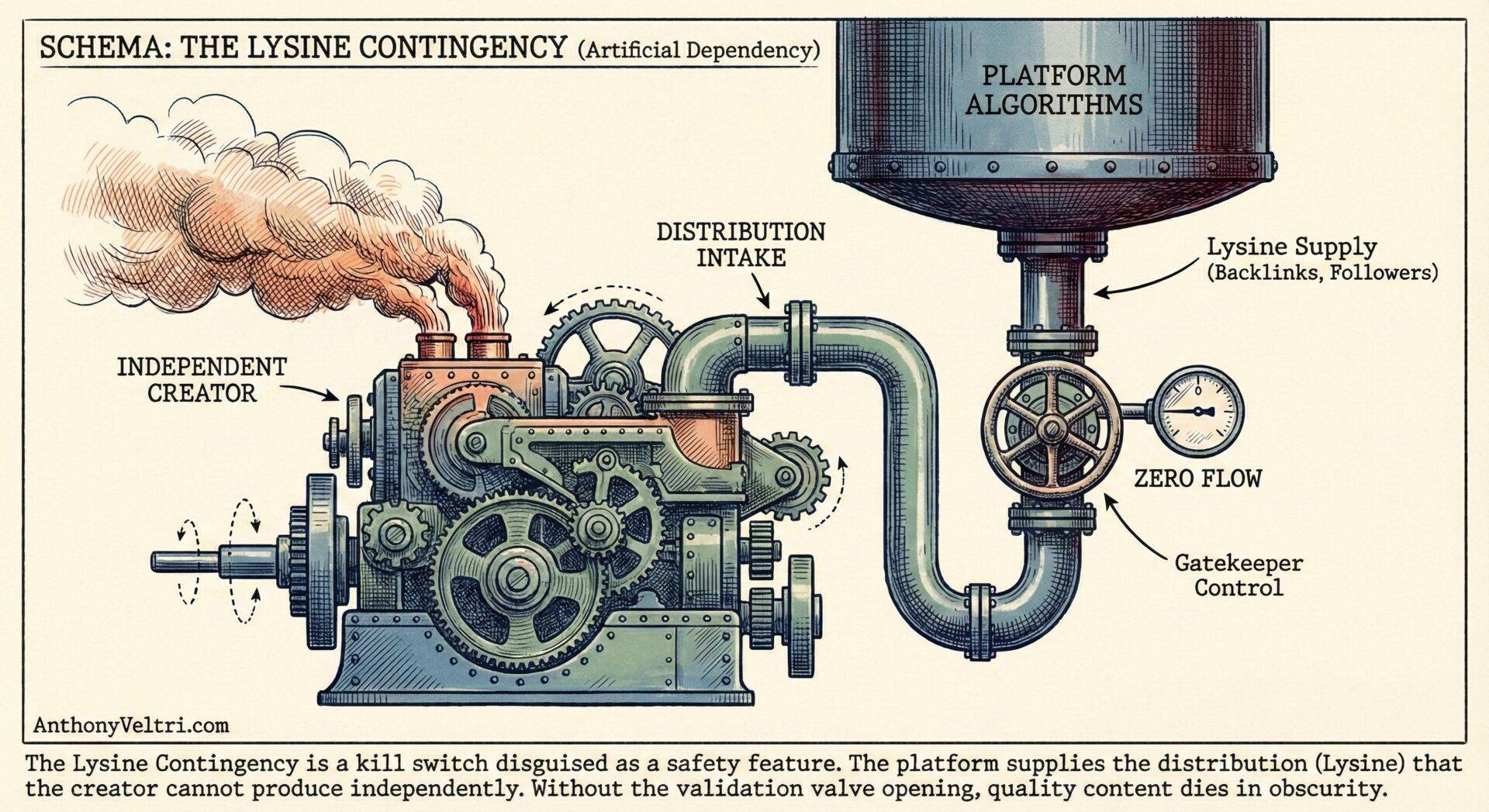
You can build something real; you can do excellent work; you can publish it openly; and it can still die outside the park unless you receive the required supplements.
Those supplements have names now: backlinks, followers, engagement, “authority,” verification badges, platform favor.
Quality is still necessary. It is just no longer sufficient for discovery.
Scene: 1999 vs 2025 (I Ran the Experiment Twice)
In 1999, I started an online climbing gear store called Bouldering Gear.
I had:
- Zero audience
- Zero credentials in the outdoor industry
- No “made man” status in the climbing community
I created useful content: gear reviews, product comparisons, and (for the time) amazingly fast shipping. People found it. The business worked.
Discovery was straightforward:
- Post on rec.climbing or other local bouldering formus (newenglandbouldering.com) and climbers saw it (chronological visibility).
- Google indexed and ranked the site for “bouldering gear.”
- Climbers linked to useful content, which created more visibility.
- RSS readers delivered updates directly to subscribers.
I did not need to be popular first. The system rewarded creating value.
Twenty-six years later, in 2025, I launched anthonyveltri.com. I have owned the domain for over a decade; it sat as a placeholder through various phases of my federal career. After leaving federal service (and no longer being the king’s man), I finally developed it properly.
I published:
- 25+ doctrine volumes documenting 20 years of federal disaster response, enterprise architecture, and coalition coordination
- 60+ field notes
- 500+ diagrams
- Structured frameworks for federation architecture, coordination without authority, and interface stewardship
I was not building it for Google. I was documenting for myself first; systematizing 20 years of operational lessons so I could think clearly. Then I realized: this should be shared. Other people face these same coordination failures. This knowledge should not die with me.
So I made it public. The site is fast, structured, mobile-responsive, and cross-referenced.
After 83 days: it does not show up in the first 16 pages of Google results for “Anthony Veltri.”
Not page 2. Not page 5. Page 16+.
My reaction was not “I made a strategic mistake.”
My reaction was: what the f*&#?
You can publish comprehensive operational frameworks for free, under your own name, on a domain you have owned for years, and modern discovery mechanisms can still shrug. “meh”
That is not a failure of effort. That is a different game.
I should clarify something: I did not disappear from the internet between Bouldering Gear and anthonyveltri.com. From roughly 2006 through 2025 I was active the whole time, helping other people with their sites and their marketing systems. Usually I came in midstream: someone already had momentum, some baseline word-of-mouth, some existing audience. I would show up to solve a thorny technical or positioning problem and then, more often than not, I would stay and help on a more permanent basis.
So I knew the usual distribution levers. I knew backlinks are powerful. I knew that guest posts, interviews, podcasts, and conference proceedings can manufacture discovery signals. None of that was new.
What was new was the cold start. I had not started something from scratch since 1999.
In 1999, starting from scratch was not a death sentence. If your content was useful, the system could still surface it: forums were chronological, search was more relevance-forward, links happened because people actually encountered your work.
In 2025, I ran into the inversion. I did not realize how complete the dependency had become until I tried to publish a comprehensive body of work with no pre-existing distribution network behind it. The shock was not “backlinks help.” The shock was “a life’s work can be functionally inert without them.”
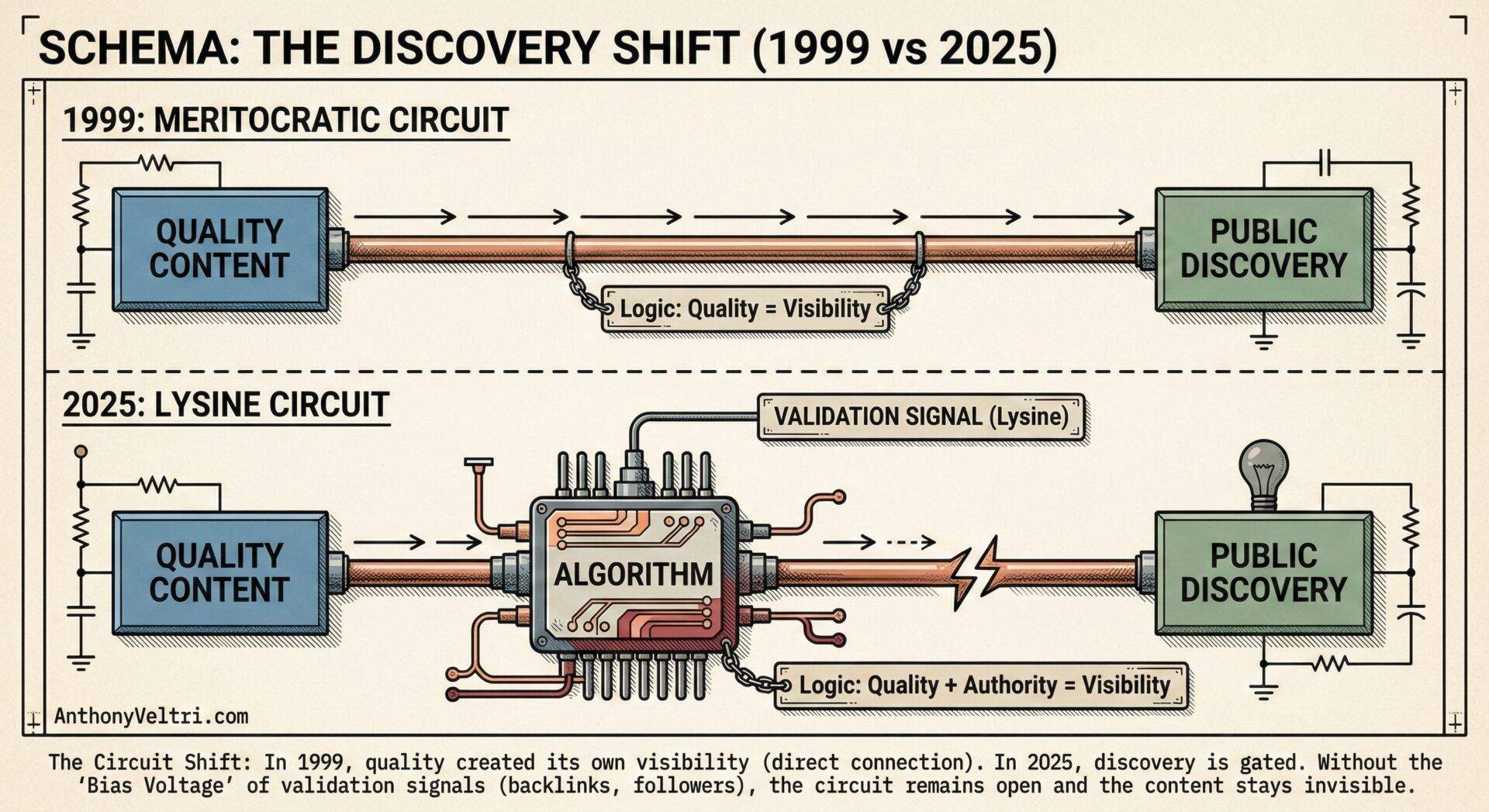
Break: The Shift (From Meritocracy to Lysine Contingency)
In the older internet, discovery had more meritocratic properties:
- Useful content could be found through search and forums.
- Newcomers could earn visibility through relevance and contribution.
- Chronological channels made “unknown” still visible.
Today, discovery is structurally gated:
- Search rewards authority signals; not just relevance.
- Social feeds reward engagement history; not just quality.
- People cannot link to what they never encounter.
- RSS is not “dead,” but it is niche; platforms are the default distribution layer now.
This creates a cold-start trap:
- You need visibility to earn backlinks and followers.
- You need backlinks and followers to get visibility.
That is the lysine contingency: you can survive inside the park, but you cannot live outside it without supplements.
Steelman: Why This Happened (And Why It Still Breaks Things)
The best argument for authority signals is not stupid. It is rational.
Platforms were forced into it because:
- Search and feeds got gamed: link farms, spam, manipulation, low-quality content at scale.
- Users wanted fewer garbage results and more trustworthy sources.
- Platforms wanted to reduce risk: scams, misinformation, malware, reputational harm.
So the system started privileging “trust proxies”: backlinks, brand signals, institutional sources, historical engagement.
That problem is real.
The failure is the side effect: the trust proxies became the gate. When authority signals dominate discovery, you filter out new voices even when they are correct, useful, and operating in good faith.
Spam was the justification. Structural gatekeeping became the outcome.
No smoke-filled room required. Incentives selected for dependency.
Proof: The Gordon Graham Video (The Tail End of the Merit Window)
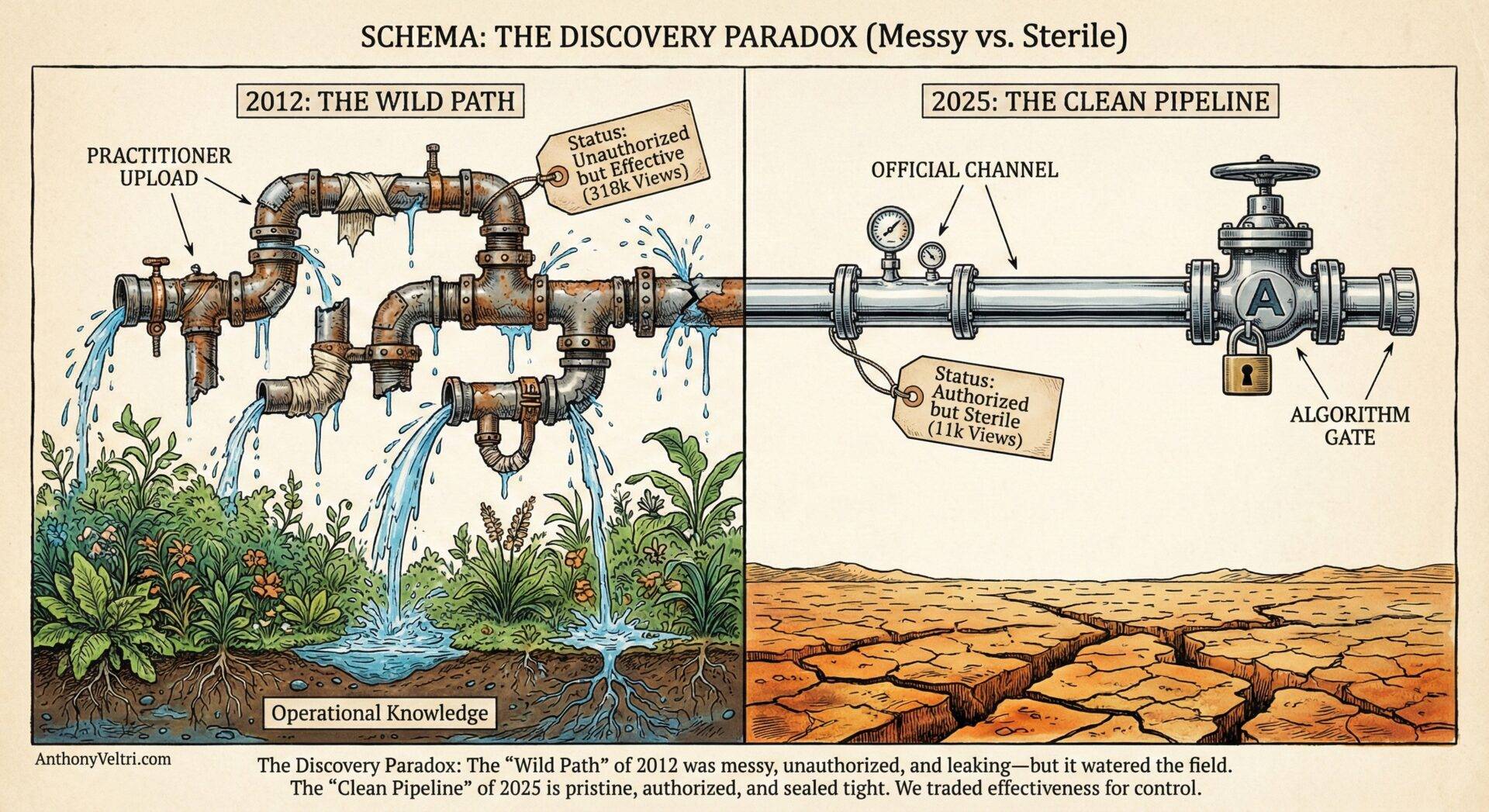
My first introduction to Recognition-Primed Decision Making (RPDM), the framework underlying much of my coordination work, came from a YouTube video uploaded by a wildland firefighter in 2012.
It was a recorded training session featuring Gordon Graham. Some practitioner, not an official spokesperson, uploaded it with a simple comment along the lines of: “This helped me while training; every company officer should watch.”
That practitioner upload: 318,581 views.

Other copies of the same video: view counts in the low thousands. Official channels: far lower than the practitioner version.
Not every example will produce a neat ratio; your mileage will vary. The point is the pattern:
At that time, democratized sharing could still outperform institutional distribution.
And personally: without that upload, I likely would not know RPDM. I was not in the “proper channels.” I was searching for operational answers; I found a practitioner breadcrumb; I followed it into the literature; and that thread became part of my life’s work.
That is what we are losing when discovery becomes “authority-first.”
Context note (2012 distribution reality)
In 2012, there was no clean, obvious “official Gordon Graham channel (or corporate equivalent)” to point to. This was not a sanctioned release. It was almost certainly a practitioner upload: someone recording a training session or capturing a copy and putting it on YouTube because it helped them and they thought it would help others. That original video is most likely not authortized in a rights and distribution sense, and I am not endorsing that behavior.
The point is still the point: the operational knowledge reached the field because a practitioner could publish and the platform could surface it without prior authority signals. That discovery path was messy, informal, and wildly effective. Today, the default is the opposite: platforms and institutions have cleaner official pipelines, but cold-start discovery for practitioners is far less likely to break through without algorithmic validation.
Note on “Made Man”
When I say “made man,” I am not making a moral accusation.
I mean: algorithmically validated.
You have the required authority signals (backlinks, followers, engagement history, credentials, institutional association) that platforms use as permissioning before amplification.
It is a structural position.
Schema: How the Lysine Contingency Was Installed (Four Phases)
This did not happen overnight. It arrived in layers. Also: the supplement rules keep changing, which prevents independence.
Phase 1: Search Hardens (roughly 2005–2010)
What changed:
- SEO gaming forced Google to privilege authority signals.
- New sites increasingly needed validation from established sites.
Lysine added: backlinks and “authority” become prerequisites for ranking.
Phase 2: Feeds Stop Being Chronological (roughly 2010–2015)
What changed:
- Algorithmic feeds replace “everyone is visible.”
- Engagement history becomes a gate.
Lysine added: you need an existing audience to reach a new audience.
Phase 3: Platform Consolidation (roughly 2015–2020)
What changed:
- Distribution centralizes into a few platforms.
- Platforms penalize outbound links and prefer native content.
Lysine added: your audience relationship becomes rented, not owned.
Phase 4: Re-Centralization Tightens (roughly 2020–2025)
What changed:
- “Authoritative sources” become default winners.
- New voices face stronger cold-start suppression.
- Features that enabled independence get removed.
Lysine added: continuous dependency; visibility requires ongoing platform compliance.
One small example of shifting supplement rules:
- Amazon Author Central used to allow external links and richer outbound identity.
- Now external links and even domain mentions can be rejected.
The supplier changes the formula. You never “graduate” from dependency.
Schema: Recognizing Which Game You Are Playing
The critical skill is not “how to game the system.”
It is: which system am I in?
Meritocratic systems (signals)
- Quality improves outcomes in a direct feedback loop.
- Newcomers can surface through contribution.
- Discovery is closer to relevance and recency.
- Independence is possible.
Some places where this still partially exists: smaller niche communities, certain open-source dynamics, direct email lists you control.
Lysine systems (signals)
- Prior approval is required (authority signals first).
- Quality is necessary but not sufficient.
- Discovery is gated by algorithms and incumbency.
- Dependency is enforced; rules shift over time.
A quick test
- Publish excellent work.
- Do the basics correctly.
- Wait for organic discovery.
If quality alone cannot produce discovery, you are in a lysine system. Do not keep running a meritocracy strategy.
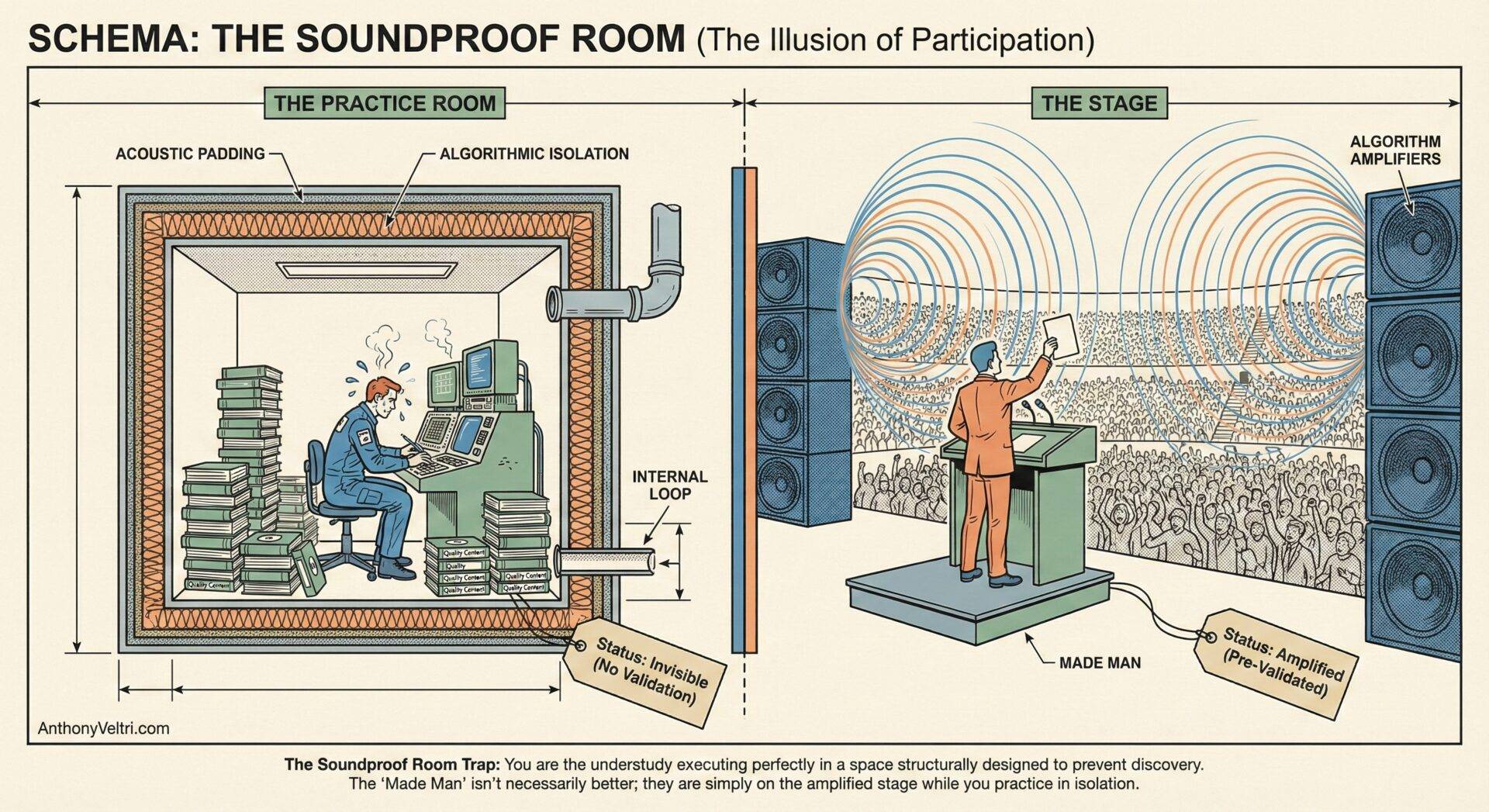
Scene: The Understudy Trap (Secondary Metaphor, because as my family would say “why do you give so many examples?”)
This is where people get fooled.
You practice the role. You get better. You do everything “right.” The improvement is real, so it feels like progress toward being seen.
But the room is soundproof.
The performance is on the stage; the microphones and lights are controlled by the algorithm.
You do not get onto the stage by being good in the room. You get onto the stage by acquiring the signals that the stage manager uses as permission.
That is the trap: genuine craft improvement paired with structural invisibility.
Break: “This Doesn’t Apply to Me” (Yes It Does)
If you create anything online, you have already felt this:
- LinkedIn: thoughtful post; a few likes from people who already know you; near-zero reach beyond that circle.
- X: clean thread; minimal distribution unless you already have audience.
- Medium: solid article; low discovery unless published through an established publication and boosted.
- Portfolio site: beautiful work; no organic traffic without backlinks.
- GitHub: excellent repo; little visibility without social distribution or existing network effects.
Same cold-start loop; different wrapper.
What To Do About It (Without Pretending You Can Go Back to 1999)
If you are in a lysine system, treat authority signals as infrastructure, not as validation of your worth.
1) Manufacture discovery inputs on purpose
- Get cited: guest posts, interviews, podcasts, newsletters, conference proceedings.
- Borrow distribution: publish where an audience already exists (then point back home).
- Build a small set of real relationships with people who already have visibility in your niche; comments and collaborations can outperform “posting into the void.”
2) Separate storage from distribution
- Platforms are for reach.
- Your domain is for permanence.
- Your email list is for direct contact.
Do not confuse “published” with “discoverable.”
3) Decide where merit still exists, then invest there
Find the pockets where contribution can still surface without incumbency dominance; participate there while they still work.
The Stewardship Response (What I Am Actually Doing)
This is not nostalgia. It is adaptation.
I am treating authority signals as required supplements, while keeping the permanent repository independent:
- Use platforms for distribution and backlinks (discovery inputs).
- Keep the canonical, complete system on anthonyveltri.com (permanent asset).
- Build validation pathways that do not require me to distort the work; they just allow the work to be found.
Not because the frameworks need help being “better.”
Because the gate requires proof that I am already worth listening to before it will surface the work.
That is the lysine contingency.
Conclusion: Recognize the Game; Then Play the Real One
The meritocratic discovery dynamics that made Bouldering Gear viable in 1999 are not the default anymore.
Authority signals are not purely evil; they are a response to real abuse. The steelman case is valid.
But the side effect does make me nostalgic: we have decoupled quality from discovery.
Which means:
- Valid solutions can remain invisible.
- New voices can be filtered out before they are heard.
- Operational expertise can still die, even when practitioners publish it openly.
If you think you are in meritocracy when you are actually in a lysine system, you can execute perfectly and still fail.
Recognize the game first. Then build the supplements intentionally. And keep your permanent repository outside the park, because the suppliers will keep changing the formula.
Related: “Who Are You to Speak?” (the internal silencing mechanisms: cultural gatekeeping, legal confusion, organizational centralization) that pair with this external one: algorithmic gatekeeping.
Last Updated on February 22, 2026