What this route does in 10 minutes
You’ll understand why forcing compliance fails with sovereign partners, identify how to build commitment through trust rather than mandate, and know how to structure partnerships that work without central authority.
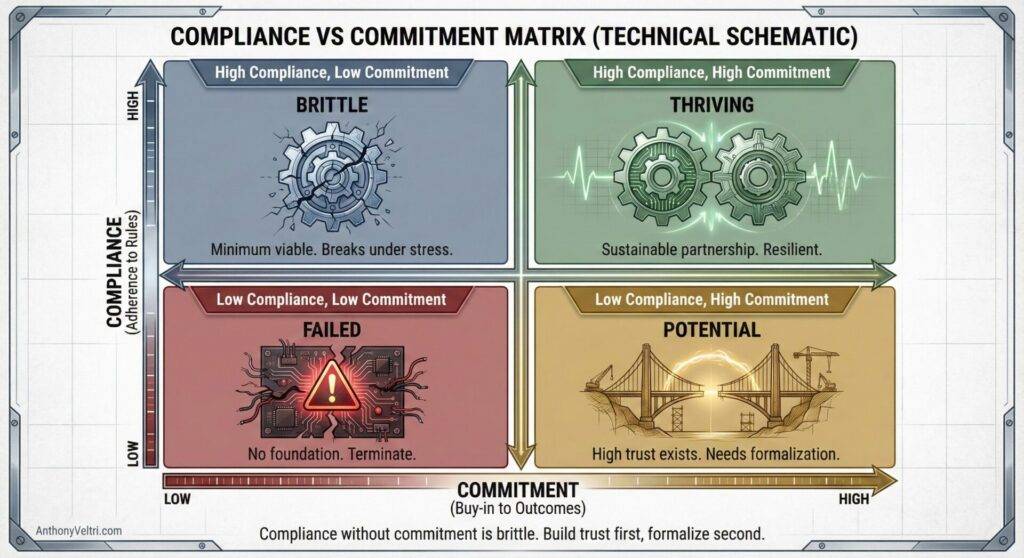
Start here: Three fast questions
Before you dive in, orient yourself:
- Who are the partners? External organizations, agencies, or entities with their own authority?
- Can you mandate changes? Do you have authority to require compliance, or must you negotiate?
- When did trust form? Did relationships exist before the crisis, or are you building them now?
If you’re working with external partners you cannot control, you’re in the right route.
Quick diagnostic

You are probably in this route if:
- Partners are external organizations with their own governance
- You cannot mandate technical or process changes
- Partners have sovereignty (agencies, companies, nations)
- Compliance mechanisms don’t work or create resentment
- Trust is missing or still being built
- Coordination requires negotiation, not command
- You hear “we can’t force them to…”
- Staging areas or crisis moments reveal coordination gaps
You are probably NOT in this route if:
- Partners are internal teams you control (try Route 07 for internal culture)
- The problem is interface ownership, not sovereignty (try Route 01)
- You have authority but decisions are stalled (try Route 02)
- Partners have commitment but you need visibility (try Route 03)
Doctrine and Annex anchors
These pieces define the principles and provide the models:
Doctrine 18: Commitment Outperforms Compliance in High Trust, High Tempo Environments Why forcing compliance with sovereign partners creates resentment and brittleness, and how commitment emerges from trust and shared mission.
ANNEX A. Human Contracts Framework for building explicit agreements between partners who don’t share command authority, using trust and negotiation instead of mandate.
Doctrine 02: Distributed Decisions Increase Alignment, Speed, and Resilience How to enable partners to make aligned decisions without requiring central approval for everything.
Field Notes that show the failure mode in the wild
These cases show what happens when you try to force compliance and what works instead:
Field Note: Bay St. Louis: Trust Before Logos After Hurricane Katrina Case study of a pastor refusing management by a relief organization because trust wasn’t established before the crisis. Shows why mandate fails with sovereign partners.
Field Note: When You Cannot Force Compliance: iCAV, Hurricane Katrina, And Lessons In Federation How DHS infrastructure protection systems worked with 200+ partners who each had sovereignty, and why federation beats forced integration.
Field Note: Disaster Response Staging Areas Are The Wrong Time To Start Trust Why you cannot build trust during crisis if relationships don’t exist beforehand, and how wildland fire agencies pre-establish trust.
Choose your situation
Pick the scenario that most closely matches your context:
Scenario A: Crisis reveals missing trust
Signals:
- Disaster, incident, or emergency exposes coordination gaps
- Partners who should work together don’t
- No pre-established relationships or agreements
- Attempting to impose structure meets resistance
- “We don’t have time to build relationships” (but that’s the problem)
Start with:
- Field Note: “Disaster Response Staging Areas” (see the timing problem)
- Field Note: “Bay St. Louis” (see sovereignty clash)
- Doctrine 18 (understand why mandate fails)
Scenario B: Partners resist central authority
Signals:
- External partners have their own governance
- They view mandates as overreach
- Compliance creates resentment, not cooperation
- “You can’t tell us what to do”
- Coordination happens through negotiation, not command
Start with:
- Doctrine 18 (commitment over compliance)
- ANNEX A (negotiated agreements)
- Field Note: “Cannot Force Compliance” (federation with 200+ partners)
Scenario C: Need coordination without authority
Signals:
- Multiple agencies, organizations, or companies
- No single entity has authority over others
- Coordination must be voluntary
- Shared mission but separate governance
- Federation is necessary, not optional
Start with:
- Field Note: “Cannot Force Compliance” (federation patterns)
- ANNEX A (explicit agreements)
- Doctrine 02 (distributed decision-making)
Scenario D: Building trust before the crisis
Signals:
- You have time to build relationships now
- Want to avoid staging area failures
- Need to establish trust before it’s needed
- Wildland fire / disaster response / coalition environments
Start with:
- Field Note: “Disaster Response Staging Areas” (timing is critical)
- ANNEX A (pre-establish agreements)
- Doctrine 18 (build commitment infrastructure)
Scenario E: Not sure which scenario fits
Start with:
- Doctrine 18 (core principle)
- Field Note: “Bay St. Louis” (sovereignty clash in action)
- Field Note: “Cannot Force Compliance” (federation patterns)
- ANNEX A (agreement frameworks)
- Field Note: “Staging Areas” (timing problem)
Recommended default path
If you’re unsure which scenario fits, follow this sequence:
- Doctrine 18: Commitment Outperforms Compliance (5 minutes) Understand why forcing compliance fails with sovereign partners.
- ANNEX A. Human Contracts (10 minutes) Framework for building agreements without central authority.
- Doctrine 02: Distributed Decisions (5 minutes) Enable partners to make aligned decisions without approval.
- Field Note: Bay St. Louis: Trust Before Logos (5 minutes) See sovereignty clash in disaster response.
- Field Note: Staging Areas Are The Wrong Time (5 minutes) Understand why trust must exist before crisis.
Total time: 30 minutes from forced compliance to voluntary commitment.
What to do next
In the next 15 minutes:
- List your external partners (organizations you don’t control)
- For each one, ask: “Do we have pre-established trust and agreements?”
- Identify which partnerships are strongest and which are most fragile
In the next 60 minutes:
- Pick the most critical partnership
- Document: What do we need from them? What do they need from us?
- Draft a one-page human contract using ANNEX A framework
- Identify trust-building opportunities before the next crisis
This week:
- Establish pre-crisis relationships with key partners
- Schedule tabletop exercises or coordination meetings
- Create explicit agreements about roles, responsibilities, escalation
- Stop trying to mandate what you should negotiate
- Build commitment infrastructure through shared mission and trust
Optional: Send me 5 sentences
If you want targeted guidance for your specific situation, describe:
- Who are the partners? (agencies, companies, organizations)
- What authority do you have? (mandate, negotiate, request)
- What’s at stake? (mission, safety, resources, reputation)
- What constraints matter? (sovereignty, politics, budget, timeline)
- What would “working” look like? (desired coordination state)