What this route does in 10 minutes
You’ll understand why governance without stewardship creates hollow compliance, identify where commitment is missing despite process adherence, and know how to build ownership culture that goes beyond checkboxes.
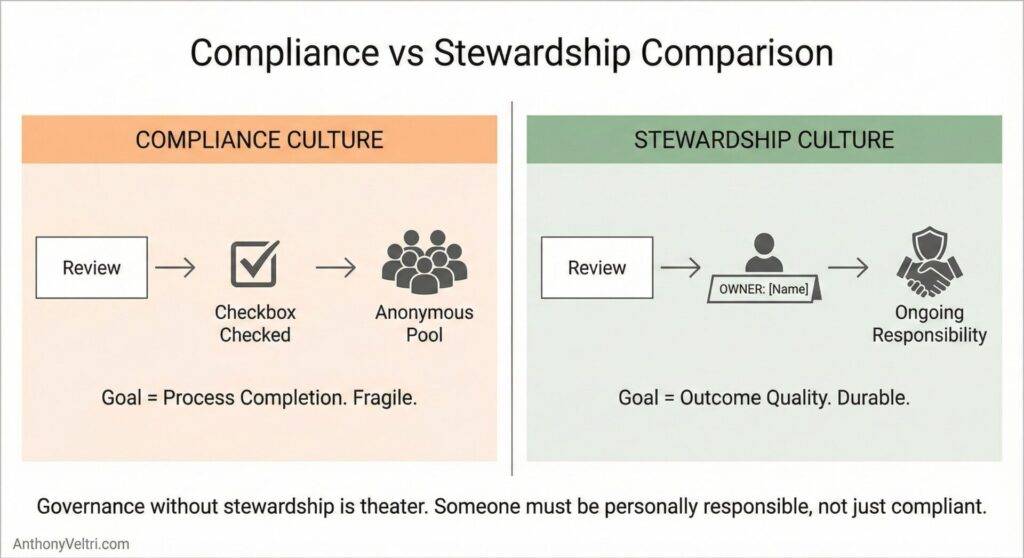
Start here: Three fast questions
Before you dive in, orient yourself:
- Are processes followed? Do people comply with procedures but without actual ownership?
- Is output declining? Does everything look fine on paper but quality is degrading?
- Do people care? Can you see pride in work, or just “good enough to pass inspection”?
If you have compliance without commitment, you’re in the right route.
Quick diagnostic
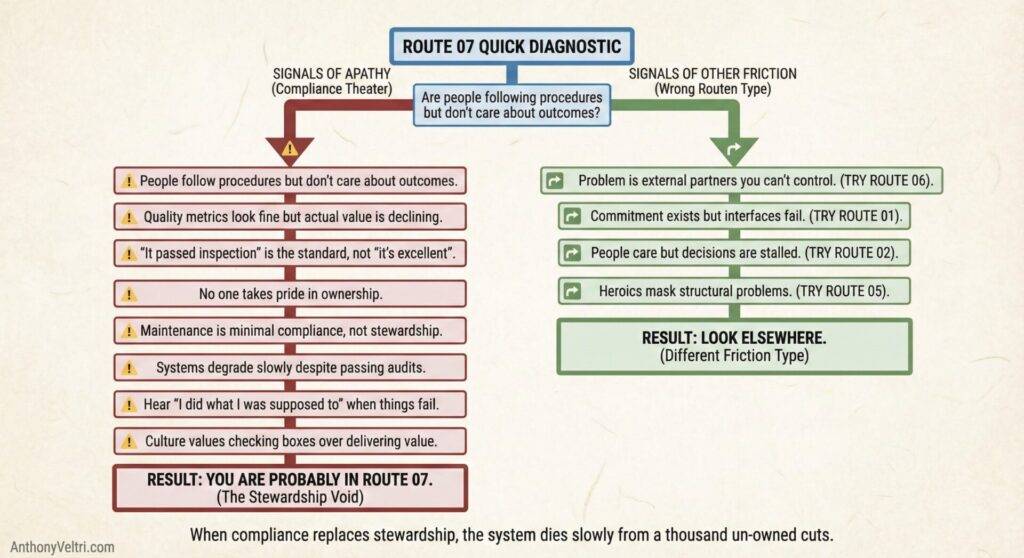
You are probably in this route if:
- People follow procedures but don’t care about outcomes
- Quality metrics look fine but actual value is declining
- “It passed inspection” is the standard, not “it’s excellent”
- No one takes pride in ownership
- Maintenance is minimal compliance, not stewardship
- Systems degrade slowly despite passing audits
- You hear “I did what I was supposed to” when things fail
- Culture values checking boxes over delivering value
You are probably NOT in this route if:
- Problem is external partners you can’t control (try Route 06)
- Commitment exists but interfaces fail (try Route 01)
- People care but decisions are stalled (try Route 02)
- Heroics mask structural problems (try Route 05)
Doctrine and Annex anchors
These pieces define the principles and provide the models:
Doctrine 18: Commitment Outperforms Compliance in High Trust, High Tempo Environments Why compliance without commitment creates hollow governance, and how to build cultures where people own outcomes, not just follow procedures.
ANNEX G. Leadership Doctrine Framework for building leadership cultures that emphasize stewardship and ownership over mere compliance.
ANNEX H. Architecture Doctrine How architectural decisions signal values, and why technical choices either enable or discourage commitment.
Field Notes that show the failure mode in the wild
These cases show what compliance without commitment looks like and how stewardship changes outcomes:
Field Note: Hoover Dam Lessons: “Proudly Maintained By Mike E.” Story of a maintenance worker at Hoover Dam who signed his name to his work, showing what pride in stewardship looks like versus hollow compliance.
Field Note: Proudly Maintained: Why Systems Need A Nameplate Why attaching names to work creates accountability and ownership that compliance frameworks cannot achieve.
Field Note: Commitment Over Compliance: How Technical Teams Actually Deliver Case studies showing how teams with commitment deliver value beyond what compliance measures capture, and what happens when compliance becomes the goal.
Choose your situation
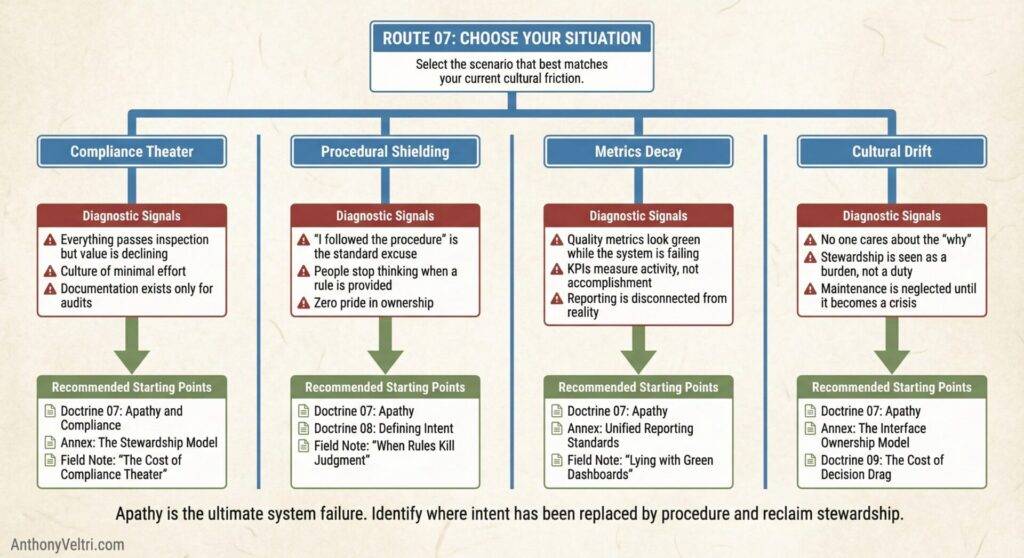
Pick the scenario that most closely matches your context:
Scenario A: Process compliance, declining outcomes
Signals:
- All procedures are followed
- Audits pass
- But quality is declining
- Customer satisfaction dropping
- Systems degrading slowly
- “We’re compliant” doesn’t mean “we’re good”
Start with:
- Doctrine 18 (understand the gap)
- Field Note: “Hoover Dam Lessons” (see stewardship in action)
- ANNEX G (leadership framework for building commitment)
Scenario B: No pride in ownership
Signals:
- Nobody signs their name to work
- “It’s not my problem” culture
- Minimum viable effort to pass inspection
- No one goes beyond requirements
- Team used to care but doesn’t anymore
Start with:
- Field Note: “Why Systems Need A Nameplate” (ownership through attribution)
- Field Note: “Hoover Dam Lessons” (pride example)
- Doctrine 18 (commitment culture)
Scenario C: Governance without stewardship
Signals:
- Extensive policies and procedures
- Compliance teams and audits
- But outcomes don’t improve
- Process is the goal, not value
- Box-checking culture dominates
Start with:
- Doctrine 18 (governance vs stewardship)
- ANNEX G (leadership that builds commitment)
- Field Note: “Commitment Over Compliance” (see the difference in practice)
Scenario D: Technical debt accumulates despite process
Signals:
- Code reviews happen but quality declines
- Testing exists but bugs increase
- Documentation exists but is useless
- Everyone follows process but system rots
- “We did everything right” but outcomes are wrong
Start with:
- ANNEX H (architecture signals values)
- Doctrine 18 (process vs ownership)
- Field Note: “Commitment Over Compliance” (technical teams with commitment)
Scenario E: Not sure which scenario fits
Start with:
- Doctrine 18 (core principle)
- Field Note: “Hoover Dam Lessons” (stewardship example)
- Field Note: “Why Systems Need A Nameplate” (ownership infrastructure)
- ANNEX G (leadership framework)
- Field Note: “Commitment Over Compliance” (technical teams)
Recommended default path
If you’re unsure which scenario fits, follow this sequence:
- Doctrine 18: Commitment Outperforms Compliance (5 minutes) Understand why compliance without commitment creates hollow governance.
- ANNEX G. Leadership Doctrine (10 minutes) Framework for building cultures that emphasize stewardship over compliance.
- ANNEX H. Architecture Doctrine (10 minutes) How technical decisions signal values and enable commitment.
- Field Note: Hoover Dam Lessons (5 minutes) See what pride in stewardship looks like in practice.
- Field Note: Why Systems Need A Nameplate (5 minutes) Understand how attribution creates accountability.
Total time: 35 minutes from hollow compliance to genuine stewardship.
What to do next
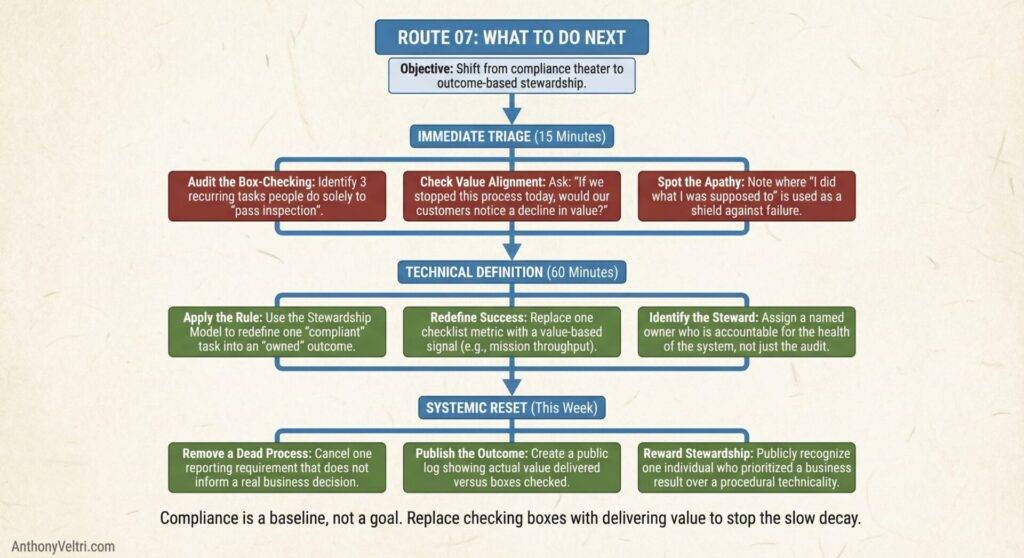
In the next 15 minutes:
- List your top 5 systems or processes where compliance exists
- For each one, ask: “Do people care about outcomes, or just passing inspection?”
- Identify where commitment is weakest despite compliance
In the next 60 minutes:
- Pick the highest-value system with missing commitment
- Diagnose: Why don’t people care? (leadership? culture? incentives?)
- Identify one small change that could signal ownership matters
- Draft a one-page plan for building commitment culture
This week:
- Create visible attribution for work (nameplates, signatures, ownership)
- Stop measuring only compliance, start measuring outcomes
- Recognize and celebrate stewardship, not just box-checking
- Remove barriers that prevent people from taking pride in work
- Build leadership practices that emphasize values over procedures
Optional: Send me 5 sentences
If you want targeted guidance for your specific situation, describe:
- What system or process has compliance? (what people follow)
- What outcomes are declining? (despite compliance)
- Why don’t people care? (leadership, culture, incentives)
- What constraints matter? (organization, politics, budget)
- What would “commitment” look like? (desired culture state)