Field Note: The Carthage Error (When Patience Becomes a Liability)
Why this note exists During periods of major institutional reorganization, aggressive corporate integrations, or prolonged structural shifts, I often observe a specific pattern among highly experienced professionals. What I notice is not panic. It is patience. Careful, disciplined patience. People doing exactly what had worked for them for twenty years. And I frequently find myself thinking that this is precisely the problem.
This is a note about what happens when experienced people apply the right strategy to the wrong clock.
Note: I first encountered this account while listening to Dan Carlin’s “Hardcore History” Punic Nightmares series, which came out in late 2008. I was driving between Forest Service district offices at the time, the kind of travel that was routine in that role. I filed it away without a clear application. The current moment provided one.
Scene: Carthage, 149 BCE Carthage did not want war. That is the part that gets lost.
By 149 BCE, Carthage had already lost two catastrophic wars against Rome. It had paid reparations for decades. When Rome began making demands again, the Carthaginian Senate chose compliance. Not because they were naive, but because compliance had worked before. The constraint system had ultimately held. Running the clock out was a viable strategy, and they had survived by using it.
Rome’s first demand, as Appian records it in the Punic Wars, was 300 children from the noblest families to be held as hostages. The Senate promised that if Carthage complied, its autonomy would be preserved. Carthage complied.
The second demand was all weapons and war engines. Armor for 200,000 men. Two thousand catapults. Carthage complied again. The assurances were repeated. Each concession was painful. Each was survivable. Each was accompanied by language that made the next request sound like the last one.
Then came the third demand: abandon the city of Carthage entirely and relocate inland. Rome would raze the city. The autonomy that had been promised applied to a people without a city, without weapons, and without leverage.
The compliance was not irrational at any individual step. At each moment, the Senate was making a defensible decision under genuine uncertainty. What they were doing, without recognizing it, was treating a ratchet as if it were a constraint. They kept waiting for the system to reassert. It did not. By the time the shape of the situation became fully visible, Carthage had already lost the capacity it needed to navigate it.
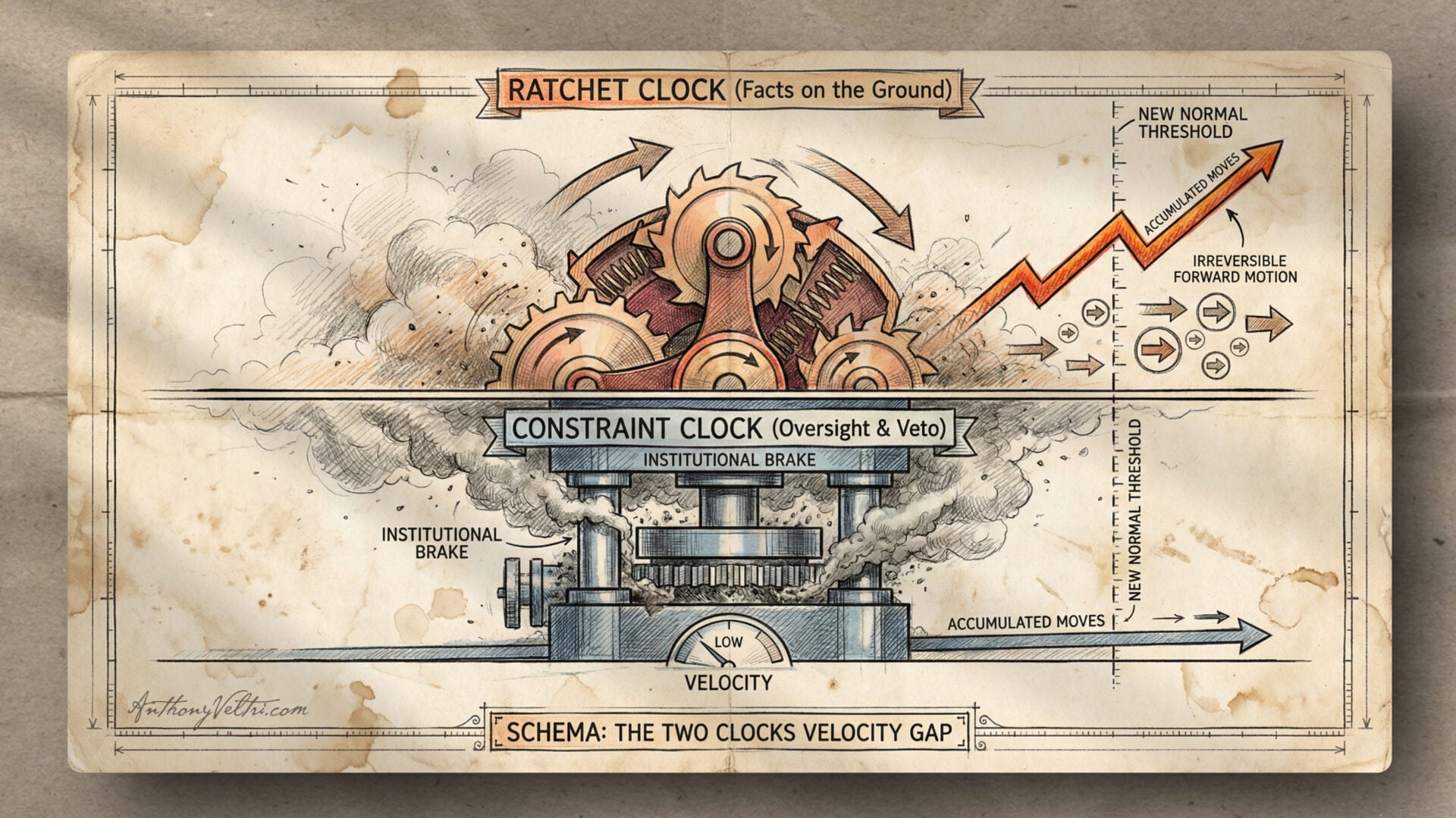
Break: The Clock Mismatch I laid out the Two Clocks model in detail in Field Note: Loosely Coupled Power Grabs, so I will not rebuild it here. The short version is this: a constraint clock is a system where veto players, oversight mechanisms, and institutional friction can impose real cost and reversal on actors who move too fast. A ratchet clock is a system where action creates facts on the ground faster than constraint mechanisms can respond, and those facts are difficult to reverse once established.
In a constraint-clock environment, patience is a legitimate strategy. Waiting preserves options. Time allows the system to correct. Running the clock out works.
In a ratchet-clock environment, the same strategy produces a different result. Each compliance cycle does not buy stability. It produces a new baseline from which the next demand is made. The ratchet moves in one direction.
The Carthage error is not weakness. It is a model mismatch. Experienced people who have survived constraint-clock environments are often specifically poorly positioned to recognize a ratchet clock, because the early signals look nearly identical. A new directive arrives (the “new guidance”). It is framed as urgent and final. You comply. The situation stabilizes temporarily. That is how constraint clocks work too. The difference only becomes visible in the pattern over time, and by then the loss of leverage is already underway.
Break: The Institutional Instance Most mature careers inside large, stable organizations operate under constraint clocks. This is not an accident. Massive enterprises are designed with overlapping oversight and slow budget cycles precisely to make unilateral action difficult.
The practical result is that seasoned professionals learn, correctly, that patience is often the right strategy. Bad initiatives exhaust their sponsors. Market pressures shift. Leadership changes. A reorganization that looks catastrophic in year one sometimes looks very different in year three. Running the clock out is a calibrated read on how a mature system actually functions.
However, when an organization shifts into a phase of rapid, unregulated restructuring, the environment often converts into a ratchet clock. The observable indicators include: action that moves faster than oversight can respond, compliance that creates new baselines rather than restoring stability, and constraint mechanisms that exist on paper but are not functioning as governors.
Navigating this requires forecasting whether the system is experiencing a temporary fluctuation or a structural ratchet. Making that forecast consciously is far safer than waiting for clarity that may not arrive in a recognizable form.
Break: What Diminishing Leverage Looks Like The three losses that accumulate during sequential compliance in a ratchet environment are capacity, confidence, and options. They interact, and they are easy to undercount while they are happening.
Capacity is the most visible: positions eliminated, institutional knowledge retired, relationships with partner organizations that atrophy. Capacity loss is measurable after the fact and nearly invisible during the process, because the people who remain cover for what has been removed and the work continues for a time.
Confidence is subtler. It is the internal erosion of the sense that staying is still rational, that the skills and judgment you have developed still apply to the environment. People in prolonged, chaotic reorganizations often describe this as fog. They are right that the environment has shifted in ways that make historical competence feel unreliable as a guide. That feeling is information.
Options are the most time-sensitive. The external market does not wait. Contacts go cold. Momentum dissipates. The energy required to build something new is finite and regenerates slowly. Every month of waiting inside a ratchet-clock environment is a month not spent building the option set that waiting is supposed to preserve.
These three losses interact badly. Reduced capacity increases the pressure on the people who remain, which accelerates confidence loss, which narrows the psychological bandwidth available for option-building. It is difficult to watch highly competent people lose their footing this way.
By the time the terminal condition becomes visible, the professional has less operational flexibility than they had a year ago. That is the Carthage clock problem in its operational form.
Schema
Pattern Statement Applying a constraint-clock strategy to a ratchet-clock environment produces a sequential loss of leverage. Each step is individually survivable and accompanied by assurances of stability, but the cumulative effect is the loss of capacity, confidence, and options.
Diagnostic Questions
- What capacity has been lost since the first change arrived, measured in knowledge, relationships, and institutional function?
- Is the next concession being requested before the previous one has produced the stability that was promised?
- Are your external options narrowing while you wait for internal clarity?
- Is the constraint system functioning as a governor or as a record-keeper?
- At what point does patience stop being a strategy and start being a structural condition?
Heuristics / Core Maxims
- The compliance was rational at every individual step. The loss of leverage was invisible until it was complete.
- Experienced constraint-clock survivors are often the last to recognize a ratchet clock, because the early signals look identical.
- Waiting does not preserve options in a ratchet-clock environment. It borrows against them.
Last Updated on April 4, 2026