The Five Stewardship Layers #
Why the right intervention at the wrong layer still fails
A stewardship system can appear healthy while failing at the layer that matters most. The diagnostic question is not whether stewardship exists, but which layer is protected, which layer is exposed, and who is named as responsible.
Stewardship is often treated as one responsibility: keep the site funded, keep the data online, keep the archive intact, keep the science visible. But these are not the same obligation.
A long-term evidence system can fail at several different layers. The operator can leave. The archive can lose its interpretive chain. The governing documents can omit stewardship duties. The law can provide no continuity requirement. The evidence can reach publication but never reach decision.
Each of these failures requires a different intervention. The most common institutional mistake is applying the right intervention at the wrong layer and counting it as a solution.
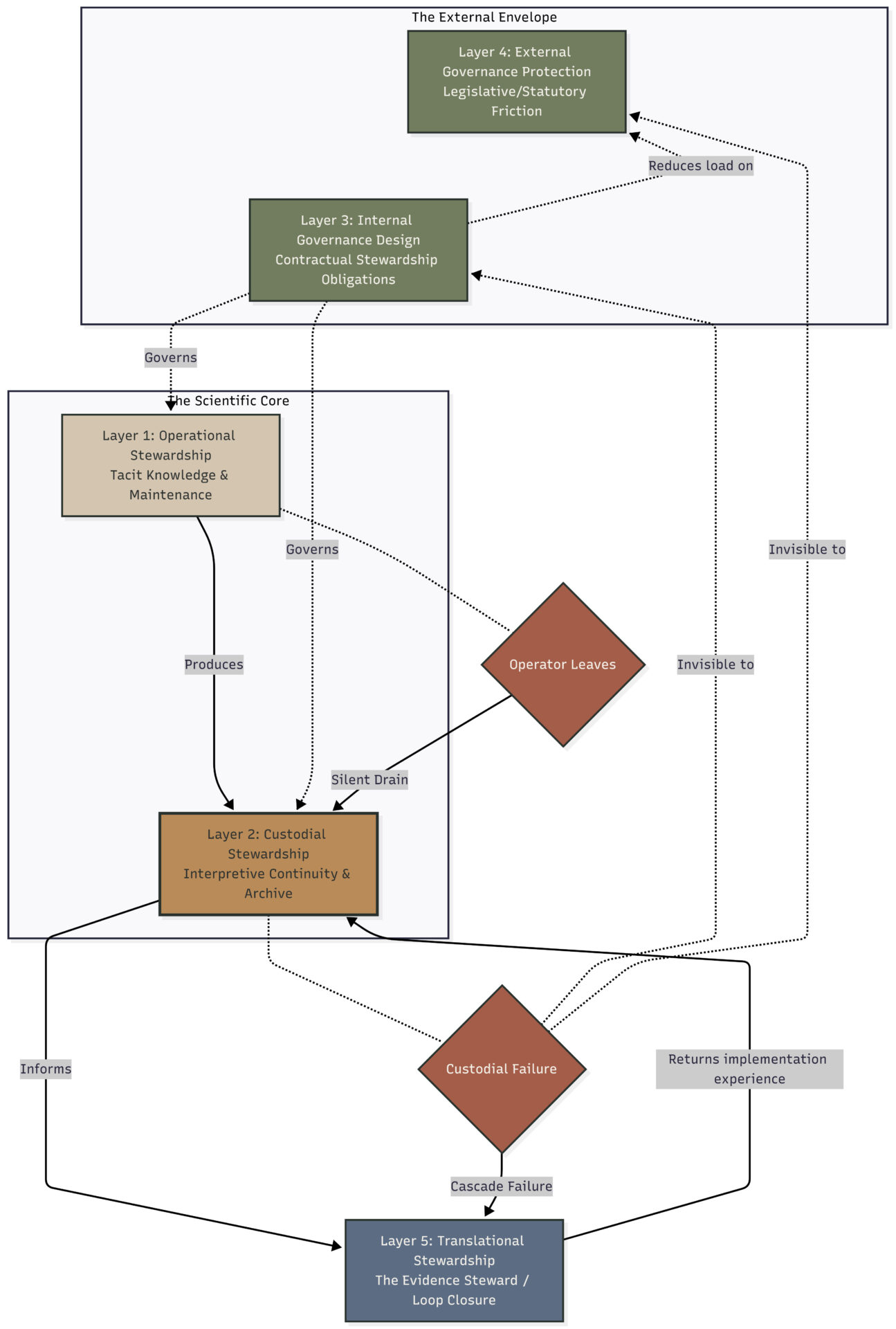
The diagram below maps all five layers, their relationships, and the cascade failure path that makes silent custodial failure the most dangerous failure mode in long-term observational systems.
Layer 1: Operational Stewardship #
What it does
Keeps the system running. Someone maintains the physical or technical infrastructure, executes the collection protocols, and holds the institutional knowledge of how the system behaves under non-standard conditions.
Failure mode
Collapse of maintenance capacity. The instrument stops functioning, or continues functioning without the knowledge required to interpret what it produces.
Responsible party
The named operator.
Sub-function: Tacit Knowledge Retention
The most dangerous operational failure is not mechanical. It is the departure of the person whose knowledge of how the system behaves under unusual conditions exists nowhere in the documentation. When the operator leaves, the instrument may continue running while its interpretive context quietly drains away. Succession planning for tacit knowledge is a distinct operational stewardship obligation, not a personnel management afterthought.
The distinction between Layer 1 and Layer 2 sub-functions matters: tacit knowledge retention is about keeping the instrument intelligible to its operators. Interpretive continuity is about keeping the archive intelligible to people who were never operators at all.
Layer 2: Custodial Stewardship #
What it does
Maintains the integrity and continuity of what the system produces: samples, records, datasets, time series, and the methodological chain that makes them usable by people who were not present when they were created.
Failure mode
Administrative disposal. Not physical degradation through neglect over decades, but governance abandonment in a single decision. The archive is intact. The chain of custody is broken. The responsible party no longer exists.
Responsible party
The named curator or archive holder.
Sub-function: Interpretive Continuity
Physical integrity of the archive is necessary but not sufficient. The archive must also be interpretable by people who were not present when it was created. Changes in collection method, instrumentation, or personnel that are not documented break the interpretive chain even when the physical materials survive. Nobody collecting water samples at Hubbard Brook in 1963 was thinking about PFAS. The archive’s option value, the ability to ask future questions of past reality, depends entirely on whether future scientists can interrogate past methodology with enough confidence to build on it. Physical custody without interpretive continuity is not stewardship. It is storage.
Relationship to Layer 1
Layer 2 does not depend on Layer 1 remaining active. The custodial obligation begins at first collection and does not end when the producing operation concludes. An ice core archive acquired on a single expedition becomes a permanent custodial responsibility the moment it is extracted. Layer 1 can be a project. Layer 2 cannot. The two layers can therefore fail independently and in either order: Layer 1 may wind down by design while Layer 2 must persist indefinitely, and Layer 2 can collapse through administrative disposal even while Layer 1 continues producing at other sites. This is a different relationship than the sequential dependency between Layers 3 and 4.
Layer 3: Internal Governance Design #
What it does
Writes stewardship obligations into the operating structure of the institution itself: founding documents, cooperative agreements, operating contracts, and institutional charters. Makes stewardship a structural requirement rather than a cultural practice.
Failure mode
Stewardship that depends on culture rather than contract. When the founding generation leaves, the culture changes, and the stewardship evaporates. The institution continues operating without the obligations that gave it integrity.
Responsible party
The institution’s governing documents and the parties who negotiate them: funding agencies, host institutions, consortia, and operating bodies.
Reference cases
ICOS and NEON write named stewardship obligations directly into their operating contracts. The obligation survives personnel turnover and changes in political environment because it is contractual, not cultural. This is the structural difference between an institution that has always done something and one that is required to do it. See: When the Governance Instrument Exists (field note series).
Layer 4: External Governance Protection #
What it does
Protects the institution from adverse administrative action through legislative, regulatory, and political instruments. Creates friction between administrative decision and institutional loss.
Failure mode
Absence of a statutory requirement to produce a successor stewardship plan before reducing or eliminating a long-term facility. No external instrument exists to slow administrative disposal or require continuity planning. The deeper governance gap is not only the decision to close. It is the absence of any obligation to plan for what is lost.
Responsible party
Legislators, regulators, and funders with long-term commitments.
Relationship to Layer 3
A well-executed Layer 3 reduces the load on Layer 4. When stewardship is written into the operating contract, the institution is more resilient to administrative disposal without external legislative defense. GRUAN is vulnerable partly because its stewardship obligation is cultural rather than contractual. A statutory or contractual anchor at Layer 3 reduces exposure to Layer 4 failure. The two layers are not parallel. They are sequential: strong Layer 3 design reduces the load on Layer 4 protection, but it does not replace it. The reverse is not true.
Commitment Durability #
Not all Layer 4 instruments carry equal weight. A public statement or press release constitutes no durable protection: it requires no internal operational change, and a facility manager cannot use it to authorize keeping the lights on. True Layer 4 protection requires at minimum a mandated procedural anchor with a hard deadline, and ideally a statutory or contractual restriction that removes the institution’s legal authority to execute the failure mode entirely. The difference between a senator’s press release and a statutory appropriations proviso is not rhetorical. It is the difference between a policy tourniquet and a governance fix. See: Doctrine 18 Companion: The Five Levels of Commitment Durability.
Layer 5: Translational Stewardship #
What it does
Carries evidence across the policy-implementation seam into decisions and back again. Someone is named as responsible for translating findings into operational choices, clarifying handoffs, maintaining decision context, tracking whether evidence changed action, and returning implementation experience into the knowledge system.
Failure mode
The orphaned finding. The evidence exists. The archive is intact. The institution is funded. The evidence never becomes operational because no named person or role is responsible for the translation. Science does not become mute because scientists lack voice. It becomes mute when institutions fail to give evidence a steward.
Responsible party
The named evidence steward: a role, not a function absorbed into communication or project management.
Sub-function: Loop Closure
Forward translation (evidence to decision) and loop closure (decision experience back to knowledge system) are distinct functions that can fail independently. Excellent forward translation with no feedback loop produces a system that improves its outputs without improving its questions. The knowledge system stops learning what decisions need from it. Loop closure is not a communication function. It is a governance function: someone must be responsible for the return path. See: Doctrine 23 (Loop Closure as Load-Bearing System Infrastructure).
The Non-Substitution Principle #
No layer substitutes for another. This is the central diagnostic claim of the taxonomy.
Legislative protection at Layer 4 does not solve the orphaned finding problem at Layer 5. An evidence steward at Layer 5 cannot compensate for a broken archive at Layer 2. Contractual governance design at Layer 3 cannot run a system whose operators and their tacit knowledge have departed at Layer 1. Network architecture and federation at any layer cannot compensate for a broken anchor node at Layer 2.
Each layer requires its own intervention, its own responsible party, and its own governance instrument. The common error is treating a successful intervention at one layer as evidence that the adjacent layers are also addressed. They are not.
The Cascade Failure Doctrine #
The most dangerous failure pattern crosses layers silently.
When Layer 2 fails without triggering any visible alarm, Layers 3 and 4 may be intact. The protective envelope is operational. The institution appears healthy. Layer 5 then carries compromised or decontextualized evidence into decisions with full institutional confidence, because nothing in the governance structure has registered the custodial failure upstream.
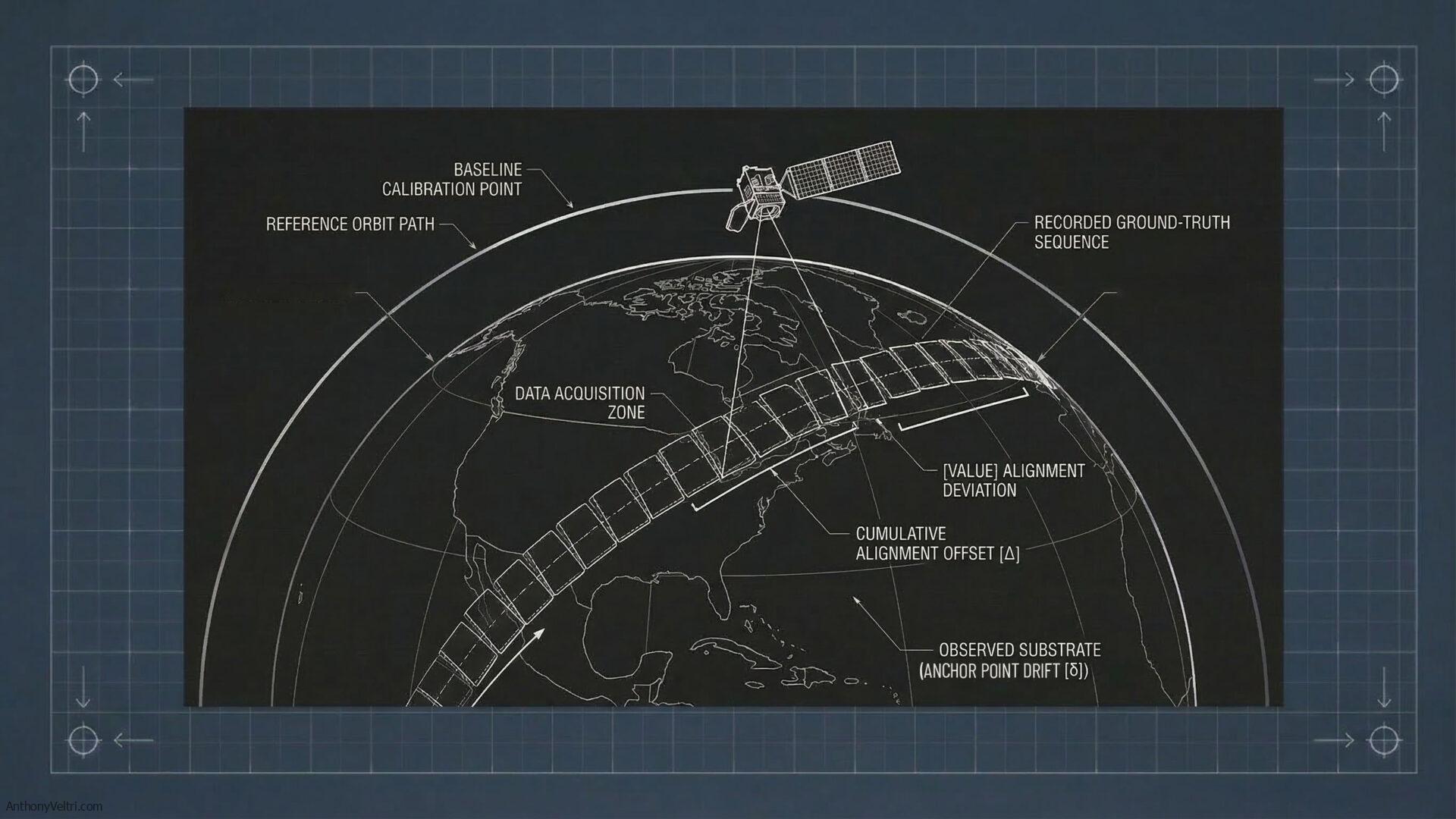
This is the GRUAN problem. This is the When the Ground Moves problem. The measurement looks correct. The instrument is running. The governance structure is intact. And the substrate the system was calibrated against no longer exists in the form the calibration assumed.
Silent Layer 2 failure is the most dangerous failure mode in long-term observational systems because it is invisible to the layers designed to protect it.
The diagnostic implication: governance protection at Layers 3 and 4 does not provide assurance about custodial integrity at Layer 2. Assurance at Layer 2 requires its own monitoring, its own audit function, and its own named responsible party. A well-governed institution can still be producing and delivering evidence that has silently lost its integrity.
Stewardship failures are often not failures of care, expertise, or funding. They are failures of layer recognition. Institutions protect the visible layer, neglect the invisible one, and then mistake continuity of activity for continuity of meaning.
Cross-References #
Field Note Series: Ground Truth, Federation, and the Anchor Point #
Layer 1: The Repeat Oblique: When You Cannot Wait for a Golden Dataset
Layer 2: Guarding the Room: A Hubbard Brook Story About Science and Funding;
When the Ground Moves: Why Institutions Misread Their Own Sensor Metrics
Layer 3: When the Governance Instrument Exists: ICOS, NEON, and the Two Paths to Named Stewardship
Layer 4: The Governance Gap Threatening Long-Term Ecological Archives (Eos, forthcoming)
Layer 5: Evidence Does Not Implement Itself (Issues in Science and Technology, in submission)
Cascade failure: Federation Cannot Anchor Itself: GRUAN and the Hidden Stewardship Layer in Global Observing Systems;
No Amount of Federation Saves a Broken Anchor Point
Related Doctrine #
Doctrine 01: Federation vs Integration in Mission Networks (Layer 3 and Layer 4 design choices)
Doctrine 18 Companion: The Five Levels of Commitment Durability (provides the commitment robustness diagnostic for any Layer 3 or Layer 4 arrangement.) Apply D18 to determine whether a given stewardship commitment will survive personnel turnover, budget cycles, and political transition.
Doctrine 20: Golden Datasets: Putting Truth in One Place Without Pretending Everything Is Perfect (Layer 2 integrity)
Doctrine 23: Loop Closure as Load-Bearing System Infrastructure (Layer 5 sub-function)
Published and Submitted Work #
Layers 2 and 3: Federation Cannot Replace Stewardship (BAMS, under peer review)
Layers 2 and 4: The Governance Gap Threatening Long-Term Ecological Archives (Eos, forthcoming)
Layer 5: Interface Stewardship in Federated Alliance Governance (anthonyveltri.com, CC-BY-4.0 self-published with full submission history)
Field notes and examples #
- Anthony Veltri Explains why Federation Cannot Replace Stewardship
- Evidence Does Not Implement Itself: Why Science Needs Stewards at the Policy-Implementation Seam
- Federation Cannot Anchor Itself – GRUAN and the Hidden Stewardship Layer in Global Observing Systems
- Series Guide: Ground Truth, Federation, and the Anchor Point
- When the Ground Moves: Why Institutions Misread Their Own Sensor Metrics
- No Amount of Federation Saves a Broken Anchor Point
- Repeat Oblique Photography: When You Cannot Wait for a Golden Dataset
- Respect The Envelope: Why Legal Is Not Always Safe
- Interfaces Break First: Designing For Partial Truth
Last Updated on May 30, 2026