What this route does in 10 minutes:
You’ll understand when to federate and when to integrate, identify which control pattern matches your constraints, and know whether to prioritize flexibility or tight coupling for your specific situation.
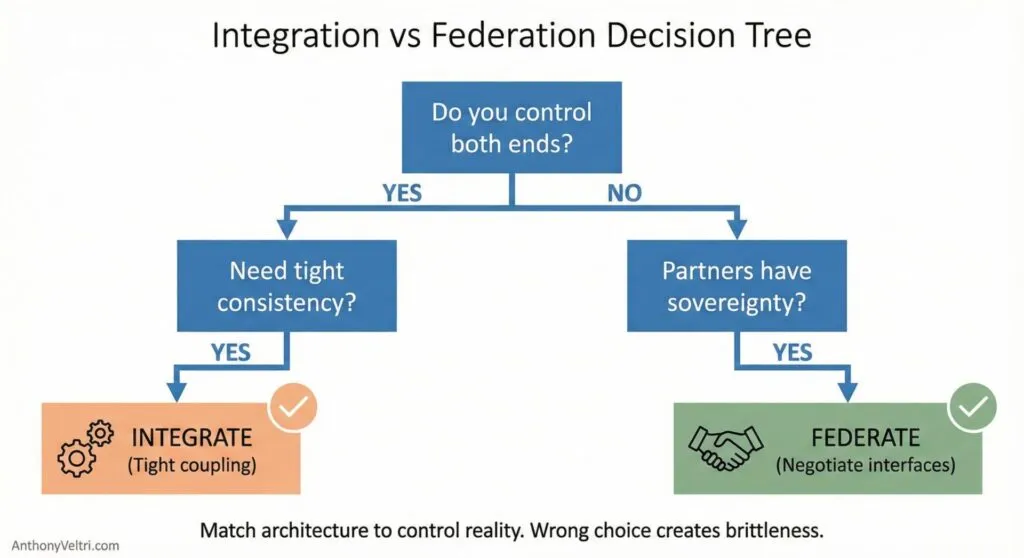
Start here: Three fast questions
Before you dive in, orient yourself:
- Who controls the systems? Do you own both sides, or are you connecting sovereign partners?
- What can break? Can you force changes across all connected systems, or must you negotiate them?
- What’s the tempo? Do you need flexibility to change partners, or stability through tight coupling?
If you’re not sure whether to build one integrated system or connect multiple independent ones, you’re in the right route.
Quick diagnostic
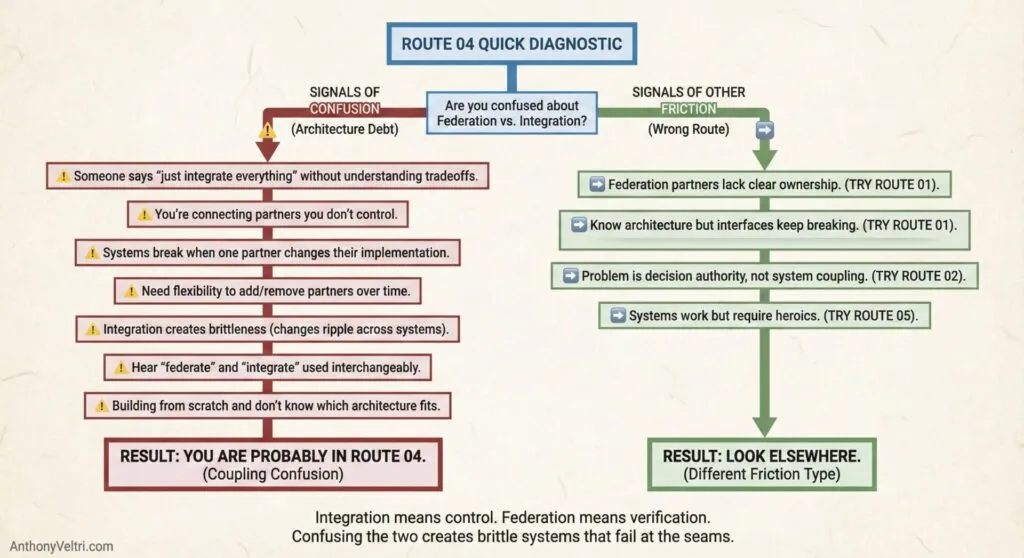
You are probably in this route if:
- Someone says “we should just integrate everything” without understanding tradeoffs
- You’re connecting partners you don’t control
- Systems break when one partner changes their implementation
- You need flexibility to add/remove partners over time
- Integration creates brittleness (changes ripple across systems)
- You hear “federate” and “integrate” used interchangeably
- You’re building from scratch and don’t know which architecture fits
You are probably NOT in this route if:
- Your federation partners lack clear ownership (try Route 01)
- You know your architecture but interfaces keep breaking (try Route 01)
- The problem is decision authority, not system coupling (try Route 02)
- Systems work but require heroics (try Route 05)
Doctrine and Annex anchors
These pieces define the principles and provide the models:
Doctrine 01: Federation vs Integration in Mission Networks The core framework for deciding when to federate (loose coupling, flexibility) versus when to integrate (tight coupling, control).
Doctrine 04: Useful Interoperability Is the Goal, Not Perfect Interoperability Why trying to achieve perfect integration across sovereign partners creates brittleness, and how to design for “good enough.”
Doctrine 06: A Two-Lane System Protects Stability and Enables Evolution How to preserve a stable core while enabling innovation at the edges through two-lane architecture.
Field Notes that show the failure mode in the wild
These cases show when federation/integration decisions go wrong and what works instead:
Field Note: The Scalpel vs. The Swiss Army Knife: When Solo Integration Beats Federation Why integration brittleness comes from multi-actor dependency, not integration itself. When a solo operator has complete control, integration enables extreme velocity.
Field Note: When You Choose Integration over Federation On Purpose Real cases where tight coupling was the right choice despite conventional wisdom favoring federation.
Field Note: When Data And Applications Divorce How to separate data persistence from application logic without destroying the system, and when this separation makes sense.
Choose your situation
Pick the scenario that most closely matches your context:
Scenario A: Connecting partners you don’t control
Signals:
- External organizations, agencies, or companies
- Each partner has their own IT governance
- You cannot force them to change their systems
- Changes on one side shouldn’t break the other side
- Partners may join or leave over time
Start with:
- Doctrine 01 (understand control as the key variable)
- Doctrine 04 (design for “good enough,” not perfect)
- Field Note: “When You Choose Integration” (see when tight coupling works anyway)
Scenario B: Building from scratch, not sure which pattern
Signals:
- Greenfield project or major redesign
- Could build one system or connect multiple
- Trade-offs unclear (flexibility vs control, speed vs stability)
- Stakeholders have different opinions
- Need to explain the decision to leadership
Start with:
- Doctrine 01 (decision framework)
- Field Note: “Scalpel vs Swiss Army Knife” (when solo integration works)
- Doctrine 06 (hybrid approach)
Scenario C: Integration created brittleness
Signals:
- Changes in one system break others
- Multi-actor coordination slows everything down
- You wish you had more flexibility
- Partners complain about dependencies
- Velocity has dropped significantly
Start with:
- Doctrine 01 (understand why brittleness emerged)
- Field Note: “Scalpel vs Swiss Army Knife” (distinguish multi-actor from solo integration)
- Doctrine 04 (relax coupling requirements)
Scenario D: Federation lacks ownership (hybrid problem)
Signals:
- You chose federation but interfaces keep failing
- Nobody owns the connections between systems
- Partners drift apart over time
- Coordination is too expensive
- You’re starting to regret federating
Start with:
- Doctrine 01 (confirm federation was right choice)
- Then go to Route 01 (interface ownership problem, not federation problem)
- Field Note: “Data And Applications Divorce” (see decoupling patterns)
Scenario E: Not sure which scenario fits
Start with:
- Doctrine 01 (core framework)
- Doctrine 04 (relax perfection requirements)
- Field Note: “Scalpel vs Swiss Army Knife” (see integration working)
- Field Note: “When You Choose Integration” (see deliberate integration choice)
- Doctrine 06 (hybrid two-lane approach)
Recommended default path
If you’re unsure which scenario fits, follow this sequence:
- Doctrine 01: Federation vs Integration in Mission Networks (10 minutes) Understand the core decision framework: control determines architecture.
- Doctrine 04: Useful Interoperability Is the Goal (5 minutes) Learn why perfect integration across sovereign partners creates brittleness.
- Doctrine 06: A Two-Lane System (5 minutes) See how to preserve stability while enabling evolution.
- Field Note: Scalpel vs Swiss Army Knife (5 minutes) Understand when integration brittleness comes from dependency, not integration itself.
- Field Note: When You Choose Integration (5 minutes) See deliberate integration decisions in practice.
Total time: 30 minutes from confusion to clear decision criteria.
What to do next
In the next 15 minutes:
- Map your systems or partners on a control axis: Do you control both sides? One side? Neither?
- For each connection, ask: “Can I force changes on the other side?”
- Identify which connections are federation (no control) vs integration (full control)
In the next 60 minutes:
- Pick your highest-friction connection
- Diagnose: Is brittleness from wrong pattern or from missing ownership?
- If wrong pattern: plan transition (usually federation to integration, rarely the reverse)
- If missing ownership: go to Route 01
This week:
- Document your architecture decision for the top 3 connections
- For each: federation or integration, why, what constraints drove the choice
- Share with stakeholders so they understand the tradeoffs
- Establish decision criteria for future system connections
- Stop treating “integrate” and “federate” as interchangeable words
Optional: Send me 5 sentences
If you want targeted guidance for your specific situation, describe:
- What systems or partners are connecting? (names or types)
- Who controls each side? (your org, partner org, third party)
- What’s breaking or unclear? (brittleness, ownership, choice)
- What constraints matter? (sovereignty, budget, timeline, politics)
- What would “good” look like? (desired outcome)